Which Software Is Best for Your Business?

Customer relationship management (CRM) is necessary to help franchises grow and boost sales by nurturing leads for both franchisees and end customers. CRM software can facilitate effective relationship management while helping streamline sales. Franchise CRM solutions are particularly important for franchise businesses, as these tools work specifically for multi-location and multi-stakeholder businesses to foster real growth.
Today’s technology is also revolutionizing the way franchise sales CRM solutions work, with AI-driven insights, mobile accessibility, and real-time analytics all combining to improve automation and decision-making.
In this blog, Mark Renehan, Vice President of Franchise Development, will help franchisors choose the ideal platform for both franchise lead generation and customer sales at each location, as we evaluate the top franchise CRM software based on their use cases, capabilities, limitations, pricing, and implementation level.
What’s Covered:
What Is Franchise CRM and How Does It Work?
Franchise CRM is a specific type of software used to build and nurture relationships with leads. Ultimately, franchises use this software to streamline the franchise sales process, converting leads into either successful franchisees or loyal customers.
Depending on your goals and needs, you might use three main types of CRM for franchises: franchise development CRM, local customer CRM, and full franchise management software.
Taking the best approach to CRM will ultimately keep you connected with our customers, optimize sales and other processes, and increase profits, maximizing customer loyalty across the customer lifecycle.
A robust franchise CRM system will give you the tools you need, including data tracking, communication tools for emails and more, and automation capabilities that boost productivity and collaboration.
However, you specifically need a solution that works for franchise sales CRM. While general businesses tend to use CRM tools for managing end customers and basic internal communications, franchise development will need these to maintain relationships with franchisees and customers alike across several locations.
Benefits of Implementing a Franchise CRM
A good franchise sales CRM will offer the following main advantages:
Streamlined Sales Processes
With the help of automation and data centralization, a CRM for franchises could significantly increase efficiency.
Workflows become far simpler, and having all of your data in a single platform can make management much easier. You’ll be able to optimize everything from lead capture, scoring, and routing to pipeline management and analytics, giving you the critical insights you need to personalize interactions with potential and existing franchisees.
Franchise CRMs are particularly helpful in optimizing targeted custom direct marketing to candidates, which 91% of companies with 10 or more employees rely on most of all to connect with prospective franchisees.
Enhanced Collaboration
Another benefit of reliable franchise CRM solutions is the ability to improve collaboration between franchisors and franchisees.
The ideal CRM for franchise operations will unify all data, ensuring every team is on the same page with effective communication at all times. All teams can easily and conveniently share documents and resources, including brand guidelines, training modules, marketing and branding materials, and more.
Subsequently, onboarding becomes much easier as corporate teams can provide franchisees with all training manuals and more. Franchisees can also submit support tickets to seek assistance from franchisors at any time.
Improved Customer Acquisition and Retention
More personalization across communications and highly targeted marketing campaigns lead to considerably higher conversion rates, especially when done using good franchise sales CRM systems.
You’ll be able to reach the right people at the right time more effectively, connecting with them using the most relevant messaging and visual content. In turn, you can acquire more qualifying customers with a high lifetime value and retain them through repeat sales.
Scalability and Growth
As your business expands to multiple locations and service areas, you need to be able to keep up with the increasing demand and changing business needs.
The right franchise CRM will be able to help you do just that. When managing several territories and attempting to maintain your business’s flexibility and adaptability, your platform should help continually optimize the franchise sales process.
Effective Territory Management
Reliable CRM for franchises will ultimately assist with managing territories and enabling them to grow.
The right franchise management system will enable you to automate lead routing to connect customers with the franchise location near them based on radius, zip code, or other factors.
Additionally, you can use your franchise CRM to map and design territory locations based on demographics, market saturation, sales potential, and proximity to your existing locations to determine the most profitable opportunities.
In turn, you can avoid potential territory disputes and effectively support each franchise location.
Our Expert Opinion on Franchise Sales CRM
To boost sales and shorten the cycle, you must make use of franchise CRM the right way. The ideal solution will make it easy to seamlessly communicate with your team and external prospects, following up with all leads in your funnel.
We’ve used franchise sales CRM solutions as part of a holistic marketing strategy for franchise clients, partnering with a multi-brand enterprise foundation services organization to connect a CRM directly to paid media campaigns, which yielded a 32.73% increase in revenue. We also helped a med spa franchise convert a single lead into a 20-unit franchise deal, which largely entailed integrating a CRM for tracking franchise candidate engagement and follow-up.
Selecting and properly implementing the right franchise CRM software will go a long way in helping with long-term business growth, whether you use it to connect with viable franchisee candidates or connect with local customers for each location.
Action Item: Choose the best franchise CRM software to meet your unique needs, and develop a strategy that will help you get the most from the software. The right approach will enable you to keep leads moving through efficiently at every level, including your franchisee and end customer targets.

Top 5 Franchise CRM Software Solutions
Here’s a breakdown of our favorite CRM software solutions:
1. Salesforce
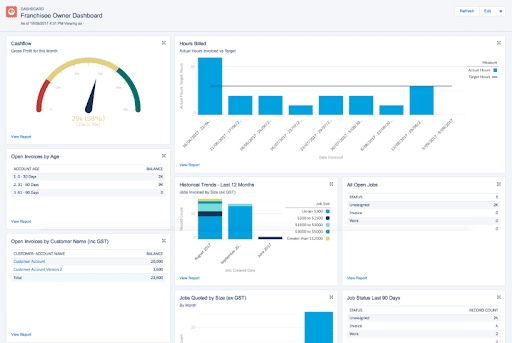
One great option available is Salesforce, which is one of the most reputable and widely used CRM platforms for franchises and other businesses.
This solution comes with a plethora of features to assist with franchise sales. For instance, it offers centralized lead tracking, lead scoring, lead nurturing, and lead assignment.
It can also boost sales efficiency with centralizd customer data, automation, sales process standardization, mobile accessibility, and much more.
If you’re looking for a platform geared specifically to all things sales, Salesforce is a solid choice.
2. FranConnect
FranConnect is one of the most comprehensive platforms available for franchise sales management, assisting with everything from lead management and operations to performance tracking and store opening.
It’s also highly scalable, helping franchises grow with many functionalities and features. However, it can be complex and costly, making it a considerable investment that might make it better for more established franchises.

3. ClientTether
Another option is CliethTether, which provides solutions for lead management and automation, along with streamlined communication. It’s particularly useful for franchise sales and growth.
One added benefit of this solution is its user-friendliness, with a simple, easy-to-use interface. It’s also more cost-effective than other platforms, with a flexible pricing structure.
The only real downside to this platform is that it’s less comprehensive than FranConnect and Salesforce, though it’s great for sales and lead management.

4. FranchiseSoft
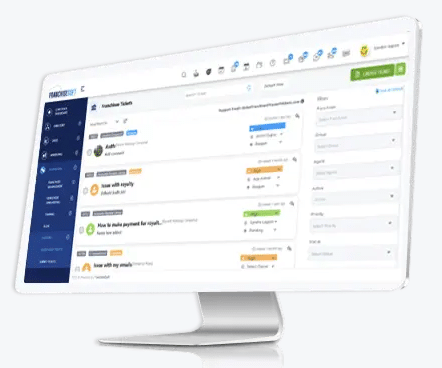
You may also opt for FranchiseSoft for a more modular yet comprehensive option that can keep track of the entire franchise lifecycle.
FranchiseSoft comes with numerous modules for different aspects of operation, including royalty collection, field service audits, training, and franchisee onboarding.
This franchise CRM is ultimately best for multi-unit management and more established franchise brands to facilitate in-depth operational oversight, complete with a “360-degree franchisee view” feature that can help corporate keep track of each unit’s financial health, compliance, and support tickets.
5. VipeCloud
VipeCloud is among the best franchise sales CRM solutions for consultants, brokers, and new brands that want to close deals faster.
Specifically, VipeCloud’s Franchise Sales Engine CRM is a robust platform that can easily automate sales while offering highly competitive pricing to maximize affordability.
Using this CRM for franchise operations will provide you with just about everything you need, including pipelines, text and email automation, and scheduling. You can also add rules for franchise lead parsing and other features to effectively track the franchisee candidate journey from a centralized platform.

Want to choose the right franchise management app for your business? Whether you’re a company specializing in franchise territory growth or looking to establish your first location, here is a comparison chart to guide you:
| Feature | Salesforce | FranConnect | ClientTether | FranchiseSoft | VipeCloud |
| Primary Target | Large enterprises | Mid-to-large franchises | Emerging and mid-level franchises | Growth-stage franchises | Small franchises, consultants, and brokers |
| Best for | Enterprise customization and multi-unit data integration | Comprehensive franchise lifecycle management for large-scale systems | Fast lead response times and unit-level service sales automation | An all-in-one yet affordable CRM for growing franchise brands | Franchise development teams and sales brokers looking for software to streamline the franchise sales process |
| Software Category | Universal enterprise CRM | Comprehensive franchise management suite | Franchise-native sales CRM and engagement engine | All-in-one franchise management software | Sales and marketing automation CRM suite |
| Core Strength | AI and analytics | Complete lifecycle management | Lead engagement and automation | Modular structure and “all-in-one” solution | Sales and marketing |
| Standout Capability | Superior scalability, advanced autonomous AI tools, and ample integrations | Expansive breadth to cover franchise development, onboarding, compliance, and royalty collection | Instant automated engagement triggering live phone routing, emails, and SMS text messages | Full lifecycle modules for brands with a mid-tier budget | Multi-channel integrating email campaigns, social media, video, email, and SMS |
| Royalty Management | Needs customization | Built-in | Generally not supported | Built-in | Limited |
| Compliance/FDD | Needs integration | Advanced tracking | Basic with integrated E-sign | Comprehensive tracking | Sales-focused with less compliance capabilities |
| User Interface | Contemporary design | Less intuitive; better for advanced users | Contemporary and user-friendly | Complex with multiple modules | Basic and functional |
| Scalability | High | High | Moderate | High | Low to moderate |
| Important Limitation | Requires in-depth custom development | Complex and rigid user interface and reporting | A lack of complete built-in operational integrations | Outdated interface with potentially complex integrations | Doesn’t manage post-sale franchise operations |
| Pricing Availability | Quote required for per-user licensing and aggressive scaling with add-ons | Quote required, with a premium tier that works best for enterprises | Quote needed, though fixed-rate options are available for unlimited users | Quote required with potential modular costs as businesses scale | Transparent pricing with locked-in rates |
| Implementation Level | Extremely high, with a deployment time of 3 to 9 months | High; expect deployment to take around 2 to 4 months | Low to moderate, with deployment taking around 2 to 4 weeks | A moderate implementation level of about 4 to 8 weeks | Low deployment timeline of 1 to 2 weeks |
How to Choose the Right CRM for Your Franchise
There are many types of franchise CRM solutions out there for you to choose from, but with so many options, it’s important to make the right selection based on your unique business requirements.
Here are some things to consider when weighing your options:
Evaluating Your Business Needs
Start by determining what your business requires in a robust CRM for franchises. What does your franchise sales process look like on the whole, and where could it benefit from increased optimization?
Think about everything from your financial and operational requirements to your business guidelines and franchisee training processes. If you expect to grow, you must also choose a CRM for franchise operations that can grow with you while keeping things simple and organized.
Identifying Use Case
Also, before choosing a vendor for franchise CRM software, you need to consider the specific use case based on your needs.
There are multiple potential applications for a franchise sales CRM, including:
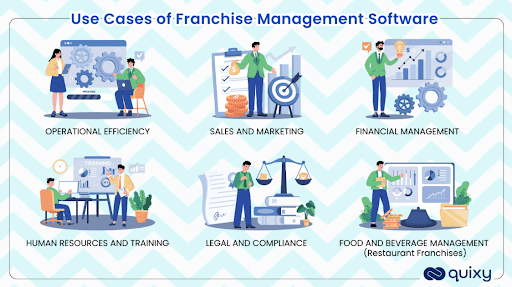
- Franchise Development: Corporate teams and brokers may look for a convenient and affordable CRM for growing franchise brands during initial development, helping them recruit, vet, and approve high-value franchisees while maintaining compliance with legal requirements and Franchise Disclosure Documents (FDDs).
- Local Lead and Customer Management: Franchisees could also implement a CRM for franchises to attract and convert more local leads and customers, often with automated text, call, and email capabilities to maximize engagement and repeat business across the customer lifecycle.
- Franchise Operations: The best franchise management software will help franchisors enforce brand standards with auditing while helping with learning management systems (LMSs) and automated royalty collection.
- Multi-Brand Management: Businesses might opt for franchise software that helps with multi-brand management across several franchises, separating individual brand data while consolidating global analytics and reporting.
- Hybrid Needs: Franchises experiencing rapid growth may want to use franchise management software to combine corporate and local data, using a CRM for tracking franchise candidate engagement while also facilitating lead conversion at each franchise and managing franchise operations across locations.
Comparing Options
It’s also important to look at the different features you get with various franchise CRM systems.
For example, platforms like FranConnect and FranchiseSoft offer just about everything under the sun, while ClientTether and VipeCloud lack the ability to manage royalties. Some platforms also fail to integrate with existing workflows, which can make them highly inefficient to implement.
Generally, FranConnect, ClientTether, and FranchiseSoft are all comprehensive for both franchisors and franchisees, while consultants and brokers may benefit from the more lead generation and sales management-focused VipeCloud and IFPG Franchise Sales CRM.
Budget and ROI Considerations
Additionally, you need to consider your available budget and what franchise CRM software is worth the purchase based on the potential return on investment.
Consider all of your current and projected expenses and weigh them against the cost of the prospective CRM solution. If it looks like you’ll maximize profitability after implementing the solution in the long term, it may be a worthwhile investment.
Vendor Support and Future-Proofing
Your solution should also have ample vendor support to help you get the most from your purchase.
These services should entail troubleshooting and continuous update rollouts to improve the software and potentially add new features. In addition, the vendor must be able to facilitate scalability so the solution can keep up with your franchise growth, regardless of how rapid it is.
To help you make the right selection as you shop for a franchise CRM, here is a brief checklist:
- Franchise-specific features like multi-level lead management, automated workflows, compliance and standardization, and royalty and fee tracking
- Core franchise sales CRM features, such as contact and data management, marketing automation, sales pipeline management, and reporting and analytics
- Technical fit and integration capabilities, including compatibility with your POS, marketing, and other tools, along with mobile accessibility, data security, compliance with GDPR and other regulations, and scalability
- Evaluation capabilities, such as total cost of ownership, training and support, a robust implementation plan, and user feedback
Key Features of the Best Franchise CRM Software
When seeking the best franchise CRM system, there are certain features to look for based on your individual franchise needs.
Here are some criteria to help you locate the best CRM for sales teams based on different business processes:
- Customer and Lead Management: Contact data management can centralize client records into a single database, while SMS texting and email marketing can enable direct outreach, follow-up, and customer engagement.
- Marketing and Sales: Look for sales and marketing automation in your software to streamline the franchise sales process and handle menial tasks, along with territory heat maps that visualize geographic sales and marketing data for local campaign optimization.
- Analytics and Reporting: Detailed analytics can give insights into key performance indicators (KPIs) and trends, with advanced analytics offering visual overviews of customer data and sales cycles, facilitating better sales enablement and other capabilities. Meanwhile, multi-location analytics can track performance at each location, and franchisee performance benchmarking can help identify top- and low-performing franchise owners.
- Operations and Franchise Management: Standardization and compliance measures can optimize brand consistency while keeping franchises in compliance with overarching operating procedures. At the same time, itemized royalty reporting can help track all royalties and fees, and integrations with other business software could connect your franchise sales CRM to POS systems, HR platforms, accounting software, and other tools.
With a better idea of how to find the best CRM for franchises, here are some of the top CRM software examples and a comparison of their features:


CRM in Franchise Development
Franchises have particular needs when it comes to CRM in sales. For example, they need these solutions for:
- Multi-location management, potentially for hundreds of locations
- Organizing prospect data, including differentiating between franchisee and customer leads
- Scoring new leads
- Automating follow-ups for large numbers of leads
Some of the franchise sales CRM tools that can meet these specific needs include HubSpot and FranConnect, both of which have specially designed franchise CRM platforms.
Dual Benefits: Operations and Sales Management
As mentioned, CRM for franchise applications will entail balancing the nurturing of franchisee leads while maximizing sales with customers. There are plenty of case studies showing how franchises have used CRMs for both purposes.
For example, the Batteries Plus franchise was able to use FranConnect to optimize the sales cycle when communicating internally and with franchisees to help it reach its growth goals.
Meanwhile, Sage CRM assisted coffee franchise Second Cup in collecting meaningful customer data from its coffee shop kiosks, putting it to use in a holistic CRM solution.
Hotel franchise Wyndham also made use of Salesforce CRM to create unique customer profiles for improved personalization, which led to increased booking rates.
Proper implementation translates to enhanced customer service and satisfaction while also streamlining lead management for prospective franchisees. The end result is growth at every level and the ability to keep up with increasing demands across teams.

Helping With Territory Growth, Validation, and Onboarding
A franchise company specializing in franchise territory growth, validation, and onboarding will ultimately benefit from using a franchise sales CRM.
The right franchise management solutions will be able to effectively connect with prospective leads and customers in specific regions, whether you want a single location to reach more people or establish more franchise locations within a particular area.
In the process, a CRM for franchise operations will help validate franchisee leads to ensure that they are ready to own and operate their franchise location.
Once you’ve acquired new franchisees for your locations, you can onboard them with your franchise CRM, automating everything from welcome emails to training, while also sharing all critical documents to equip them.
How to Create Workflows for CRM (And Why They’re Essential)
What is a workflow? Put simply, workflows allow you to create custom journeys for specific leads.
These workflows will send automated tasks out to you, your sales reps, and other team members, reminding them when to text, call or email a prospect. You can set these workflows in steps and the workflow will automatically proceed through the steps unless directed not to proceed, until a task is complete.
You can create these custom workflows by identifying these key components:
- Tasks or Steps: Individual actions or activities that need to be completed.
- Sequence: The order tasks are performed in.
- Participants: People, teams and systems responsible for completing each task.
- Resources: Tools, software, or materials needed to complete tasks.
Workflow Example for a Prospect
Here’s an example of what a workflow might look like for a franchise lead that clicks a CTA on your website requesting more information:
Stage 1: Initial Capture and Verification
At this stage, you would initially connect with the franchisee candidate and verify whether they are viable.
- Trigger: Candidates complete inquiry forms on franchise websites or lead portals
- Owner: Franchise Development Representative
- Timing: Immediate automated email or SMS text within minutes, with a call from the representative within the next few hours
- Exit Condition: The lead becomes sales-qualified after a successful phone screening and meeting all financial requirements.
- KPI: Lead-to-screen ratio, e.g., “reach a target of over 35% inbound lead advancement”
Stage 2: Mutual Discovery and Education
Using the CRM for tracking franchise candidate engagement, franchises can confirm whether the candidate is a good fit for the organization and ready to move on.
- Trigger: Confirming that the franchisee prospect is a good “financial and cultural fit” within the CRM
- Owner: Franchise Development Representative
- Timing: Around 10 to 14 days, during which the franchisee engages with multiple webinar or video presentation sessions
- Exit Condition: Candidate undergoes sufficient education and submits a complete franchisee application
- KPI: Application submission rate, e.g., “15% to 30% of application submissions from screened leads”
Stage 3: Operational and Financial Validation
At this point, screened candidates will have submitted approved applications to move them down the sales funnel.
- Trigger: Compliance teams review and approve formal franchisee applications.
- Owner: Franchise Development Representative, compliance team, and Regional Operations Director
- Timing: About 7 to 10 days as teams coordinate intro calls with engaged, qualified franchisees
- Exit Condition: Candidate reviews and signs the FDD
- KPI: FDD receipt date, e.g., “100% of qualifying, verified applicants need to sign the receipt”
Stage 4: Executive Approval
Applicants sign the FDD receipt and begin the mandatory waiting period.
- Trigger: Teams receive signed FDD receipt and initiate the legal waiting period, such as 14 days
- Owner: Executive leadership team and VP of Franchise Development
- Timing: After the waiting period, teams conduct an in-person or virtual Discovery Day
- Exit Condition: The executive team officially awards the franchisee a specific franchise opportunity
- KPI: Discovery Day approval rate, e.g., “Target an approval rate of over 85% for invited candidates
Stage 5: Closing and Agreement Signing
Here, the franchisor would provide executive approval and issue the Franchise Agreement.
- Trigger: The executive team approves the candidate and has them review and sign the Franchise Agreement
- Owner: Legal team and VP of Franchise Development
- Timing: 7 to 10 business days after the Discovery Day
- Exit Condition: Both parties sign the Franchise Agreement, and franchisees pay the full franchise fee
- KPI: Close rate and pipeline velocity, e.g., “Get over 75% of approved candidates to sign within a pipeline of 60 days or less
Key Benefits of Workflows
- Efficiency: Reduces redundancy and saves time
- Clarity: Everyone knows their roles and responsibilities
- Consistency: Ensures tasks are done the same way each time
- Scalability: Makes processes easier to replicate and scale as needed
- Transparency: Allows tracking progress and identifying bottlenecks
Challenges and Solutions in Franchise CRM Implementation
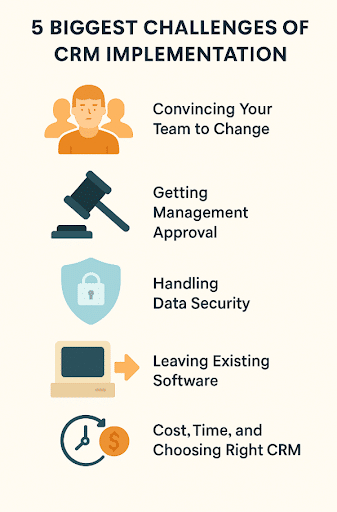
Today, many large businesses implement a franchise sales CRM, with 91% of large businesses using a CRM. However, adopting and integrating franchise management solutions can come with certain difficulties.
There are many potential challenges that franchises could face when adopting CRM solutions, such as:
- Low-quality or inaccurate data
- Data silos
- User adoption due to an unintuitive design or resistance to adoption
- Feature overload that leaves you unsure of where to start or go
- Inadequate integration capabilities
However, you can overcome these with the right approach to adopting CRM in sales. Here is an actionable sequence to guide you when implementing your franchise CRM software:
- Data Preparation: Audit existing data to weed out duplicate and outdated data, followed by standardizing formats, segmenting data for better targeting, and purging dead leads and disengaged contacts.
- System Configuration: Establish data access hierarchy for franchisors and franchisees, adding custom fields where necessary, automating the pipeline to keep leads moving, and using email or SMS text templates, ensuring all of these elements maintain compliance with policies and FDD details.
- Integrations: Connect all relevant lead portals, website forms, background check and financial verification tools, e-signature solutions, and calendars.
- Pilot: Run a pilot with two high-performing representatives and a successful franchisee for a trial period, which could involve running fake leads down the pipeline to test automation triggers, mobile app responsiveness testing, feedback loops, and refinement.
- Training: Run training paths tailored to both franchise development teams and local franchisees, with micro-learning exercises like short video guides, hands-on practice in sandbox environments, and certifications.
- Governance: Run monthly audits with automated reports to identify any missing data or unassigned leads, with de-duplication rules to mitigate the risk of duplicate leads.
- Optimization: Based on performance, continually optimize your franchise management software with changes to data as needed and regular software updates upon release.
For example, a fitness franchise could provide franchisees at each location with in-depth training on its franchise CRM, ensuring that each franchisee understands analytical data and how to use all relevant features, while also implementing software like ClientTether that’s easy to use with a user-friendly interface.
How Franchises Use CRM to Increase Sales (Best Practices)
To further optimize sales with franchise sales CRM, there are some strategies you can use to get the most from these solutions.
Set Realistic, Attainable Goals
An example here could include setting clear goals based on what you want to achieve, whether it’s a certain number of franchisee leads or sales figures with end customers. Based on these goals, you can then determine which features to use and which key performance indicators (KPIs) to track to measure your progress.
Incorporate Automation
Additionally, you can automate lead nurturing and follow-ups with personalized communications at every stage of the sales cycle. In turn, your sales teams could spend more time on urgent tasks and benefit from more overall productivity.
Measure Performance
Use analytics to assess performance based on your goals, and use the insights gathered for more informed decision-making.
Align Marketing and Sales
To keep your franchise marketing and sales teams on the same page and working toward the same goals, align both teams with your franchise CRM systems.
To sum things up, here’s a checklist of best practices to implement when using a franchise sales CRM:
- Clear goals to guide your campaigns
- Automation capabilities to streamline lead nurturing and follow-ups
- Performance measurement to inform decisions based on goals
- Marketing and sales alignment
How Does CRM Help Sales Teams in Franchises?
There are several key ways CRM can help your sales teams, as long as you choose the right tools and implement best practices.
First, you’ll be able to simplify task management and follow-ups, keeping everyone within your teams consistently organized and communicative.
You can also personalize communications with potential franchisees. In your communications with potential and existing franchisees, your messaging might address certain pain points or concerns while appealing to their specific needs and wants as franchise owners.
Meanwhile, CRM in franchise applications could simultaneously track sales pipelines, identifying and eliminating potential bottlenecks to increase conversion rates. Based on the data you collect, you can continually optimize and streamline the sales funnel to maximize profits.
At the same time, you can effectively align marketing and sales teams by creating a single source of truth for both HQ and local locations. All of your marketing and sales staff will have access to the same real-time data and resources to keep them consistently on the same page, enabling them to support each other.
Case Studies and Success Stories Using Franchise Sales CRM
Want to see what kinds of results businesses have gotten from their franchise CRM tools? Check out these compelling case studies:
McDonald’s Franchise CRM System Helps With Large-Scale Management
According to CRMside, quick-service restaurant chain McDonald’s uses Astute Solutions’ PowerCenter CRM for franchise operations, which has helped the company maximize its efficiency in a number of ways.
For example, the company has been able to more effectively manage its massive database of customer contacts, franchisees, locations, and vast data.
As a result, McDonald’s is able to effectively manage all locations, close more deals, and satisfy more end customers.
Let’s break this example down based on the following:
- Use Case: Franchise operations management
- Platform: Astute Solutions’ PowerCenter CRM
- Implementation Change: Managing customer contacts, locations, franchisees, and other data using a centralized CRM for franchises
- Measured Result: More efficient and reliable management across locations, increased franchise deals, and happier customers
- Source Caveat: No available specific metrics to prove effectiveness

Batteries Plus Reaches 70% of Its Sales Target With Franchise CRM Software
Expanding on our earlier Batteries Plus example, the platform used FranConnect’s franchise CRM platform to achieve 70% of its annual sales goals.
Specifically, the company started to implement AI at the top of the sales funnel to connect with more qualifying candidates and maximize appointments with developers. From there, FranConnect’s Sales Accelerator solution automatically contacted leads, automating the franchise sales process.
The solution then continued to nurture leads, enabling far more sales than the company would have seen with top-of-funnel AI solutions alone.
- Use Case: Implementing software to streamline the franchise sales process
- Platform: FranConnect Sales Accelerator
- Implementation Change: Top-of-funnel integration for automated candidate qualification and developer appointment scheduling
- Measured Result: Achievement of 70% of yearly sales goals
- Source Caveat: A lack of details about how FranConnect’s tool integrated into the rest of the pipeline

Crunch Fitness Attracts More Signups and Leads With Its Franchise CRM Solution
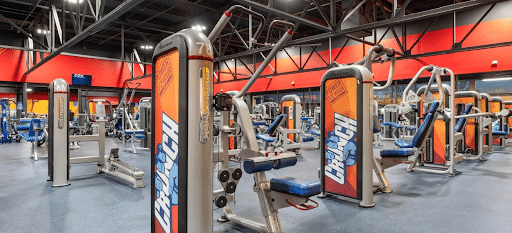
One example of a fitness brand that experienced success with its franchise CRM software was Crunch Fitness.
Using HubSpot’s CRM platform, Crunch Fitness was able to get a 28% increase in free trial signups, double the email open rate, and an 83% shorter email creation process.
- Use Case: Implementation of a CRM for tracking franchise candidate engagement
- Platform: HubSpot CRM
- Implementation Change: Deployment for simplified trial signups and email campaigns
- Measured Result: 28% boost in free trial signups, twice the email open rate, and an 83% decrease in email creation time
- Source Caveat: Lack of visible “before and after” results
FAQs
1. Which CRM offers the best support for franchise recruitment and sales?
The answer here will depend largely on your franchise’s operations, with FranConnect being ideal for more complex operations, while Salesforce offers more customization. HubSpot and Zoho are also user-friendly franchise management solutions that allow for growth.
2. What is a franchise CRM?
CRM for franchises differs from standard CRM in that it focuses on multi-location management, enabling franchises to optimize the sales funnel for prospective franchisees and customers at each location.
3. What features should I look for in a franchise sales CRM?
There are many features that make up a good franchise CRM, including a centralized database, multi-level lead management, automated workflows, reporting and analytics, compliance tracking, and customizable sales pipelines.
4. What is the difference between franchise CRM and franchise management software?
The specific type of franchise software you want to use will depend on your objectives, with a franchise CRM enabling you to build and nurture relationships with franchisee and customer leads, while franchise management software can help manage franchise operations, from royalty collection to training and auditing.
5. Do franchisors need one CRM for corporate teams and another for franchisees?
No, franchisors and franchisees can use the same franchise software, but there should be strict permission layers in place giving corporate operators a full overview of all data across the franchise, while franchisees get a specific window into the performance of their owned locations.
6. Which CRM features matter most for franchise recruitment?
There are various features that can help you implement a CRM for tracking franchise candidate engagement and qualification, including lead scoring capabilities, territory mapping, automated email drip campaigns, and FDD tracking.
7. Can a franchise CRM manage royalties and compliance?
Typically, a franchise CRM won’t be able to help track royalty collection or compliance; instead, you’ll want to use franchise management solutions that help handle operations.
8. Can a general CRM such as Salesforce or HubSpot work for a franchise?
Yes, you can use these CRMs for franchise use cases, but you may need to heavily customize them to meet your specific needs as a franchise, which these solutions do allow through ample flexibility and vast integration ecosystems.
9. How should franchises measure CRM ROI?
You can measure the ROI of your CRM by tracking the ROI of recruitment efforts, operational profitability, and customer retention, from the corporate to the individual franchise level.
10. Who owns customer and prospect data in a franchise CRM?
Generally, the franchisor owns all of the data stored in a CRM, giving access to franchisees to help them develop locally tailored campaigns that connect with new customers.
Make Full Use of Franchise Sales CRM With Ignite Visibility
Want some help with franchise sales CRM integration and other aspects of franchise marketing or sales? Ignite Visibility has the resources to help your franchise experience long-term growth in alignment with your goals. We’ll help with everything from sales efforts to franchise advertising, potentially putting together a complete franchise lead generation strategy.
Specifically, our experts can help by:
- Helping integrate CRM for franchise operations
- Demonstrating how to use CRM to increase sales
- Aligning your teams for successful adoption
- Managing other aspects of your franchise sales and marketing efforts
If you’re interested, learn more about our franchise development and franchise marketing services today.