How to Think Like CRO Expert Buse Hizarci


Buse Hizarci, Optimisation Manager at Vervaunt, is the latest expert to open up their playbook for our Testing Mind Map series. These interviews look past the tidy version of experimentation and into the day-to-day: how evidence fares against conviction, which test wins survive contact with production, and where judgment sits now that AI has commoditized execution.
Buse, tell us about yourself. What inspired you to get into testing & optimization?
I am an Optimisation Manager at Vervaunt, a UK DTC ecommerce consultancy and paid media agency, where I run testing programmes for brands like Adanola, Ancient & Brave, AU Vodka, YETI UK. I started my career as a developer. At my previous company, I kept catching myself thinking about the pages I was building from the user’s side. How would this look to them, what would they think, what would they actually say. That way of thinking pulled me away from development and into an in-house UX role. From there, I moved to Vervaunt, where I started working across a much wider range of brands, and I love doing that. Working with so many different brands means I’m constantly trying to see things through different users’ eyes, and that’s really where the habit started, asking why before asking what to change.
Answer in 5 words or less: What is the discipline of optimization to you?
Turning assumptions into evidence
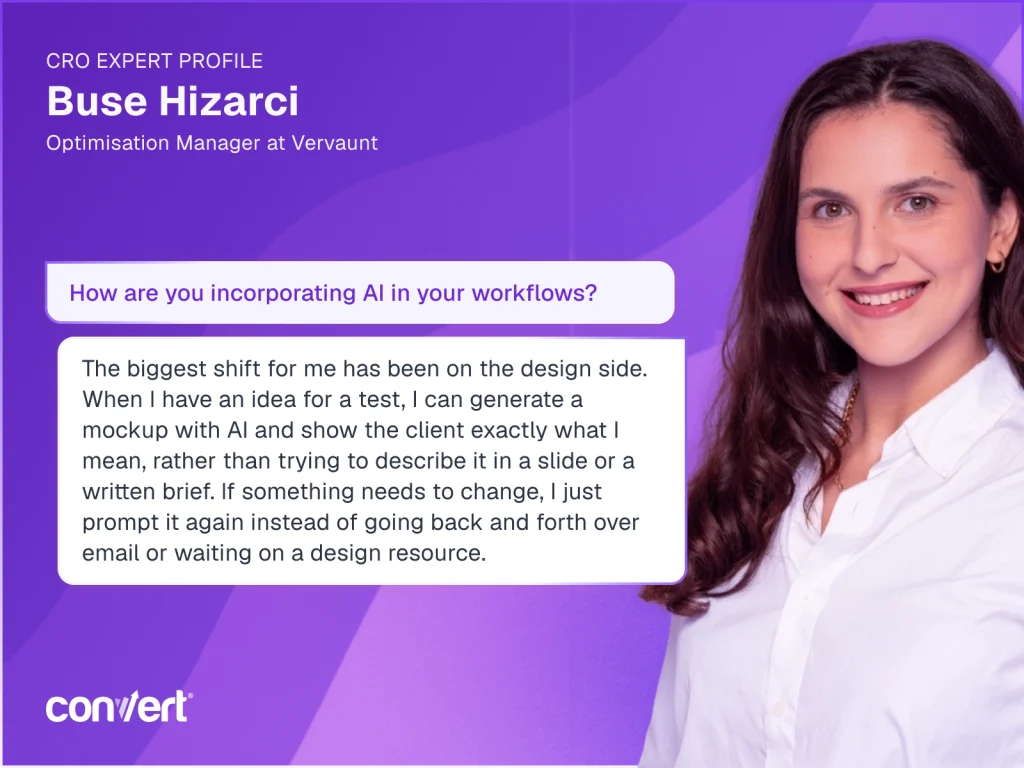
How is AI influencing experimentation for you? How do you think about incorporating AI in your workflows?
AI hasn’t changed what I test, it’s changed how fast I can get from an idea to actually running it. The biggest shift for me has been on the design side. When I have an idea for a test, I can generate a mockup with AI and show the client exactly what I mean, rather than waiting on a designer or spending time building it out in their system. If something needs to change, I just prompt it again instead of going back and forth over email or waiting on a design resource. That alone has cut the time between having an idea and getting client buy-in dramatically.
I use AI for analysis as well. I built an interactive tool preloaded with each client’s real traffic and conversion numbers, so it runs the MDE calculation for me and asks me to pulls the data straight from Shopify and GA4, rather than me having to check it manually every time. It tells me how long a test needs to run, so I actually know what I can fit in and when, instead of guessing.
But the mockup piece is the one I’d call out as the most useful part. It lets us move faster, the client can pick between a couple of design directions and we can make changes on the spot instead of waiting days for a new version.
Where are CRO & experimentation headed? And why? How can practitioners adjust?
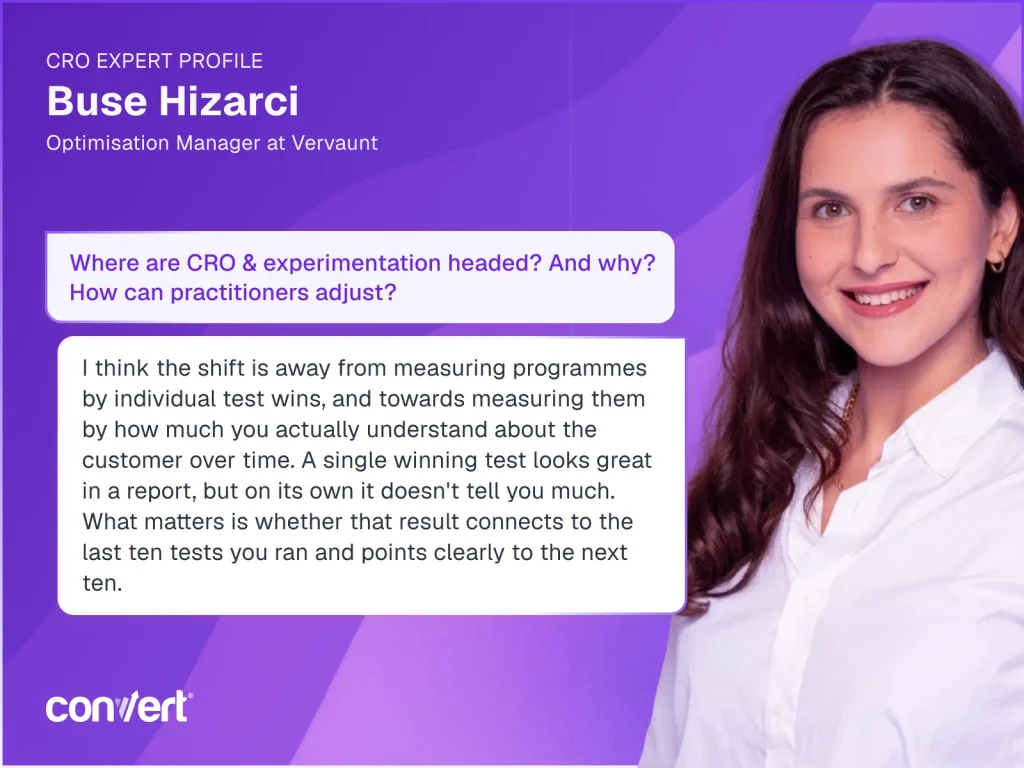
I think the shift is away from measuring programmes by individual test wins, and towards measuring them by how much you actually understand about the customer over time. A single winning test looks great in a report. On its own though, it doesn’t tell you much. What matters is whether that result connects to the last ten tests you ran and points clearly to the next ten.
This is actually how we structure the programmes we run at Vervaunt. Instead of a flat backlog of test ideas, we build a proper hierarchy. We start with the business metric we’re trying to move, tie that to a broader objective, then break that down into the specific problem areas on site, the solutions we think could fix them, and only then the individual tests themselves. When a test wins or loses, we’re not just recording an outcome, we’re updating what we know about a specific problem area, and that reshapes what we prioritise next.
I think that’s the direction the industry is heading generally. Programmes built around chasing individual wins test by test will start to look outdated next to programmes that actually build on their test history, where what you learned last month shapes what you test next, instead of every result just getting filed away.
Talk to us about the unique experiments you’ve run over the years.
The test I remember most wasn’t the one with the biggest result, it was the one where figuring out what actually needed fixing was the hard part.
We had a category that was bringing in a lot of new customers, one of our strongest acquisition drivers, but we needed to get them buying more, or coming back for a second purchase. So we designed an interstitial that pops up after ‘add to bag’ and before cart. Right after someone added a piece to their bag, it would surface other pieces from the same set or collection, something that deepened the customer’s investment in that specific look rather than just adding basket value. We framed it around clearing the free shipping threshold, so the offer felt worth acting on.
What I enjoyed most was building it around a different question from the start. It wasn’t about how to get them to come back, it was about how to get them more invested while they were already there. We ran it as a straightforward test. We could’ve rushed it out in a day, but we didn’t, because how fast something gets built has nothing to do with whether it’s the right thing to build. It won, and the brand’s since implemented it permanently on the site.
Last but not least, AI taking over repetitive tasks and simplifying execution. How has that changed the way you describe work?
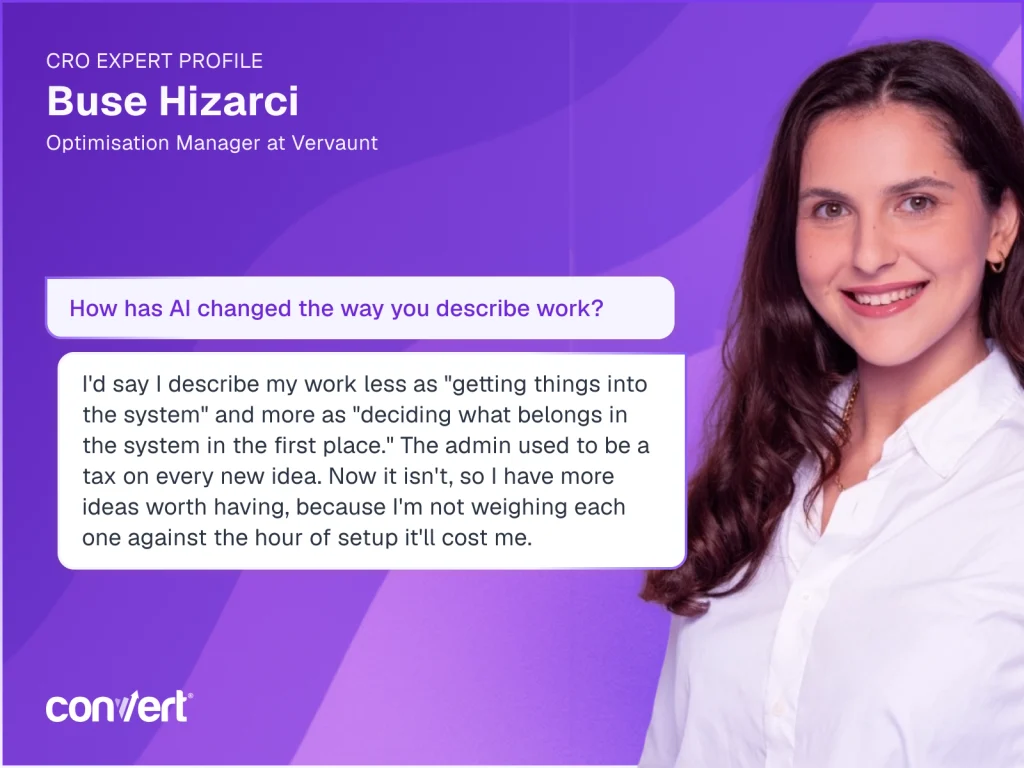
It’s changed the admin side of my job the most, not the strategic side. The clearest example is onboarding a new client. Every time, I used to start the research document from scratch, same structure, same sections, just typed out again from a blank page. That took time I could’ve spent actually thinking about the client instead.
The other one is after client calls. I love writing things down and keeping notes, that part I actually enjoy. But during busy weeks, having a ticket for myself created automatically straight after a call, without me having to sit down separately and turn everything into a to-do, has been brilliant. It means nothing gets missed even when the week is packed.
Both of those help me stay organised, which matters, but what it’s really done is free up time for the parts that actually need my attention, not just setting things up. I’d rather spend that time on the work that moves things forward.
Cheers for reading! If you’ve caught the CRO bug… you’re in good company here. Be sure to check back often, we have fresh interviews dropping twice a month. And if you’re in the mood for a binge read, have a gander at our earlier interviews with Gursimran Gujral, Haley Carpenter, Rishi Rawat, Sina Fak, Eden Bidani, Jakub Linowski, Shiva Manjunath, Deborah O’Malley, Andra Baragan, Rich Page, Ruben de Boer, Abi Hough, Alex Birkett, John Ostrowski, Ryan Levander, Ryan Thomas, Bhavik Patel, Siobhan Solberg, Tim Mehta, Rommil Santiago, Steph Le Prevost, Nils Koppelmann, Danielle Schwolow, Kevin Szpak, Marianne Stjernvall, Christoph Böcker, Max Bradley, Samuel Hess, Riccardo Vandra, Lukas Petrauskas, Gabriela Florea, Sean Clanchy, Ryan Webb, Tracy Laranjo, Lucia van den Brink, LeAnn Reyes, Lucrezia Platé, Daniel Jones, May Chin, Kyle Hearnshaw, Gerda Vogt-Thomas, Melanie Kyrklund, Sahil Patel, Lucas Vos, David Sanchez del Real, Oliver Kenyon, David Stepien, Maria Luiza de Lange, Callum Dreniw, Shirley Lee, Rúben Marinheiro, Lorik Mullaademi, Sergio Simarro Villalba, Georgiana Hunter-Cozens, Asmir Muminovic, Edd Saunders, Marc Uitterhoeve, Zander Aycock, Eduardo Marconi Pinheiro Lima, Linda Bustos, Marouscha Dorenbos, Cristina Molina, Tim Donets, Jarrah Hemmant, Cristina Giorgetti, Tom van den Berg, Tyler Hudson, Oliver West, Brian Poe, Carlos Trujillo, Eddie Aguilar, Matt Tilling, Jake Sapirstein, Nils Stotz, Hannah Davis, Jon Crowder, Mike Fawcett, Greg Wendel, Sadie Neve, Cristina McGuire, Richard Joe, Ruud van der Veer, Merritt Aho, Felipe Henrique Fogarolli, Riccardo Oricchio, Bruno Borges, Daniel Mullins, Matthew Bass, Pieter Boonstra, Simbar Dube, Dzifa Mensah, Katie Faulkner, Andrea Bronzini, Sanne Maach Abrahamsson, and Craig Kistler.

Mobile reading?

Carmen Apostu
Content strategist and growth lead. 1M+ words edited and counting.