How to Build Trust and Rank Higher
When you’re creating content that has the power to influence someone’s financial decisions, health, safety, or legal outcomes, the stakes for accuracy and trustworthiness are incredibly high.
That’s what Your Money or Your Life, or YMYL, content is. Google holds this type of content to incredibly high standards. If you want to rank for YMYL, you need to demonstrate that your content is credible enough to be trusted with the type of life decisions that really matter.
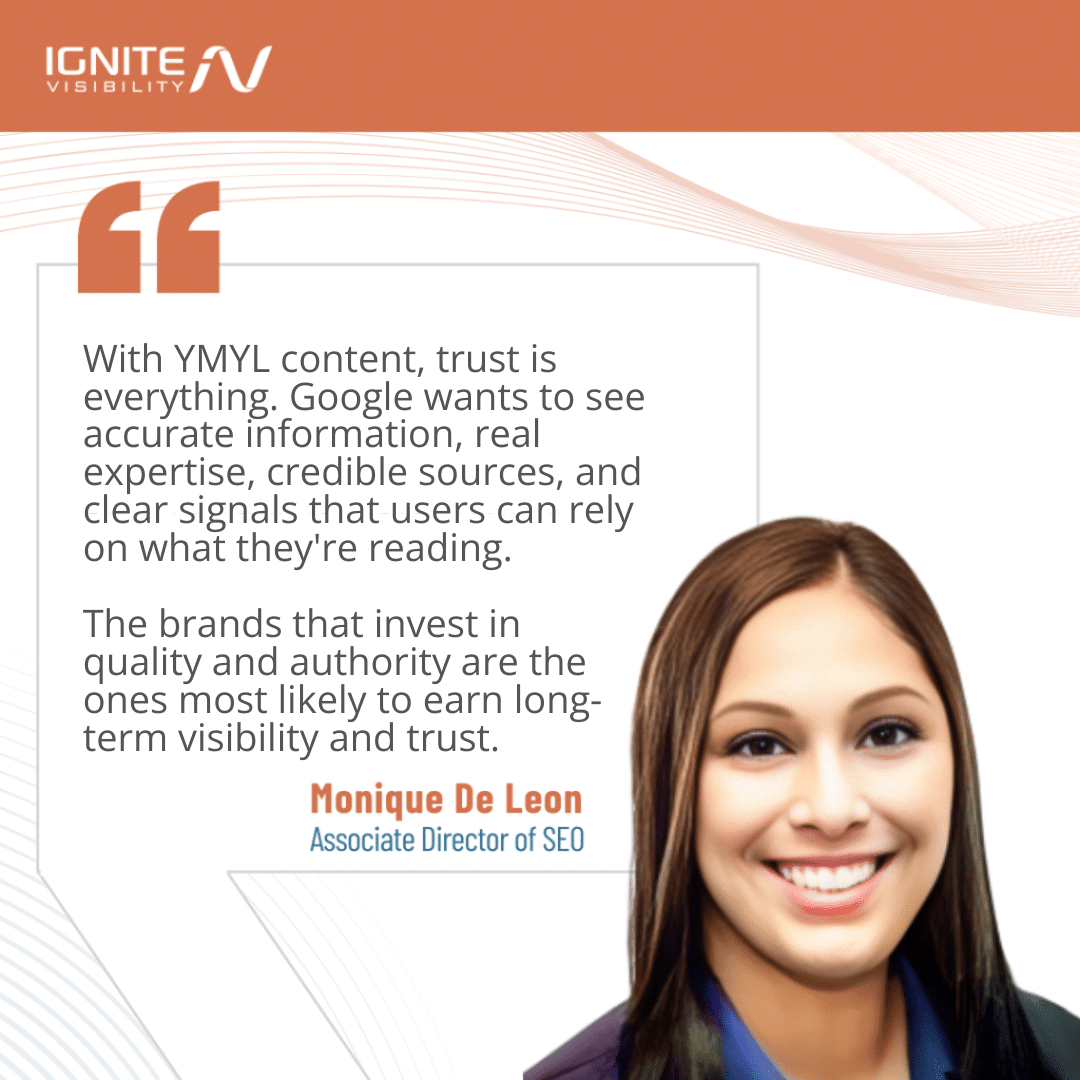
In this article, Monique De Leon, our Associate Director of SEO, will go over what you need to know about YMYL pages and how to rank for them.
What We’ll Cover:
What Is YMYL?
Despite the “M” in the acronym, YMYL sites are about more than just money.
According to Google, any page including content that can affect someone’s health, happiness, safety, or financial stability falls under the YMYL umbrella.
Here are a few examples of YMYL pages:
| YMYL Category | Marketer Example |
| Finance | Blog post on stock investment strategies or housing loan advice |
| Health & Medicine | Article diagnosing symptoms or recommending treatments |
| Legal | Landing page offering legal advice or explaining local regulations |
| Safety | Product page detailing proper use of a potentially hazardous item |
| News & Current Events | News article covering breaking stories or new legislation |
| Parenting & Child Safety | Blog post dispensing parenting or child development advice |
| Civic & Government | Informational page about voting, laws, or public policy |
YMYL Topic Examples: What Counts and What Doesn’t
Not every piece of content falls neatly into the YMYL category, and understanding where your content lands can help you prioritize your optimization efforts. Google doesn’t apply a hard-and-fast rule to every topic. A general recipe blog is very different from a page advising someone on medication dosages, even if both live in the “health” space.
Use the table below as a practical reference for how common YMYL topics tend to be classified:
| Definitely YMYL | Sometimes YMYL | Usually Not YMYL |
| Healthcare & medical advice | Parenting & child development | General lifestyle content |
| Financial planning & investment | E-commerce product pages | Entertainment & pop culture |
| Legal advice & representation | News & current events | Hobby or interest blogs |
| Insurance policies & coverage | Housing & real estate | Food & recipe content |
| Public safety information | Major purchases (cars, appliances) | Travel guides |
| Public policy & civic information | General shopping comparisons | Sports & recreation |
The “Sometimes YMYL” category is where marketers often get tripped up. A general e-commerce page selling athletic wear is unlikely to trigger YMYL website scrutiny, but a page selling supplements with health claims absolutely will.
When in doubt, treat borderline content as you would a YMYL website. The cost of getting it wrong is far greater than the effort of doing it right.
Our Expert Insights into YMYL Content
The quality of your YMYL pages directly influences how Google ranks them, and the bar is high! Google evaluates this content through the lens of E-E-A-T (Experience, Expertise, Authoritativeness, and Trustworthiness), meaning thin, outdated, or poorly sourced content won’t cut it in competitive YMYL categories.
To give your YMYL content the best chance of ranking, here’s where to focus your efforts:
- Keep information accurate and current. Audit YMYL pages regularly to ensure facts, statistics, and recommendations reflect the latest data and guidelines.
- Write with genuine expertise. Content should be created or reviewed by someone with real, demonstrable knowledge in the subject matter, not just optimized for keywords.
- Cite authoritative sources. Link to reputable, primary sources to back up claims and signal credibility to both users and Google.
- Optimize for both users and search. Strong YMYL content is well-structured, easy to read, and technically sound. It needs to meet your audience’s needs while adhering to SEO best practices.
- Strengthen your brand’s trust signals. Author bios, credentials, editorial policies, and transparent sourcing all reinforce the trust you can place in your content.
Done right, high-quality YMYL websites will help you build long-term brand authority and keep you ahead of competitors who cut corners.
How Does Google Rank YMYL Content?
It’s important to clarify a common misconception: YMYL is not a standalone ranking factor.
Google doesn’t have a separate algorithm that scores your content as “YMYL compliant” or not. Instead, Google’s systems look for signals that align with helpfulness and E-E-A-T. For YMYL topics, those signals are weighted more heavily because the potential impact on readers is greater.
This distinction matters for how you approach your content strategy. Rather than trying to “optimize for YMYL,” the goal is to build the kind of content quality and site authority that Google’s systems already reward: accurate information, credible authorship, transparent sourcing, and a strong user experience.
Google’s history of core updates tells a clear story about where this is heading. The 2018 “Medic” update significantly impacted health, finance, and e-commerce sites. Since then, Google has continued refining how it evaluates content quality and trustworthiness.
Successive core updates have placed increasing emphasis on rewarding genuinely helpful content and penalizing thin, spammy, or misleading pages. With AI-generated content now flooding the web, that scrutiny is only going to intensify.
For YMYL content creators, the takeaway is straightforward: Google’s YMYL guidelines emphasize creating people-first rather than search-engine-first content.
If your pages are built with accuracy, expertise, transparency, and a genuine goal to serve your audience, you’re already on the right track.
So, how do you get there? Let’s take a look.
How to Improve YMYL Content
If your content focuses on health & safety, financial security, society, public interest, or any other topic that could harm someone or their well-being, it’s considered YMYL content.
Google YMYL guidelines use E-E-A-T: Experience, Expertise, Authoritativeness, and Trustworthiness, to evaluate content. Each E-E-A-T pillar plays a specific role in how Google and users assess your content’s credibility:
- Experience: Does the author have firsthand, relevant experience with the subject? Readers want YMYL content written by people who have actually lived or worked in the space, not just researched it.
- Expertise: Is the author a genuine subject matter expert? Clearly displaying qualifications, credentials, and professional background signals authority to both readers and search engines.
- Authoritativeness: Is the author or brand recognized as a trusted voice in the field? Certifications, awards, media mentions, and backlinks from reputable sources all contribute to this.
- Trustworthiness: Is the content accurate, verifiable, and transparent? Every claim should be backed by credible sources, and any potential conflicts of interest should be disclosed.

The YMYL Trust Signal Stack
E-E-A-T applies to both your content and your entire site. Google’s Quality Raters are instructed to evaluate who is responsible for a website and who created its content, which means your sitewide trust signals matter just as much as the quality of any individual page.
Here’s a comprehensive checklist of trust signals every YMYL site should have in place:
- Author bios with credentials, professional background, and links to other published work
- Expert reviewers listed on content where relevant, especially for health, legal, or financial topics
- Citations and sourcing linking to primary, authoritative references for all key claims
- Editorial policy outlining how content is researched, written, and approved
- Corrections policy showing readers and Google that inaccuracies are taken seriously and addressed promptly
- Contact information that is easy to find and up to date
- A detailed About page that clearly explains who you are, your mission, and your area of expertise
- Privacy and security measures, including HTTPS, a clear privacy policy, and transparent data practices
- Disclaimers, particularly for medical, legal, or financial content
- Reputation signals such as third-party reviews, industry mentions, and external endorsements
How to Create YMYL Content That Can Rank
Building trust signals into your site isn’t enough on its own to get your content into the SERP. You still have to create content that passes the test and rightfully earns its place.
Here’s a step-by-step approach to creating YMYL content that meets Google’s expectations and genuinely serves your audience:
- Validate search intent. Before writing a single word, confirm what your reader actually needs. Most content falls into one of three buckets: informational, navigational, or transactional.
- Assign a qualified expert. Every YMYL piece should be written or co-written by someone with demonstrable expertise in the topic. If your in-house team doesn’t have that expertise, bring in a credentialed contributor or reviewer.
- Gather primary and credible sources. Research should draw from peer-reviewed studies, government sources, industry bodies, and recognized authorities. Don’t use secondary summaries or unverified claims.
- Write with nuance. Avoid overgeneralizations and absolute statements. Acknowledge complexity, edge cases, and the limits of what the content can advise, especially in health, legal, and financial topics.
- Add an expert reviewer. Have a qualified third party review the content before publishing. Share their credentials on the page.
- Cite every significant claim. Link your sources. This builds credibility with readers and signals to Google that your content is grounded in verifiable information.
- Disclose limitations. Be transparent about what your content is and isn’t. For example, a legal blog post is not a substitute for an attorney and a health article is not medical advice. Tell your readers this.
- Update regularly. YMYL content has a shelf life. Review it at least annually, or whenever significant developments occur in the subject area, to update the content to reflect the latest information.
- Monitor SERP changes. Keep a close eye on ranking fluctuations, especially around Google core updates. Significant drops on YMYL pages are often a signal that trust or quality improvements are needed.

YMYL Content Audit Checklist
To keep up with Google’s expectations, get into the habit of running regular YMYL audits on your content.
Use the checklist below to evaluate any YMYL page on your site:
Authorship & Expertise
- Is the author clearly identified by name?
- Does the author bio include relevant credentials, certifications, or professional experience?
- Has the content been reviewed or co-signed by a qualified expert?
- Is the reviewer’s name and credentials visible on the page?
Accuracy & Sourcing
- Are all significant claims backed by a cited source?
- Do source links point to primary, authoritative references (not secondary summaries)?
- Are your sources still current and factually accurate?
Currency & Freshness
- Does the page display a published and last-updated date?
- Is all advice, data, and guidance current with today’s standards and regulations?
- Are there any references to outdated laws, studies, statistics, or guidelines that need updating?
Transparency & Disclaimers
- Does the page include appropriate disclaimers (e.g., “this is not medical/legal/financial advice”)?
- Are any conflicts of interest, affiliations, or sponsored relationships disclosed?
- Is there a clear corrections policy in place if errors are identified?
Ethical CTAs & Recommendations
- Are calls to action honest and free of manipulative or fear-based language?
- Do product or service recommendations align with the best interests of the reader?
- Are affiliate relationships or paid partnerships clearly disclosed near relevant CTAs?
Technical & On-Page Quality
- Is the page served over HTTPS?
- Does the page’s structured data (schema) accurately reflect the visible content on the page?
- Is the page free of intrusive ads or pop-ups that disrupt the user experience?
- Does the page load quickly and perform well on mobile?
Sitewide Trust Signals
- Is there a detailed, up-to-date About page?
- Is contact information easy to find?
- Does the site have a visible privacy policy?
- Are there positive third-party reviews, media mentions, or industry recognitions linked or referenced?
If you find yourself checking “no” on several items within any category, you have some work to do. Improving your content will boost your ranking and build your brand’s credibility.
How to Use AI Safely for YMYL Content
If you’re going to use AI to create YMYL content, make sure it’s supporting your process. Not replacing it.
You can use AI to:
- Build content outlines
- Organize research
- Draft schema markup
- Run content QA checks for structure, readability, and completeness.
These are efficiency gains that free up your experts to focus on what actually matters: applying real knowledge, judgment, and nuance to content that affects people’s lives.
You could never use AI to replace a human expert’s insight. Google’s guidance on this is very clear. Every piece of YMYL content, regardless of how it was drafted, needs to be reviewed, verified, and signed off by a qualified human expert before it goes live.
YMYL content is also more vulnerable to trust-based volatility. Google’s AI Overviews and generative search features need clear, citable, expert-led answers. If your content isn’t built on clear, citable answers, you’re hurting your chances of being cited.
YMYL SEO Tools and Workflow
The right tools will make managing your YMYL sites easier. From tracking ranking volatility to validating schema and vetting sources, here’s how to organize your YMYL toolkit by purpose:
Performance Monitoring
- Google Search Console: Track impressions, clicks, and ranking changes on YMYL pages, especially around core update windows
- Google Analytics 4: Monitor engagement metrics like scroll depth, session duration, and bounce rate to assess whether users are finding your content genuinely helpful
Technical SEO & Crawling
- Screaming Frog or Sitebulb: Crawl YMYL pages for broken links, missing metadata, thin content flags, and indexability issues
- PageSpeed Insights / Core Web Vitals: Ensure YMYL pages meet Google’s page experience benchmarks
Content Inventory & Freshness Tracking
- Google Sheets or Airtable: Maintain a content inventory that logs publish dates, last-reviewed dates, assigned authors, and reviewer sign-off status for every YMYL page
Backlink & Reputation Monitoring
- Ahrefs or Semrush: Monitor backlink profiles and track whether your YMYL content is earning citations from authoritative domains
- Google Alerts: Set up alerts for your brand name and key contributors to track external mentions and reputation signals
Schema Validation
- Google’s Rich Results Test: Validate that structured data accurately reflects the visible content on the page
- Schema.org documentation: Reference when implementing Article, MedicalWebPage, FAQPage, or other YMYL-relevant schema types
Plagiarism & AI Content QA
- Copyscape: Check that YMYL content is original and hasn’t been duplicated across your site or externally
- Originality.ai or GPTZero: Flag AI-generated copy that may need additional human review before publishing
Expert Review Workflow
- Google Docs or Notion: Manage the review and approval process with clear version history, comment threads, and sign-off checkpoints
How to Measure YMYL Content Performance
Ranking is only one piece of the picture for YMYL content. You also need to track specific metrics and KPIs to ensure you’re getting the most out of your content.
Here are the KPIs that matter most:
Visibility & Rankings
- Organic visibility: Track overall impressions and click-through rates in GSC, particularly around core update periods
- Rankings for high-intent terms: Monitor positions for transactional and decision-stage keywords
- Featured snippet ownership: Identify which YMYL pages are earning position zero and optimize others to follow the same structure
- AI Overview citations: Track whether your content is being surfaced or referenced in Google’s generative search results.
Engagement & Quality
- On-page engagement: Use GA4 to measure scroll depth, time on page, and engaged sessions as indicators of content usefulness
- Assisted conversions: Look at how YMYL content contributes to conversion paths, even when it isn’t the last touch before a lead or sale
- Lead quality: For service-based YMYL sites, assess whether organic traffic from YMYL pages is generating qualified leads, not just volume
- Trust-page views: Monitor traffic to your About page, author bios, and editorial policy pages as a signal that users are actively vetting your credibility
Authority & Longevity
- Backlink quality: Track new referring domains and prioritize earning citations from authoritative, topically relevant sources over raw link volume
- Content decay: Regularly audit ranking and traffic trends on older YMYL pages to identify content that needs refreshing before it loses ground in the SERPs
Common YMYL SEO Mistakes
Even well-resourced sites make avoidable YMYL site mistakes that negatively affect their ranking. Here are the most common ones to watch for:
- Anonymous bylines: Content with no named author says that no one is accountable for its accuracy
- No expert review: Publishing YMYL content without a qualified reviewer is one of the fastest ways to fall short of E-E-A-T expectations
- Outdated claims: Old statistics or expired legal and medical information can actively mislead readers and damage credibility
- Weak or missing sources: Citing secondary summaries, unreliable outlets, or providing no citations at all undermines the trustworthiness of every claim on the page
- Exaggerated guarantees: Overpromising outcomes, especially in health, finance, or legal content, raises red flags for both Google’s quality raters and your readers
- Hidden affiliate relationships: Undisclosed paid partnerships or affiliate links on YMYL pages are a transparency violation that can damage both rankings and reader trust
- No contact information: A site that can’t be easily reached signals low accountability, a key trust concern for YMYL evaluation
- Thin AI-generated content: Pages that use AI to produce generic, surface-level content without expert input or added value risk running afoul of Google’s spam policies
- Medical, legal, or financial advice without disclaimers: Failing to clarify the limitations of your content exposes your brand to liability and signals a lack of transparency to Google’s quality raters
FAQs About YMYL Content
1. What does YMYL mean in SEO?
YMYL stands for “Your Money or Your Life.” It refers to content that could significantly impact a person’s health, financial stability, safety, or legal situation. Google holds these pages to a higher standard because inaccurate or misleading information in these areas can cause real harm to readers.
2. What are YMYL pages?
YMYL pages are websites that contain YMYL topics. They typically include things that could really impact someone’s life, such as legal, medical, or financial advice.
3. What are examples of YMYL topics?
Common YMYL topics include medical advice, financial planning, legal guidance, insurance, housing, pharmaceuticals, public safety, and news covering current events or public policy. Any content that could meaningfully influence a high-stakes decision in someone’s life is likely to fall under the YMYL category.
4. Is YMYL a Google ranking factor?
Not directly. YMYL is not a standalone ranking signal, but Google’s systems apply heightened scrutiny to YMYL content when evaluating helpfulness and E-E-A-T signals. Pages that fall short on trustworthiness, accuracy, or expertise are more likely to underperform in the SERPs when the topic carries real-world consequences.
5. How does E-E-A-T affect YMYL content?
E-E-A-T, or Experience, Expertise, Authoritativeness, and Trustworthiness, is the primary framework Google uses to assess YMYL content quality. The stronger your E-E-A-T signals, the more credible your content appears to Google’s quality raters and algorithms.
6. How do you optimize YMYL content for SEO?
You can optimize YMYL content for SEO by focusing on qualified authorship, expert review, credible sourcing, transparent disclaimers, and regular content updates. Strengthen sitewide trust signals, including your About page, contact information, editorial policy, and improve technical fundamentals, like HTTPS, schema markup, and page experience.
7. Can AI be used to create YMYL content?
AI can support YMYL content production by helping with outlines, research organization, and QA, but it should never replace expert authorship or review. Google has indicated that scaled AI content without added value may violate spam policies. All YMYL content should be verified and approved by a qualified human expert before publishing.
8. How often should YMYL content be updated?
At minimum, YMYL content should be reviewed annually. However, any significant change in regulations, medical guidance, financial conditions, or legal standards warrants an immediate update. Outdated YMYL content not only risks misleading readers but can also trigger ranking drops, particularly following Google core updates.
Work With Ignite Visibility to Succeed With YMYL Content
When it comes to YMYL pages, you are what you E-E-A-T.
As we can see, these pages will be under increased scrutiny moving forward. If you own a site that offers this kind of content, make sure you follow the rules above to ensure top SEO rankings.
With the help of Ignite Visibility’s experts, you can:
- Develop and maintain top-quality YMYL content
- Incorporate SEO best practices for improved search engine rankings
- Build a strong content strategy that establishes you as a thought leader
- Get help with nearly every aspect of your digital marketing
Whether you need assistance with search engine optimization, content marketing, or another component of a complete digital strategy, reach out to us today and we’ll connect you with a team member to discuss your unique needs.
Improve your ranking with our expert SEO marketing services today!