Sales and marketing alignment lessons from 500+ SMBs (2026 Report)
TABLE OF CONTENTS

Josh Gallant
Josh is the founder of Backstage SEO, an organic growth consulting firm that helps B2B SaaS companies capture demand from search. He’s a self-proclaimed spreadsheet nerd by day, volunteer soccer coach by night (and weekends), and wannabe fantasy football expert every fall.
» More blog posts by Josh Gallant
To find out what’s actually happening inside SMB go-to-market teams, Unbounce surveyed 500+ SMB GTM professionals.
87% of teams expect better sales and marketing alignment to lift performance, yet only 56% describe themselves as highly aligned.
In this guide, we’ll unpack what the data reveals about where GTM alignment actually breaks down, what it costs, and what the top performers are doing differently.
Key sales and marketing alignment statistics from the full report
Before we dig into what’s behind the gap, here are the key sales and marketing alignment statistics from Unbounce’s 2026 anatomy of aligned go-to-market teams report:
- 87% of SMB professionals expect better alignment to lift performance—yet only 56% describe their teams as highly aligned. That means alignment is still aspirational for many teams.
- 77% saw some alignment improvement over the past year, but only 25% reported major gains. A lot of teams are inching forward, not breaking through.
- Aligned teams are 3.5x more likely to have strong cross-functional data sharing (59% vs 16%)—the single widest performance gap in the dataset.
- Aligned teams are 2x more likely to report high-quality leads (39% vs 18%). Better handoff discipline shows up directly in pipeline health.
- 54% of GTM teams name improving communication frequency as their primary alignment strategy. Highly aligned teams focus on making alignment operational.
- 56% of GTM professionals see tool bloat as a problem, and 60% use less than half their available tools. The result is a stack that is more complex than productive.
- Teams that significantly consolidated their tech stack are 2x more likely to rate lead quality as excellent (55% vs 20%).
- 69% of executives report strong alignment. Only 47% of non-executives say the same—the perception gap is built into the org chart.
What sales and marketing alignment statistics actually show
The numbers land differently once you sit inside an SMB GTM team. Here’s what’s actually happening.
What it means to be truly aligned (and where teams fall short)
Overall, 56% of GTM professionals say their organizations are “highly aligned”, but this doesn’t necessarily imply that everything works perfectly.
More often, they’re saying the right pieces exist. Sales and marketing talk regularly, leads move between teams, and both sides have at least some shared view of the pipeline.
But true sales and marketing alignment goes further than that.
Aligned teams share lead data, use coordinated handoff rules, and measure performance against the same KPIs. The work is visible in how a lead gets qualified, routed, followed up with, and credited once it turns into revenue.
And that is where teams often fall short.
They build the meeting cadence without fixing the operating model underneath it.
The teams may be communicating more often, but still disagree on what counts as a good lead, when sales should follow up, or who owns credit for a conversion when a deal closes.
In that version of alignment, marketing counts the lead, sales counts the close, and the numbers do not match. The team is doing alignment work, but the actual system still produces conflicting answers.
The reality is, true sales and marketing alignment is measurable. But when teams do not agree on the data, handoff rules, and success metrics, alignment gets stuck at the meeting-cadence layer.
Recommended podcast: Sales and marketing alignment: What it really takes to operationalize it
The perception gap: Why executives think you’re more aligned than you are
Imagine the last “alignment” meeting where leadership simply declared that all sides were aligned because a recurring sync call was scheduled and you defined what a good lead looks like together.
The reality is, you left the meeting knowing the handoff process was still broken, the quality definitions were still fuzzy, and the key performance indicators didn’t really match what either side of the debate was focused on chasing.
To put some numbers behind it:
69% of executives report strong sales and marketing alignment while only 47% of non-executives agree.
Marketing and sales teams tell different stories too, with 62% of sales feel highly aligned versus 53% of marketing.
Why does the view from the top look so different?
Executives see alignment in strategy decks. Non-executives experience it in the barriers execs tend to underreport, like data inconsistencies (28% vs 22%), limited communication (33% vs 28%), and leadership silos (19% vs 14%). The gap is a structural information lag that compounds every time the org chart widens.
In practice, alignment lives or dies with the people farthest from the table (who often feel it breaking down but get no say in the fix).
What misalignment actually costs your GTM team
Misalignment reads like a culture problem. In the report, it shows up as operational cost—the kind that surfaces first, then compounds.
The consequences of poor GTM alignment that show up first
Ask GTM teams what poor alignment produces and employee frustration tops the list at 29%. The revenue costs sit right behind it, and they’re what often go uncounted:
- 28% report lost opportunities or lower win rates
- 28% report delayed or inconsistent lead follow-up
- 26% report duplicated work and wasted resources
Delayed follow-up becomes missed opportunities, and duplicated work drains budget that could raise conversion rates. Marketers feel it first—32% flag delayed follow-up versus 22% of sales, and 29% cite unclear target customers versus 16%.
Reverse the list and the benefits of sales and marketing alignment become clearer—cleaner follow-up, less duplicated work, and fewer conversion gaps between campaign and close.
How poor communication gaps compound into pipeline problems
Different definitions of lead quality mean marketing sends marketing qualified leads that sales ignores. Lead volume looks healthy while win rates are falling.
So when the question of “why are closed-won’s down?” gets asked, you’ll get a different answer depending on who you’re talking to:
- Sales is pointing to poor lead quality from marketing.
- Marketing is pointing to poor close rates from sales.
According to the data, 20% of sales and 19% of marketing cite different definitions of lead quality (MQL vs SQL) as a blocker—and both functions keep it that way.
But why doesn’t fixing the MQL definition alone fix the problem?
Because the definition is a symptom, not the solution itself.
23% of sales professionals cite poor handoff process as a barrier, and lead qualification is the real gap. Sales and marketing misalignment stacks—soft lead quality plus broken handoff plus delayed follow-up equals a sales cycle that drags.
Why improving communication frequency isn’t enough
Plenty of alignment programs chase the wrong lever. 54% of GTM teams put communication frequency first—yet the data points to how teams operate.
What aligned sales and marketing teams actually require
Sales and marketing alignment often comes down to the underlying operating practices. Many teams start with the visible layer—recurring meetings, shared updates, and more frequent check-ins. It’s better than fully ignoring the problem, but it isn’t the end-all-be-all solution.
What aligned teams actually put in place looks more like:
- Joint planning sessions that connect marketing’s demand generation to sales’ pipeline targets
- Sales enablement support that hands reps usable campaign assets instead of orphan collateral
- Shared data both functions trust
The harder work is more specific. Integrated workflows, shared KPIs, and coordinated lead qualification are the sales and marketing alignment best practices that move teams past the communication layer.
Alignment gets built in the operating model—meetings only broadcast what’s already there.
As an example, account-based marketing often shows the proper shape in practice. Campaigns and account targeting get coordinated by design rather than stitched after the fact.
The root causes of sales and marketing misalignment
The report sorts sales and marketing misalignment into four root causes—operational (53%), goal and incentive (43%), cultural (40%), and structural (34%). That matters because the biggest causes sit inside how the team works, not how often the team talks.
Siloed data and inconsistent information sharing
40% of GTM teams report excellent cross-functional data sharing—yet 68% encounter regular data inconsistencies. The confidence runs ahead of the reality.
Marketing feels the data gap sharply too:
32% of marketing teams cite data inconsistencies as a barrier versus 18% of sales, the widest functional split in the report.
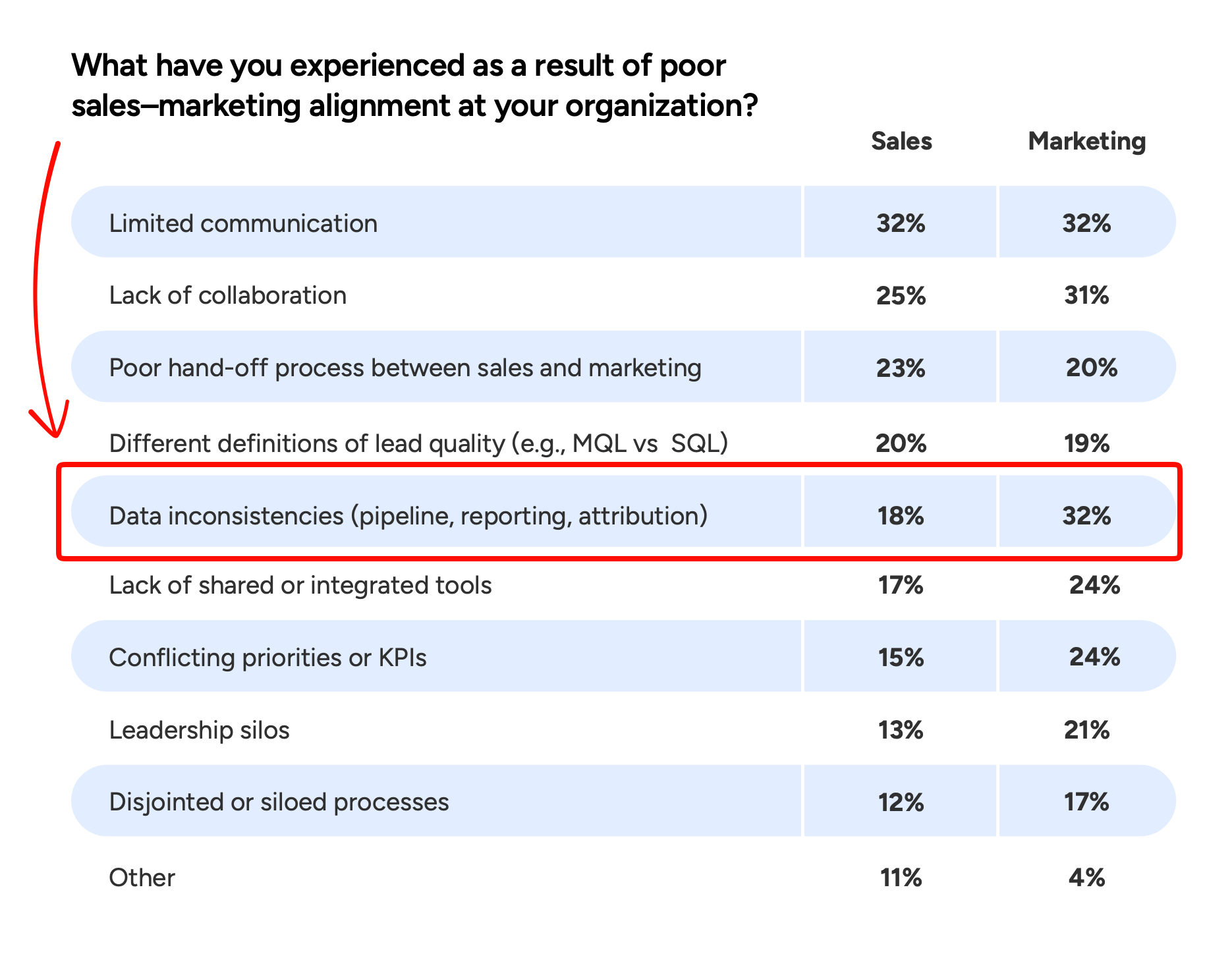
Marketing relies on shared sales and marketing data for measurement and attribution, and sales tracks via rep-owned pipeline signals. The two functions aren’t looking at the same numbers.
What does siloed data look like on a run-of-the-mill Tuesday morning?
Marketing pulls a lead report from the CRM, sales is working off a spreadsheet, and neither has the same definition of “qualified.” That’s how disconnected customer data fragments execution and undermines campaign strategy alignment—and where sales and marketing misalignment compounds across every campaign.
Tool bloat and fragmented tech stacks
Tool bloat is the alignment problem teams keep buying their way into.
56% of GTM professionals say tool bloat is an issue at their organization, and 60% use less than half their available tools.
Adoption tells the operational story too:
14% of teams use 0 to 25% of their stack, and 46% use 26 to 50% of their stack.
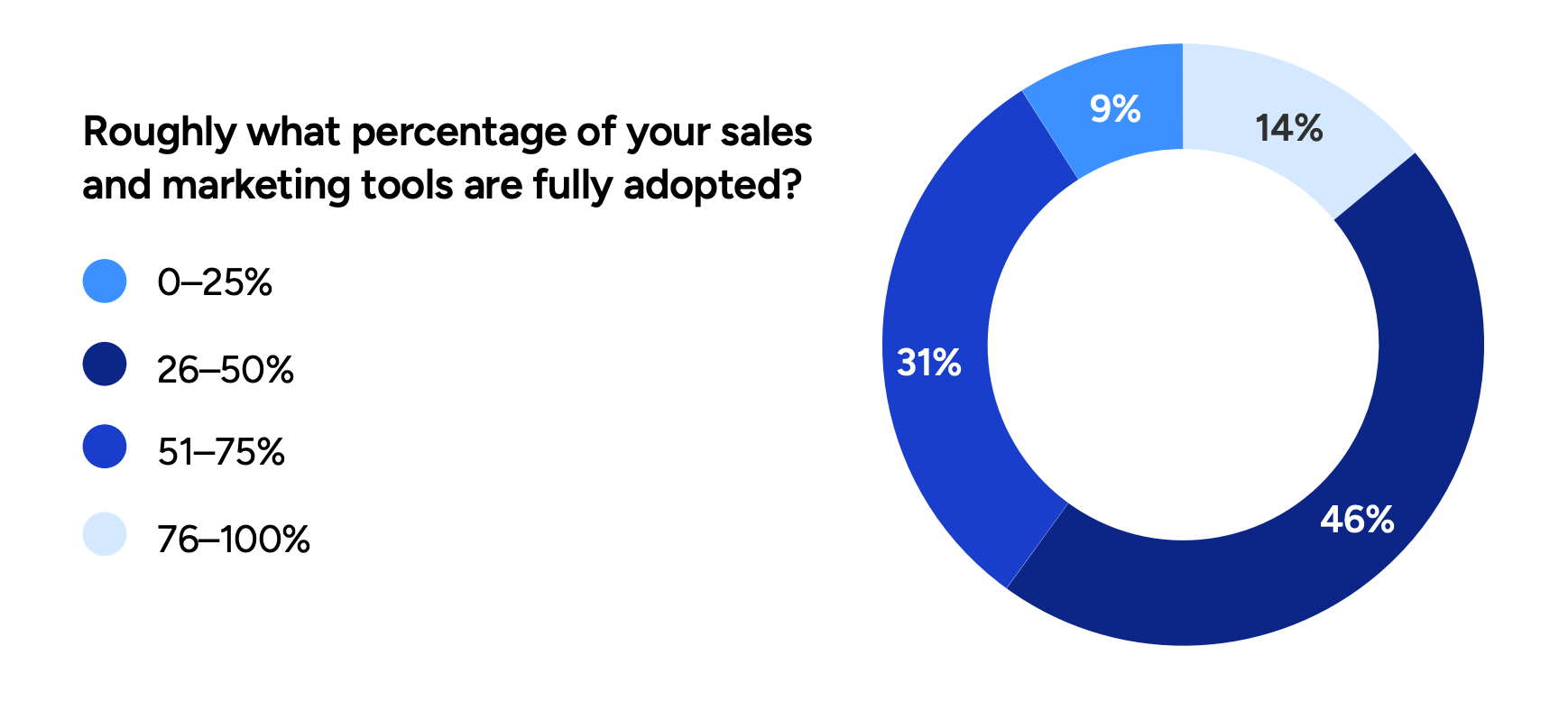
Unused tools simply generate maintenance overhead and data silos.
When marketing automation platforms aren’t shared or adopted consistently, demand generation strategies run in isolation from what sales is actually executing. The result is sales and marketing misalignment built into the tooling layer.
The instinct when alignment is poor is often to buy another tool—a new CRM module, another automation layer. But the truth is, leaner stacks with higher adoption often outperform bloated and sprawled tool collections.
Lead handoff and qualification gaps
23% of sales teams cite poor handoff process as an alignment barrier, and the matching MQL versus SQL definition gap shows up at near-identical rates from both functions.
The gap lives in the process:
Without an agreed SLA between marketing and sales—what marketing delivers, with what information, by when—leads slip through gaps the process never built a way to catch.
Lead quality is the downstream symptom.
Only 29% of GTM teams rate lead quality as excellent, and the upstream definition gap is why that number doesn’t move when more leads come in.
The marketing side feels it more sharply as well, with 32% of marketers reporting delayed or inconsistent lead follow-up versus 22% of sales professionals. From marketing’s perspective, they’re generating marketing qualified leads that disappear into the pipeline with no feedback loop. Broken sales processes are where sales and marketing misalignment becomes pipeline reality.
Misaligned goals, KPIs, and incentives
Measured separately, sales and marketing run on metrics that don’t require each other to look good.
43% of GTM teams cite goal or incentive misalignment as a root cause of sales and marketing misalignment, and marketers feel it more sharply (48% versus 38%).
In practice, marketing is often measured on MQL volume, and sales is often measured on closed revenue. Neither function is structurally motivated to close the gap because their metrics don’t seem to directly “need” each other on the surface.
Why don’t the teams just agree on shared KPIs?
Because the KPI problem sits downstream of the compensation problem.
When marketing’s comp is incentivized around lead volume and sales around deals closed, agreeing on a shared metric is more of a philosophical exercise that doesn’t change behavior. Go-to-market strategies have to connect to how people are rewarded as well.
Shared key performance indicators only work when the underlying goal architecture—targets, incentives, success definitions—is actually aligned.
After all, as Charlie Munger puts it—show me the incentive and I’ll show you the outcome.
Recommended podcast: Sales and marketing misalignment: How RevOps and culture can help fix it
What highly aligned sales and marketing teams do differently
The report compared the 56% of teams that call themselves highly aligned against everyone else. The gaps cluster around data sharing, messaging consistency, and technology adoption.
How they improve communication and close the data gap
Data sharing is where aligned teams pull furthest ahead.
Aligned teams are 3.5x more likely to have strong cross-functional data sharing, 59% versus 16%.
The pattern repeats in measurement confidence too. 54% of weekly-discussion organizations describe data sharing as excellent versus 28% with less frequent discussions. The discussions correlate with data sharing only when the underlying systems are shared, not on their own.
Discussing data and sharing data are different operations. Aligned teams build systems where marketing data feeds both functions from one source, and pipeline definitions are shared from the start rather than translated across teams.
True alignment is visible in what both teams measure.
When sales and marketing data flows from a shared source—customer data, pipeline definitions, conversion signals—both functions measure success against the same metrics. That infrastructure turns communication into a decision layer instead of another place to debate whose numbers are right.
How they build consistent messaging across the buyer’s journey
A campaign promising one outcome and the discovery call delivering another is a mismatch that aligned teams hit far less often, with 17% reporting messaging inconsistencies versus 28% of others.
Consider the entire buyer’s journey as the handoff surface. Every transition from marketing-owned context to sales-owned context risks message drift. Aligned teams build messaging off shared buyer behavior data and customer insights, not each function’s assumptions.
Consistent messaging across the entire customer journey starts with both teams working from one customer profile—same personas, same positioning, and language that reflects what buyers say.
Marketing campaigns should reflect the language and objections sales hears on calls. When they don’t, prospects experience a disjointed customer journey that erodes trust before the deal is on the table.
What does that look like in a lean SMB team?
Shared customer interview notes, call recording access for marketers, and campaign messaging that gets a sales rep review before it goes live.
How they align sales and marketing around a leaner tech stack
Aligned teams keep their tooling lean.
30% of aligned teams say their tech stacks are lean and focused tech versus 15% of others reporting the same.
Aligned teams also show stronger tool adoption (12% at 75% or higher usage versus 4%) and better data sharing (45% versus 29%).
As we mentioned earlier, the instinct when alignment fails is to add tools—new marketing automation platforms for lead generation, more enrichment layers, whatever AI tool has the most buzz on YouTube.
The data points the other way, with fewer better-adopted tools outperforming bloated stacks.
And consolidation tends to pay in lead quality.
Teams that significantly consolidated their tech stack are 2x more likely to rate lead quality as “excellent” at 55% versus 20%—one of the clearest action signals in the report.
Looking forward, 24% of GTM teams prioritize landing page optimization and testing tools as a tech investment for the next twelve months. Marketing automation, analytics, and data integration sit higher on the priority list. Across categories, teams get more from tools both functions actually use than from bloated stacks feeding disconnected data.
How to align marketing and sales: The actions that move the needle
Aligned-team behavior is observable. Building it into your own team comes down to three operating moves.
Defining shared buyer personas and a shared definition of lead quality
Alignment problems often start at the top of the funnel.
Marketing’s picture of the ideal buyer and its definition of a good lead don’t match the sales team’s. Buyer personas work best as a joint artifact rather than a marketing deliverable. Sales input changes the audience definition before campaigns go live, so lead quality debates do not wait until the handoff.
23% of GTM teams cite lack of clarity on target customers as a misalignment consequence, and marketers feel it more acutely (29% versus 16% of sales).
The lead quality definition is the other half. Without it, MQL-to-SQL handoff rates are meaningless and marketing celebrates lead volume while sales complains about lead quality.
A shared persona exercise produces shared language around buyer behavior and customer insights, firmographic and behavioral qualifiers that turn raw marketing leads into marketing qualified leads, and a definition of sales-ready.
Buyer personas and lead quality definitions are the operating agreements behind every alignment practice.
Aligning lead qualification and handoff processes
Asked how to do sales and marketing alignment, the largest share of GTM teams point to lead qualification and handoff. 36% cite it as the action that would matter most.
A functional handoff has three pieces:
- An agreed SLA between marketing and sales—what marketing delivers, by when, with what information
- A defined SQL threshold both functions can apply the same way
- A feedback loop so marketing learns whether leads convert
Handoff alignment keeps the sales cycle moving and puts revenue goals and customer acquisition targets within reach. It’s one of the sales and marketing alignment best practices aligned teams run more often (36% versus 26%) and the lever for revenue growth.
What does a broken handoff actually cost?
Delayed follow-up at 28%, stalled deal cycles at 20%, and a pipeline that converts poorly because lead quality was never agreed on—all in the report data.
Unifying data, analytics, and reporting systems
This action closes the data paradox—sales and marketing data look unified on the surface while real-world consistency is fragmented.
The fix starts with the report’s three highest-rated alignment tools:
- CRM tools at 31% combined (30% sales, 32% marketing)
- Reporting tools also at 31% combined (25% sales, 34% marketing)
- Collaboration platforms at 30% combined (23% sales, 39% marketing)
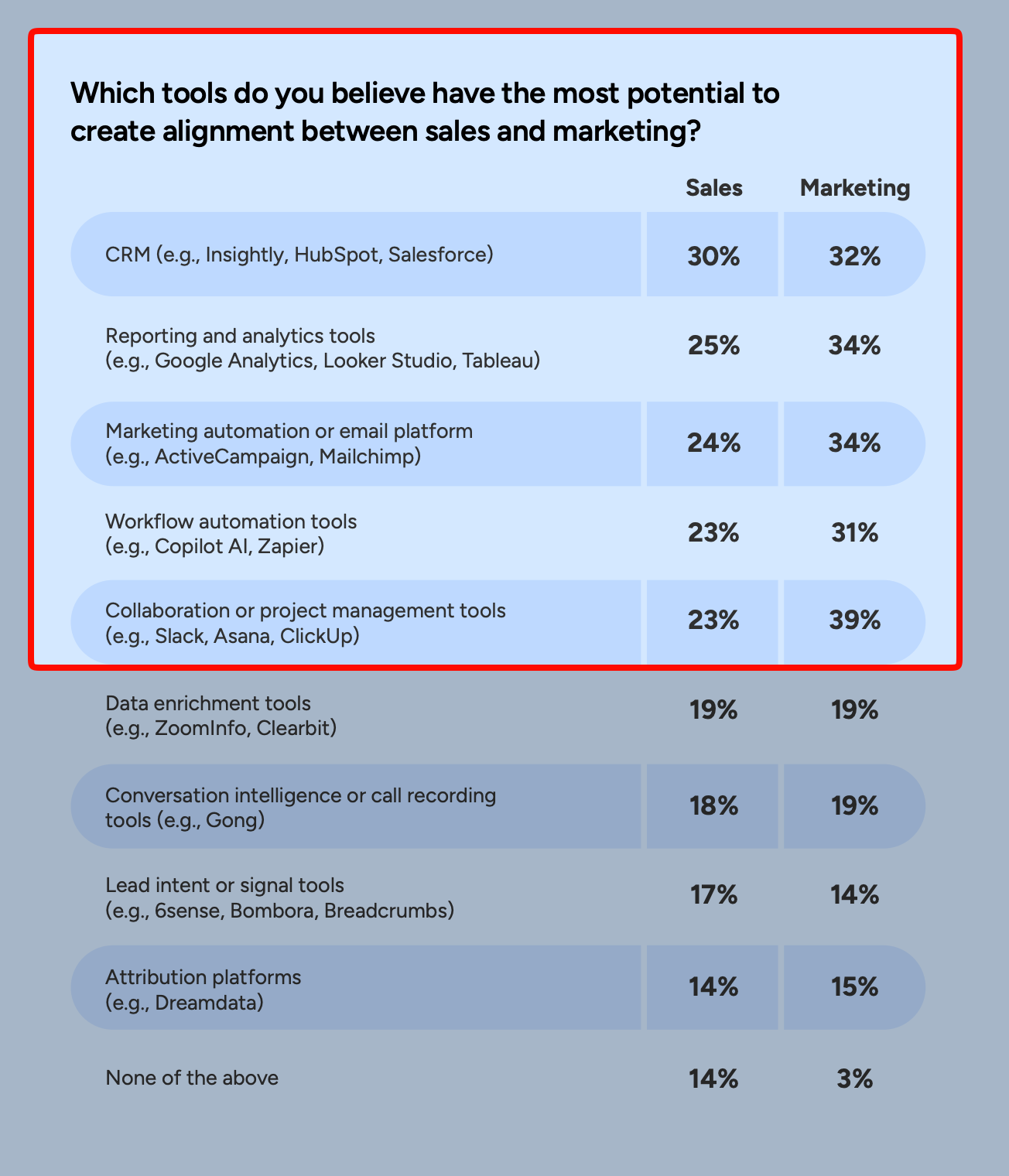
Still, the data systems and software are only half the answer. The other half is agreeing on which key performance indicators both teams own—customer acquisition cost and conversion rates are concrete examples where one shared number beats two team-specific ones.
44% of GTM teams are prioritizing data integration and AI-driven insights for the next twelve months. Unifying reporting is becoming a core investment for teams trying to make alignment measurable.
When marketing and sales efforts pull from the same marketing data and measure success against the same dashboard, every handoff has a cleaner source of truth.
SUBSCRIBE
Don’t miss out on the latest industry trends, best practices, and insider tips for your marketing campaigns
Get the full report: What 500+ SMB GTM professionals can teach your business
Sales and marketing alignment problems rarely stay contained. A loose lead definition becomes a handoff problem. A handoff problem becomes a pipeline problem. A pipeline problem becomes a growth problem both teams explain differently because they are working from different data.
That is why the strongest alignment moves are operating-model changes like shared buyer definitions, clearer handoff rules, cleaner reporting, and a tech stack both teams actually use.
The full Unbounce report expands that picture across 50+ data points from 500+ surveyed SMB GTM professionals. It shows where aligned teams pull ahead, where the biggest gaps usually start, and which changes create the clearest path to better lead quality and pipeline performance.
Inside the full report, you’ll find:
- The complete alignment benchmark data across 500+ SMB GTM professionals
- The biggest perception gaps between executives, sales teams, and marketing teams
- The tech stack consolidation findings tied to stronger lead quality
- Practical frameworks for operationalizing GTM alignment across sales and marketing
Download the full report to see the complete dataset and use the benchmarks to identify which alignment gaps are costing your team the most.
Common questions about sales and marketing alignment
A few alignment questions surface more often than the rest. Here’s a quick pass, with the full data in the report.
Sales and marketing alignment is the degree to which both functions share goals, data, processes, and a common definition of the buyer, so that every handoff, campaign, and customer interaction moves in the same direction.
The work happens at the operating-model layer—shared definitions, agreed handoffs, unified data. Meeting cadence is where the gaps become visible.
GTM alignment is the broader operating model—it encompasses sales-marketing alignment alongside product, customer success, and operations.
Sales-marketing alignment is one critical dimension inside GTM alignment. A team can have strong sales-marketing alignment and still have GTM misalignment if product, CS, or ops are out of sync.
The most common GTM alignment mistake is treating alignment as a communication problem rather than an operating model problem.
54% of teams cite improving communication frequency as their primary alignment strategy, but operationalization is what separates high performers. Other mistakes include misaligned lead definitions, siloed data, and over-investing in tools while under-investing in process.
Four concrete metrics measure sales and marketing alignment:
- Shared lead quality score: percentage of MQLs that convert to SQL
- Data sharing consistency: how often both teams pull from the same source
- Perception gap survey: how similarly executives and non-executives rate alignment
- Pipeline velocity: speed from MQL to closed-won
Only 29% of teams rate lead quality as excellent today, which makes the first metric the easiest place to start.
More sales and marketing alignment advice
Unbounce Go-to-Market Solutions helps SMBs move faster with easy-to-use tools built for scalable revenue growth. Together, Unbounce landing pages and Insightly CRM help lean sales and marketing teams stay connected from first click to closed deal.
Want more ideas for improving sales and marketing alignment? Subscribe to our monthly LinkedIn newsletter for easy-to-implement ideas that help lean go-to-market teams work better together and grow more efficiently.