Wingify unifies optimization into one connected suite
Most digital businesses are short on clarity, and the gap between collecting data and acting on it confidently is costing them more than they realize.
Teams run experiments but struggle to connect results to revenue. Personalization tools are there, but they can’t target the right audience with confidence. Teams ship features, but have no reliable way to know whether those features helped. They also have AI tools, but have to manually re-explain their context every time they use them.
These are coordination failures, the predictable result of building an optimization strategy from disconnected point solutions that don’t share data, audiences, and a definition of what success means.
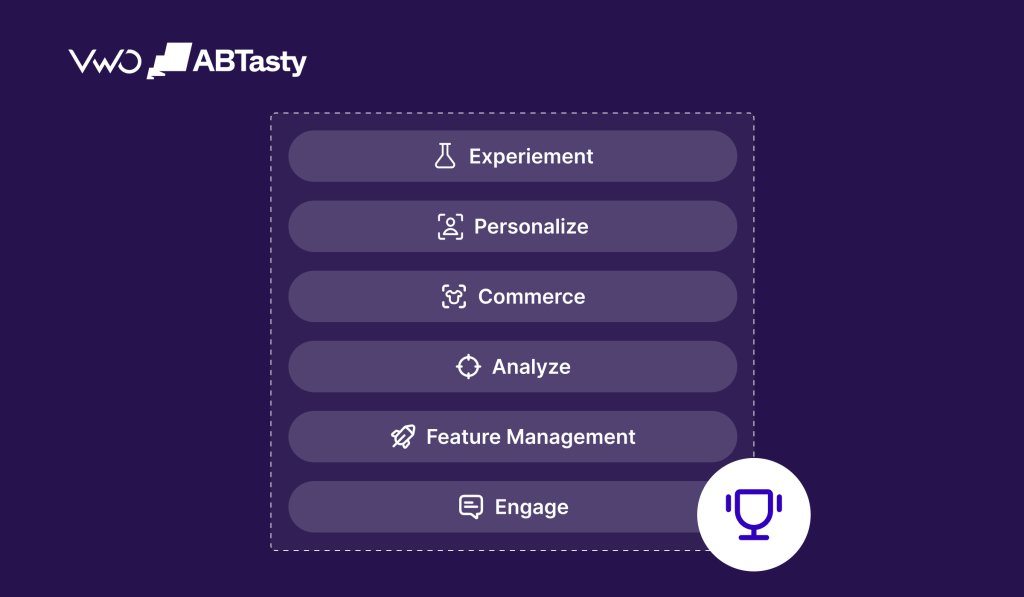
Wingify exists to solve this by combining VWO and AB Tasty, two of the most mature and widely adopted suites in experimentation, personalization, and digital experience optimization, into a single connected suite. Wingify gives organizations the one thing that individual tools can’t: a complete, shared view of the customer that every team can act on, from the same place, without the translation layer.
Every feature inside Wingify feeds into the next, so insight becomes a hypothesis, a hypothesis becomes an experiment, and an experiment becomes a better experience, automatically, without anyone manually stitching the stages together.
Before explaining what Wingify enables, it’s worth naming the problem precisely, because it tends to hide behind productivity metrics and tool adoption numbers rather than showing up as a line on a report.
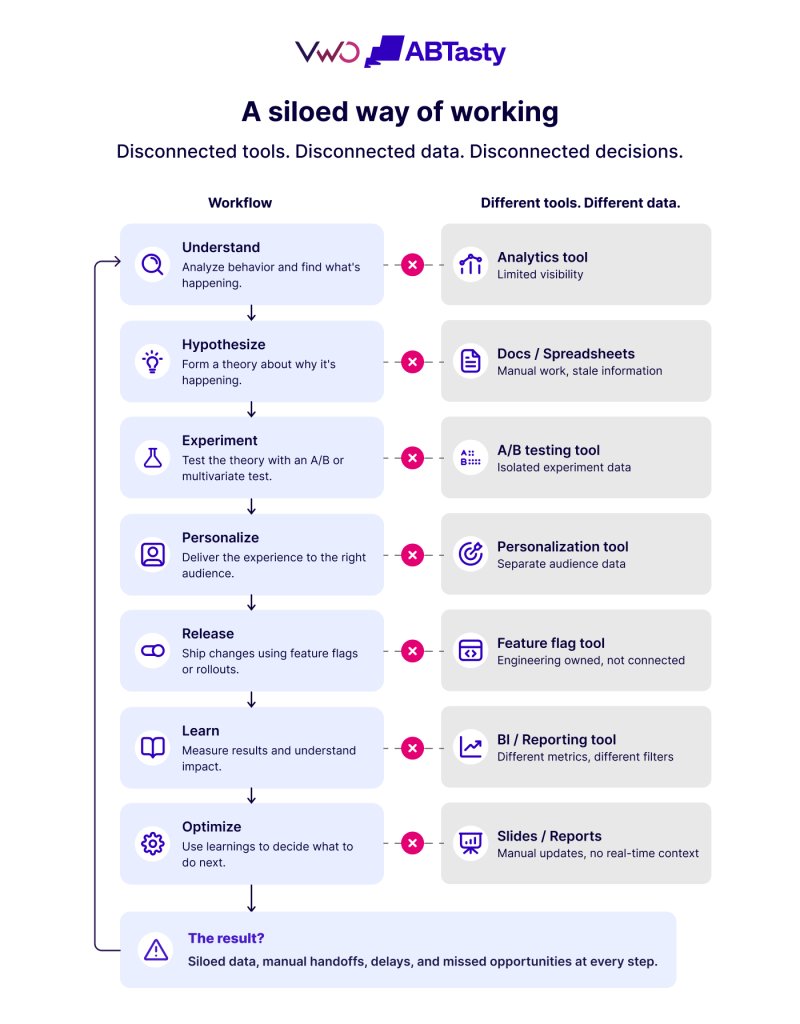
Decisions slow down when data doesn’t travel
- An insight surfaced in a heatmap tool has to be manually translated into a hypothesis in an experimentation suite.
- A winning experiment variant has to be manually reconfigured as a personalized experience in a separate personalization engine.
- A personalization audience has to be rebuilt from scratch in a feature flag tool before a rollout can target the right users.
Each handoff takes time, introduces interpretation error, and means that by the time a good idea becomes a live experience, the window it was designed for may have passed.
Audiences drift and metrics conflict
When the same audience “returning customers who abandoned checkout” is defined separately in four different tools, it stops meaning the same thing in all four.
Experimentation sees one number, personalization targets a slightly different set, analytics reports a third, and no one can explain why the figures don’t match. The result is less time spent optimizing and more time spent reconciling.
AI helps less when it doesn’t know where it is
General-purpose AI tools are genuinely useful for brainstorming and drafting. But they have no access to your live experiments, your audience segments, your feature rollout history, or your campaign metrics.
Getting useful output requires exporting, copying, and pasting enough context to make an answer relevant, then manually carrying that answer back into the suite to act on it. The round trip is where the value bleeds out.
Governance becomes a patchwork
In organizations running optimization across multiple teams, brands, or regions, every tool that doesn’t share a permission model is another security surface to configure and maintain separately.
Audit trails fragment, compliance questions get harder to answer, and the overhead of governing five tools adds up to a real cost that rarely appears in any single tool’s ROI calculation.
Why connectivity is the foundation of every business outcome
The reason a connected suite produces better business outcomes is structural.
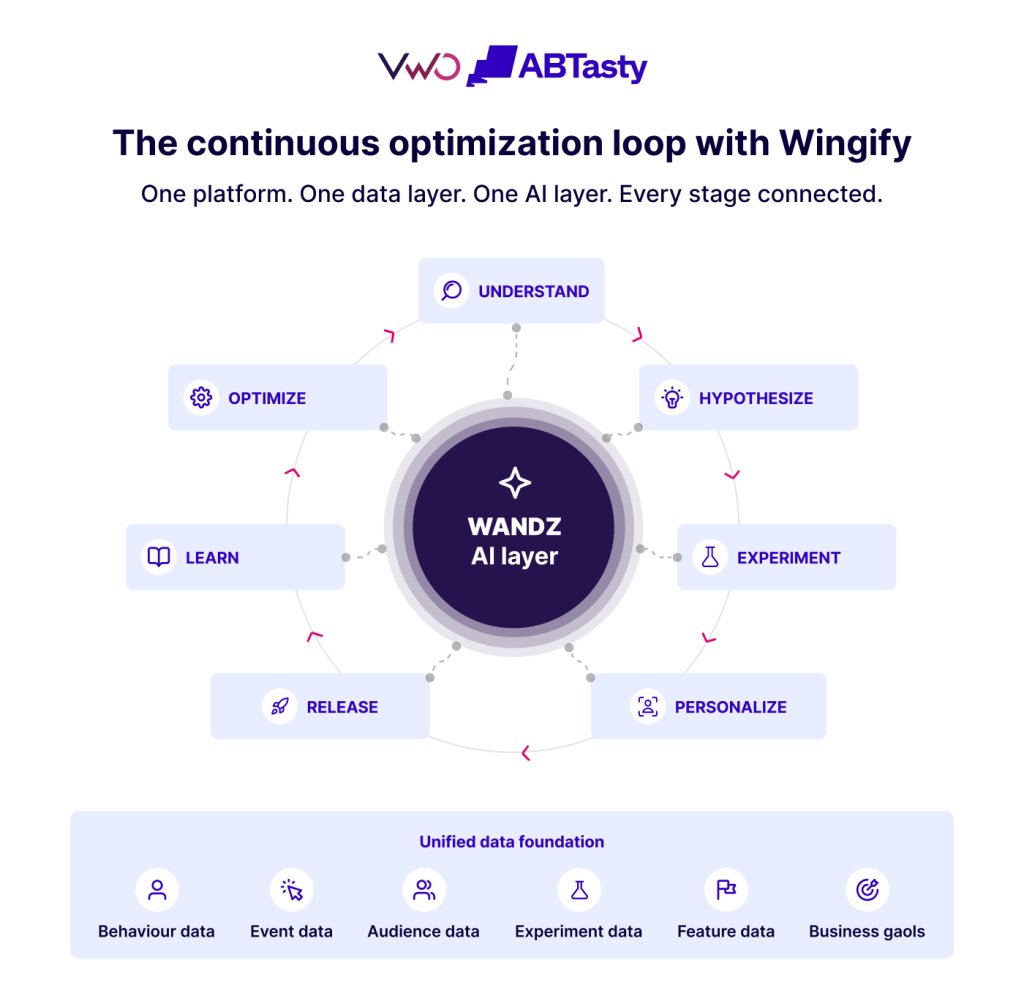
When experimentation, personalization, feature delivery, customer insight, commerce, customer feedback, and analytics share the same data layer, the output of each stage of optimization automatically becomes the input for the next. A heatmap showing checkout friction informs a hypothesis. The hypothesis becomes an experiment.
The experiment’s winning variant becomes a personalized experience for the specific segment where the friction was worst. The personalization informs a feature change. The feature change is rolled out progressively to the segment that responded best. All of that feeds back into what the team understands about customer behavior, which becomes the basis of the next test.
That loop:
Understand → Hypothesize → Experiment → Personalize → Release → Learn → Optimize.
That’s how compounding improvements actually happen. It requires no heroic effort, just that the tools don’t break the chain at every handoff.
Wingify keeps that chain intact, drawing on VWO’s decade-plus of expertise in experimentation and behavioral insight on one side, and AB Tasty’s depth in personalization, segmentation, and AI-driven targeting on the other.
Why AI layer changes the equation
An AI layer that lives outside your suite adds a step to everything. One that lives inside it removes steps.
Wandz is Wingify’s embedded AI layer, the intelligence built directly into experimentation, personalization, feature management, and analytics workflows. It builds on what VWO offered through Copilot and AB Tasty offered through Evi, unifying both into a single AI layer with access to the same shared context across the entire suite.
Wandz runs inside every feature across the Wingify platform as the intelligence layer that keeps the connected loop moving. It generates hypotheses, reviews configurations, builds audiences, interprets results, and surfaces the next opportunity, all from inside the workflow where the work already lives. The loop gets faster because Wandz removes the pauses between each stage.
The business value of that positioning is specific:
Faster hypothesis generation
Instead of a growth team spending a week pulling data to justify a test idea, Wandz can surface experiment hypotheses grounded in what’s already in the suite: behavioral patterns, segment performance, and historical test results in minutes.
Fewer launch errors
Before an experiment or rollout goes live, Wandz reviews the configuration metrics, audience targeting, traffic split, and flags likely mistakes. A misconfigured test that runs for two weeks before anyone notices is an expensive way to learn something a pre-launch review could have caught.
Faster result interpretation
Rather than waiting for an analyst to interpret a completed test, teams can query Wandz in plain language, “How did this campaign perform on mobile vs. desktop for first-time visitors?”, and get an answer directly from their actual data, immediately.
Faster campaign execution
The AI Editor lets teams build or modify campaigns using natural-language instructions, with every change visible and reversible before it ships. The result is faster time-to-live without giving up oversight.
Each of these enables faster insight and action, which, across every experiment, every rollout, and every personalization campaign a team runs in a year, adds up to a meaningful difference in how much optimization actually gets done.
The value Wingify offers
Wingify’s value is that two suites, viz., VWO’s experimentation depth and AB Tasty’s personalization and AI-driven experience capabilities, have been brought together into one data layer, one workflow, and one AI system that spans all of it.
The outcome for teams is a tighter loop between understanding customers and improving their experience, running continuously rather than in one-off bursts whenever someone has time to reconcile five dashboards manually.
That is the business case for a unified Digital Experience Optimization suite. And it is exactly what Wingify delivers. Request a demo and experience it yourself.