Local SEO for dentists: The complete guide (2026)
Local SEO for dentists helps your practice appear in Google Search, Google Maps, and other local search experiences when people in your area are looking for dental care. By optimizing your online presence, you can improve local visibility, build patient trust, and turn nearby searches into appointment bookings.
Summary
Whether you're a general dentist, orthodontist, pediatric dentist, or cosmetic dental practice, local SEO is one of the most effective ways to attract high-intent patients. From optimizing your Google Business Profile and maintaining consistent business listings to earning patient reviews and creating location-specific content, every local ranking signal plays a role in helping your practice stand out.
This guide explains how local SEO for dentists works, the factors that influence local rankings, and the strategies that drive long-term growth. You’ll also learn how AI-powered search is changing the way patients discover dental practices, and what you can do to improve your visibility across Google, Google Maps, ChatGPT, Gemini, and other AI search experiences.
Table of contents
- What is local SEO for dentists?
- Why local SEO matters for your dental practice
- What are the 7 local SEO strategies for dentists?
- What are some common local SEO mistakes dentists should avoid
- How does local SEO differ by dental specialty?
- How is AI search changing how patients discover dental practices?
- Maximize your dental practice’s local SEO with Birdeye
What is local SEO for dentists?
Local SEO for dentists is the process of optimizing your dental practice’s online presence, so it appears in local search results when nearby patients search for services like “dentist near me,” “family dentist in Austin,” or “emergency dentist in Chicago.” It is a specialized branch of dental SEO that focuses on attracting patients within your service area through Google Search, Google Maps, online directories, reviews, and location-specific website content.
While dental SEO includes broader strategies to improve your website’s visibility in organic search results, local SEO prioritizes signals that help your practice rank in Google’s Local Pack and Maps. These include:
- An optimized Google Business Profile
- Accurate business information across directories
- Positive patient reviews
- Relevant local content
- Strong local authority
Local search has also expanded beyond traditional search engines. Patients now use AI-powered search platforms like ChatGPT, Gemini, and Perplexity to find nearby healthcare providers, compare reviews, and evaluate treatment options. As a result, maintaining accurate business information, earning high-quality reviews, and publishing helpful local content have become even more important for improving online visibility.
A successful local SEO strategy helps your dental practices appear wherever prospective patients search, making it easier for them to discover your services, trust your expertise, and book an appointment.
How Google ranks local dental practices
Google uses three primary factors to determine which dental practices appear in local search results and the local pack:
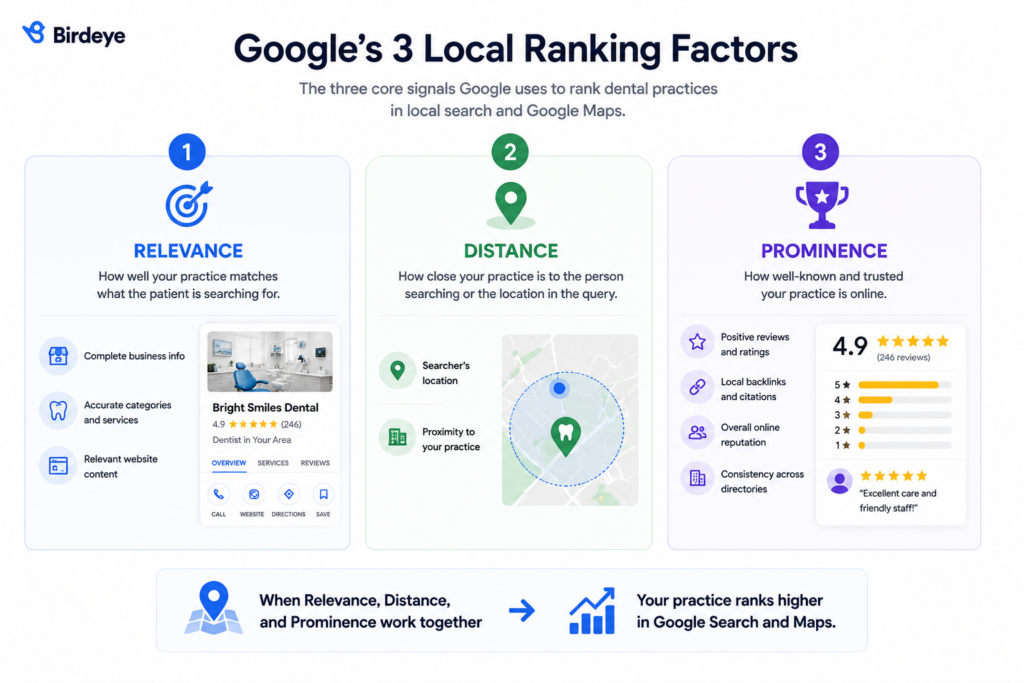
- Relevance measures how closely your Google Business Profile and website match a patient’s search. Complete business information, accurate categories, and detailed service descriptions help Google understand what your practice offers.
- Distance refers to how close your practice is to the person performing the search or the location included in the query. While you can’t control proximity, you can strengthen other local ranking signals to improve visibility.
- Prominence reflects your practice’s overall reputation and authority online. Google considers factors such as patient reviews, ratings, local citations, backlinks, and your overall online presence when deciding which dental practices deserve higher visibility.
Local SEO vs. dental SEO
| Local SEO | Dental SEO |
| Focuses on attracting patients within a specific geographic area | Focuses on improving overall organic search visibility |
| Prioritizes Google Business Profile and Google Maps | Prioritizes website content and technical SEO |
| Relies on local citations and NAP consistency | Relies on backlinks, content quality, and domain authority |
| Targets keywords like “dentist near me” or “dentist in Dallas” | Targets broader keywords like “dental implants” or “Invisalign treatment” |
| Helps improve Local Pack rankings | Helps improve organic search rankings |
Why local SEO matters for your dental practice
Most patients begin their search for a dentist online. Whether they need a routine cleaning, cosmetic treatment, or emergency dental care, they typically compare multiple practices before booking an appointment. A strong local SEO strategy helps your practice appear where these decisions are made, increasing your chances of attracting qualified patients in your service area.
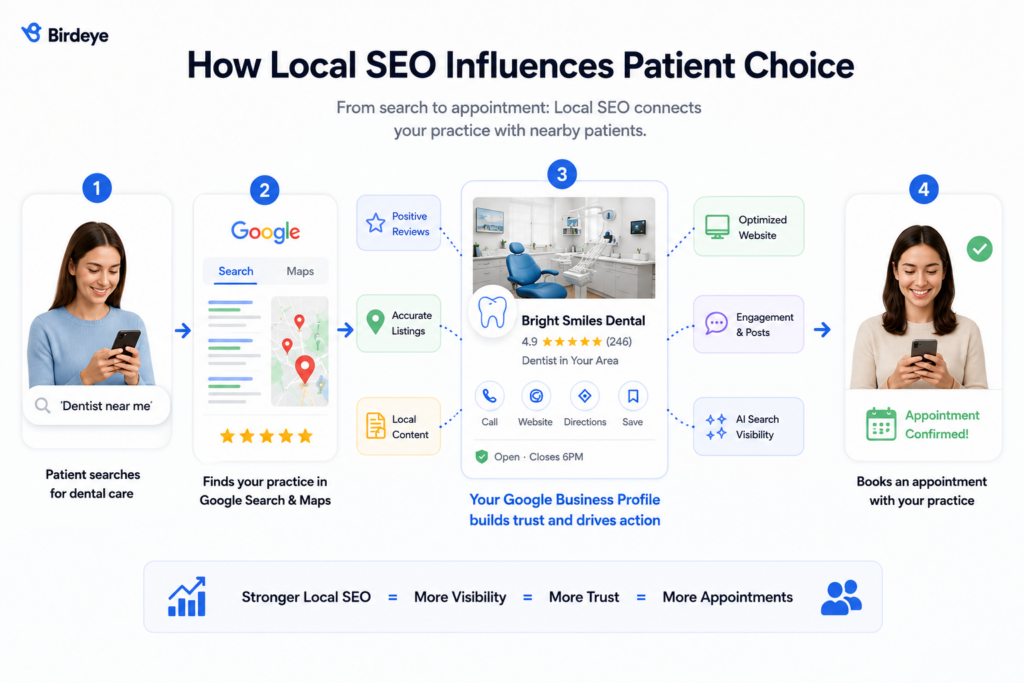
Here are the biggest benefits of investing in local SEO for your dental practice:
- Support long-term practice growth: Consistent optimization helps your practice generate qualified traffic, increase appointment requests, and remain competitive in your local market.
- Increase local visibility: Appear in Google Search, Google Maps, and other local search experiences when patients look for nearby dental services.
- Attract high-intent patients: Reach people actively searching for treatments such as routine checkups, Invisalign, dental implants, teeth whitening, or emergency dental care.
- Build patient trust: Strong ratings, authentic patient reviews, and accurate business information help establish credibility before a patient even visits your website.
- Reduce dependence on paid advertising: Unlike paid campaigns that stop generating leads when your budget runs out, local SEO continues to drive organic visibility over time.
What are the 7 local SEO strategies for dentists?
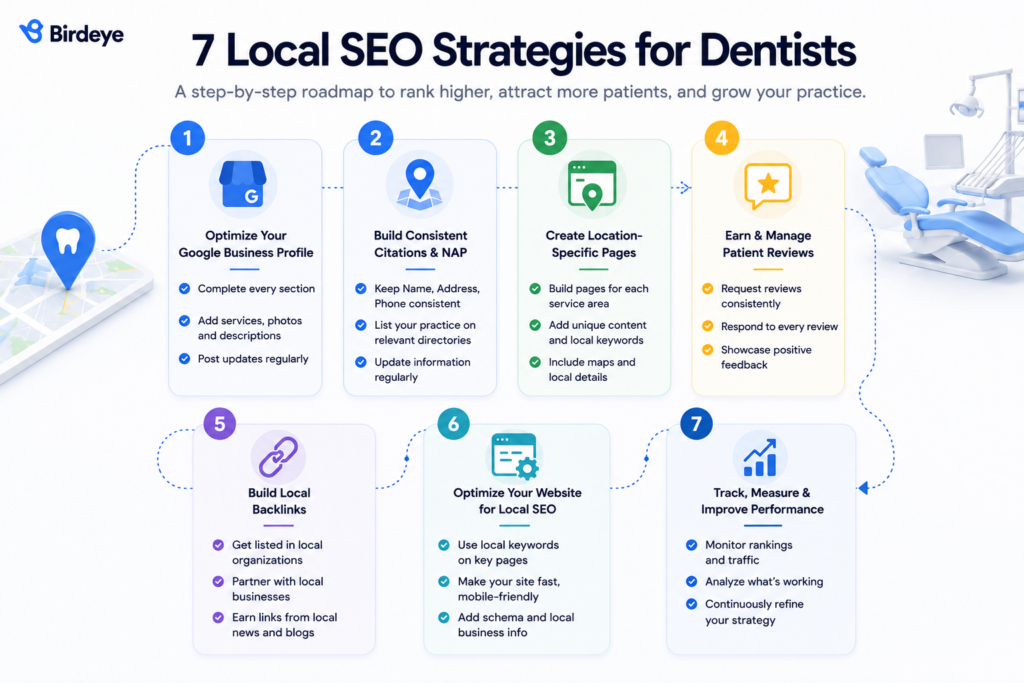
1. Optimize your Google Business Profile
An optimized Google Business Profile helps your practice appear in Google Search and Google Maps while giving prospective patients the information they need to book an appointment.
Follow these best practices to keep your profile competitive:
- Complete your profile: Add accurate business details, including your practice name, address, phone number, website, business hours, and appointment link.
- Choose the right categories: Select Dentist as your primary category and add relevant secondary categories, such as Cosmetic Dentist, Pediatric Dentist, or Orthodontist, based on your services.
- Keep your profile active: Regularly upload photos, publish Google Posts, and update your profile whenever your services, hours, or contact information change.
- Answer common questions: Use the Q&A section to address topics such as insurance, emergency appointments, payment options, and treatments, helping patients make informed decisions.
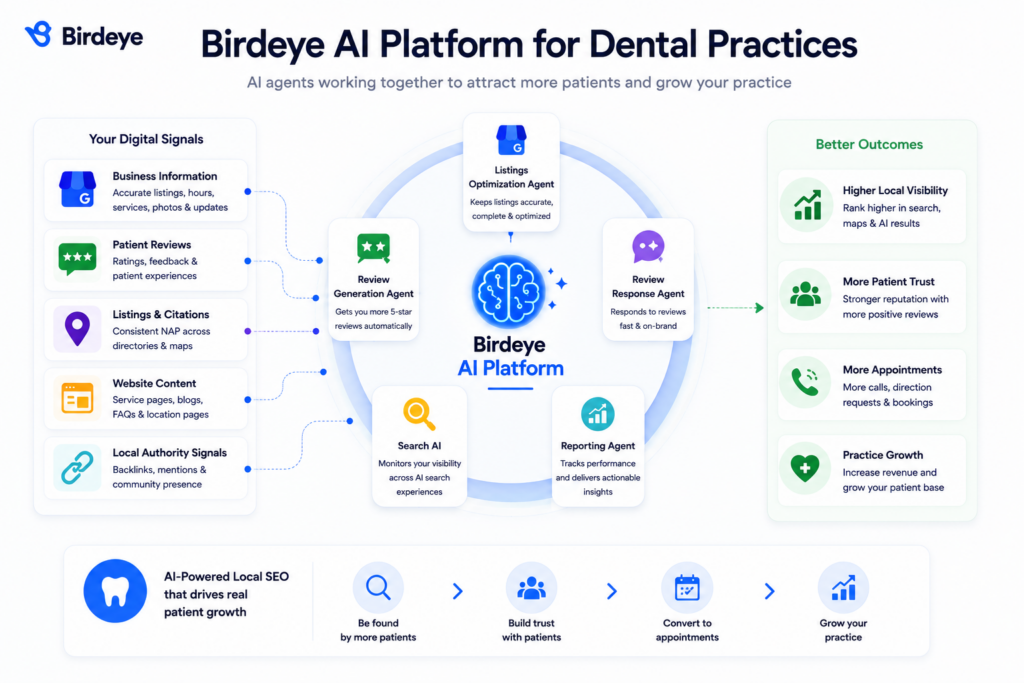
Managing Google Business Profiles across multiple locations can become time-consuming. Powered by AI coworkers at every location, Birdeye's Listings Optimization Agent helps businesses monitor profiles, identify optimization opportunities, and maintain accurate, up-to-date business information across major search platforms.
2. Build consistent local citations and maintain NAP consistency
Local citations are online mentions of your dental practice’s Name, Address, and Phone number (NAP) on trusted business directories, healthcare websites, and local listings. Consistent NAP information helps search engines verify that your practice is legitimate, improving local search visibility and making it easier for patients to find accurate information.
Focus on listing your practice on directories that patients actually use, including:
- Google Business Profile
- Yelp
- Healthgrades
- Zocdoc
- WebMD
- 1-800-Dentist
- American Dental Association (ADA) directory
Even small inconsistencies, such as an outdated phone number, a different suite number, or abbreviated street names, can confuse search engines and prospective patients. Conduct a citation audit whenever your practice relocates, changes contact information, or updates business hours. As a best practice, review your listings at least once every quarter to identify and correct any discrepancies.
For multi-location dental organizations, maintaining consistent business information across hundreds of listings can quickly become a manual, time-intensive process. Birdeye builds AI agents for multi-location brands that need trust, consistency, and control at scale.
3. Create location-specific service pages
Patients don’t just search for a “dentist.” They search for specific treatments in specific locations, such as “dental implants in Dallas” or “Invisalign in Austin.” Creating dedicated local SEO service pages helps your practice rank for these high-intent searches while providing patients with information that’s relevant to their needs.
Instead of listing every treatment on a single page, create individual pages for your primary services. For example:
- Dental implants in [City]
- Invisalign in [City]
- Teeth whitening in [City]
- Emergency dentist in [City]
- Family dentist in [City]
Each page should include:
- A unique title and meta description.
- Treatment-specific information tailored to the local audience.
- Original images where possible.
- Patient testimonials related to that service.
- A clear call-to-action for booking an appointment.
If your practice serves multiple cities or operates several locations, avoid duplicating content across all pages. Customize each page with location-specific information, local landmarks, directions, FAQs, and services available at that office to improve relevance for both search engines and prospective patients.
4. Generate and manage patient reviews
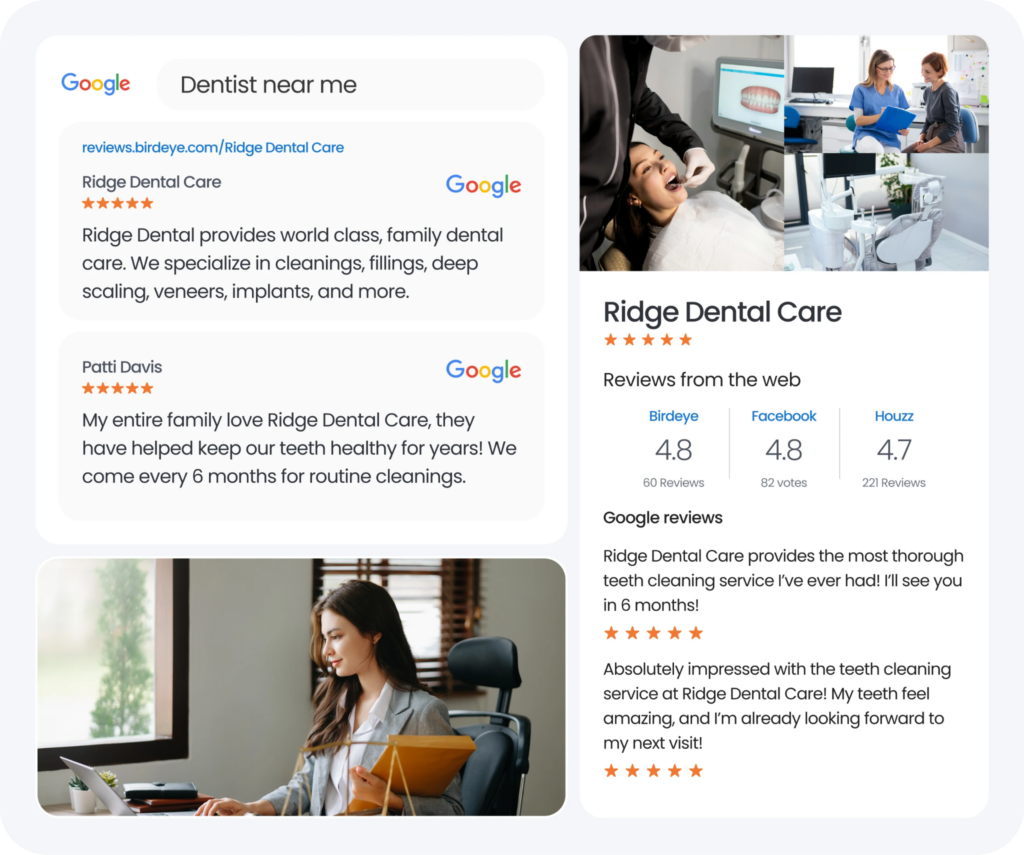
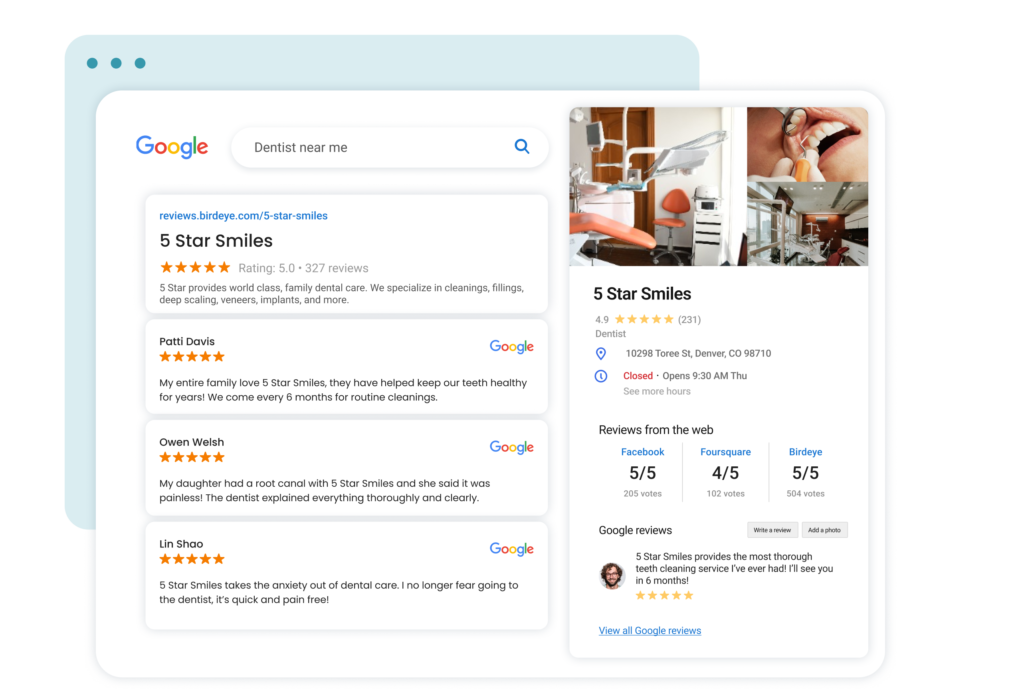
Reviews play an even bigger role in patient discovery as AI search becomes more common. Patient reviews influence both your local search visibility and a prospective patient's decision to choose your practice. According to Birdeye's State of Online Reviews 2026 report, Google accounts for roughly 80% of all online reviews.
A steady flow of recent, authentic reviews signals that your practice is active, trustworthy, and delivers positive patient experiences.
Follow these best practices to build a stronger online dental reputation:
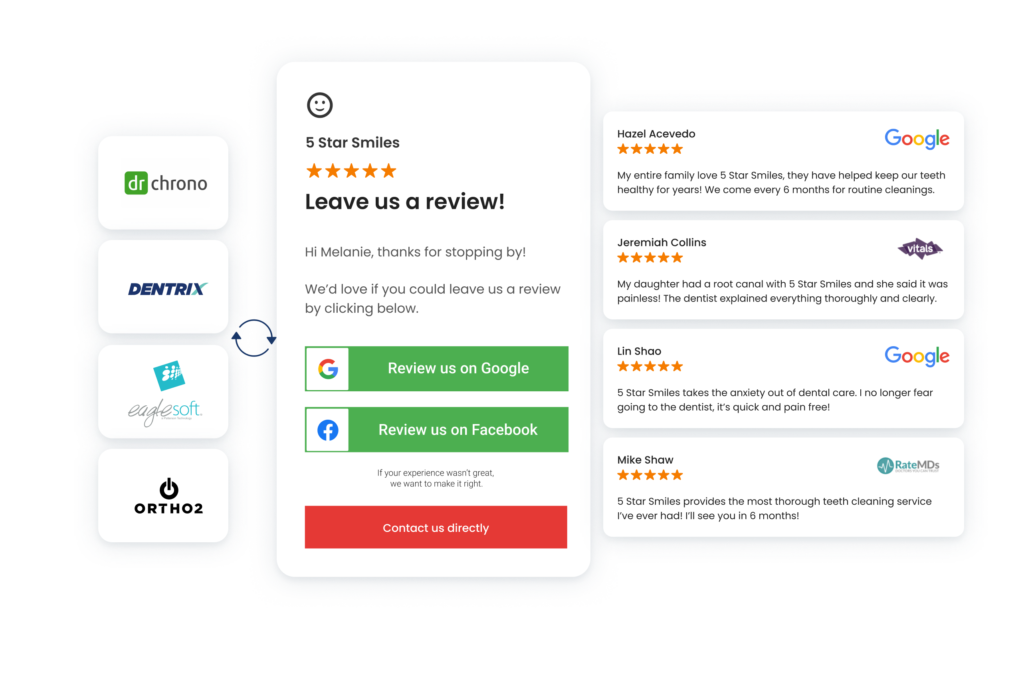
- Ask every patient for a review. Send review requests soon after an appointment, when the experience is still fresh.
- Make it easy to leave feedback. Share a direct review link through text or email to reduce friction and improve response rates.
- Respond to every review. Thank patients for positive feedback and address negative reviews professionally without sharing protected health information.
- Encourage detailed feedback. Reviews that naturally mention treatments, staff, or the patient experience provide more context for both prospective patients and search engines.
- Focus on consistency. A regular stream of new reviews is more valuable than receiving many reviews all at once.
For multi-location dental organizations, managing review generation and responses across hundreds of practices can quickly become overwhelming.
Birdeye’s Review Generation Agent automatically sends review requests at the right time and on the right review site, while the Review Response Agent helps teams create personalized, on-brand responses that can be reviewed or published automatically based on your workflows.
5. Build local backlinks
Backlinks remain an important local SEO ranking factor because they signal credibility and authority to search engines. When reputable local organizations and healthcare websites link to your practice, they reinforce your relevance within the communities you serve.
Focus on earning high-quality backlinks instead of building a large number of low-value links.
Here are a few effective ways to build local backlinks:
- Join trusted healthcare directories and professional organizations, such as the American Dental Association (ADA) and your state or local dental association.
- Keep your profiles updated on reputable healthcare platforms like Healthgrades and Zocdoc.
- Partner with local businesses, schools, or community organizations that can feature your practice on their websites.
- Sponsor community events, health camps, or local charities that acknowledge sponsors with a backlink.
- Share practice updates, awards, or community initiatives through local media and news publications.
As you build backlinks, prioritize relevance and quality over quantity. Focus on websites that are trusted by both search engines and prospective patients, and avoid purchasing backlinks or participating in link schemes that violate Google’s guidelines.
6. Optimize your dental website for local SEO
An optimized website helps search engines understand your services and makes it easier for prospective patients to find the information they need. Beyond ranking well, your website should deliver a fast, seamless experience that encourages visitors to book an appointment.
Use this checklist to strengthen your on-page SEO:
- Write clear title tags and meta descriptions. Include your primary service and location naturally to improve relevance in search results.
- Use a logical heading structure. Organize each page with descriptive H1, H2, and H3 headings to improve readability for both users and search engines.
- Implement structured data. Add schema markup, such as DentalClinic, LocalBusiness, and FAQ, to help search engines better understand your content and potentially enhance search results.
- Improve page speed and mobile usability. Ensure your website loads quickly and runs smoothly across all devices, since many patients search for and book appointments on mobile.
- Strengthen internal linking. Connect related service pages, location pages, and educational resources to help users navigate your website and distribute authority across important pages.
Review your website regularly to identify outdated content, broken links, and technical issues that could affect user experience or search performance.
7. Track and improve your local SEO performance
Local SEO isn’t a one-time project. Regular monitoring helps you identify what’s working, uncover opportunities for improvement, and stay competitive in local search.
Review these metrics every month:
- Google Business Profile analytics: Track how patients find your profile, the keywords they use, and the actions they take, such as website visits, calls, and direction requests.
- Google Search Console: Monitor impressions, clicks, and keyword rankings to understand how your website performs in local search.
- Local keyword rankings: Keep an eye on your visibility for high-value searches, such as dentist near me and location-specific service keywords.
- Website conversions: Measure appointment requests, contact form submissions, and phone calls to determine whether your SEO efforts are driving new patient visits.
As search behavior evolves, it’s also important to monitor your visibility beyond traditional search engines.
When combined with Reporting Agent and Insights, marketing teams can quickly identify performance changes, prioritize improvements, and measure the impact of their local SEO strategy across all locations.
Make local SEO management a breeze for your practice
Want to see the impact of Birdeye on your practice’s SEO? Watch the Free Demo Now.
Customer success story: How Aspen Dental strengthened its online reputation with Birdeye
The challenge
As Aspen Dental expanded to 1,000+ locations across the United States, maintaining a consistent patient experience and building a strong online reputation became increasingly challenging. The organization needed a scalable way to generate patient reviews across both new and existing practices without adding operational complexity.
The solution
Aspen Dental partnered with Birdeye and implemented its Reviews solution, integrating it with its Practice Management System (PMS). By automating review requests and collecting patient feedback at scale, Aspen Dental made it easier for patients to share their experiences while giving teams actionable insights to improve care.
The results
- Increased patient reviews across Google and Facebook within the first 3 months.
- Improved its nationwide average rating from 3.8 to 4.0 stars.
- Collected 38,000+ patient reviews across its network.
- Used patient feedback to identify improvement opportunities, strengthen the patient experience, and support continued growth across 1,000+ dental practices.
What are some common local SEO mistakes dentists should avoid
Even small mistakes can limit your visibility in local search and make it harder for prospective patients to find your practice. Use this checklist to identify and fix common issues before they affect your rankings.
| Common mistake | Best practice |
| Incomplete Google Business Profile | Keep your business hours, services, contact information, and photos accurate and up to date. |
| Inconsistent NAP details across directories | Use the same practice name, address, phone number, and website on every listing. |
| Duplicate or thin location pages | Create unique, location-specific content for every office instead of copying pages. |
| Not requesting or responding to reviews | Generate reviews consistently and respond professionally to patient feedback. |
| Slow or poorly optimized website | Regularly audit your website for page speed, mobile usability, and broken links. |
| Treating local SEO as a one-time project | Review your listings, website, and local performance regularly to keep information accurate and competitive. |
How does local SEO differ by dental specialty?
While the fundamentals of local SEO remain the same, every dental specialty attracts patients with different needs and search intent. Tailor your content and local presence to match what your ideal patients are searching for.
General dentists
Focus on broad, high-volume local searches.
Best practices:
- Target keywords like “family dentist in [city]” and “dentist near me.”
- Create pages for preventive care, cleanings, fillings, and routine checkups.
- Highlight convenience factors such as online booking, extended hours, and insurance acceptance.
Pediatric dentists
Build trust with parents before they book an appointment.
Best practices:
- Target keywords like “kids dentist in [city]” and “pediatric dentist near me.”
- Showcase child-friendly facilities and your team’s experience treating children.
- Include FAQs about first visits, preventive care, and insurance.
Cosmetic dentists
Patients often compare providers before making a decision.
Best practices:
- Create dedicated pages for veneers, teeth whitening, smile makeovers, and cosmetic bonding.
- Include before-and-after galleries and patient testimonials where appropriate.
- Target treatment-specific keywords with your location.
Emergency dental practices
Patients need immediate information and a clear next step.
Best practices:
- Make your phone number and emergency hours highly visible.
- Clearly explain the emergency services you provide.
- Target keywords such as “emergency dentist near me” and “emergency dentist in [city].”
Orthodontists
Support patients throughout a longer research and decision-making process.
Best practices:
- Create separate pages for braces, Invisalign, and other treatment options.
- Explain financing plans and treatment timelines.
- Target keywords like “Invisalign in [city]” and “orthodontist near me.”
How is AI search changing how patients discover dental practices?
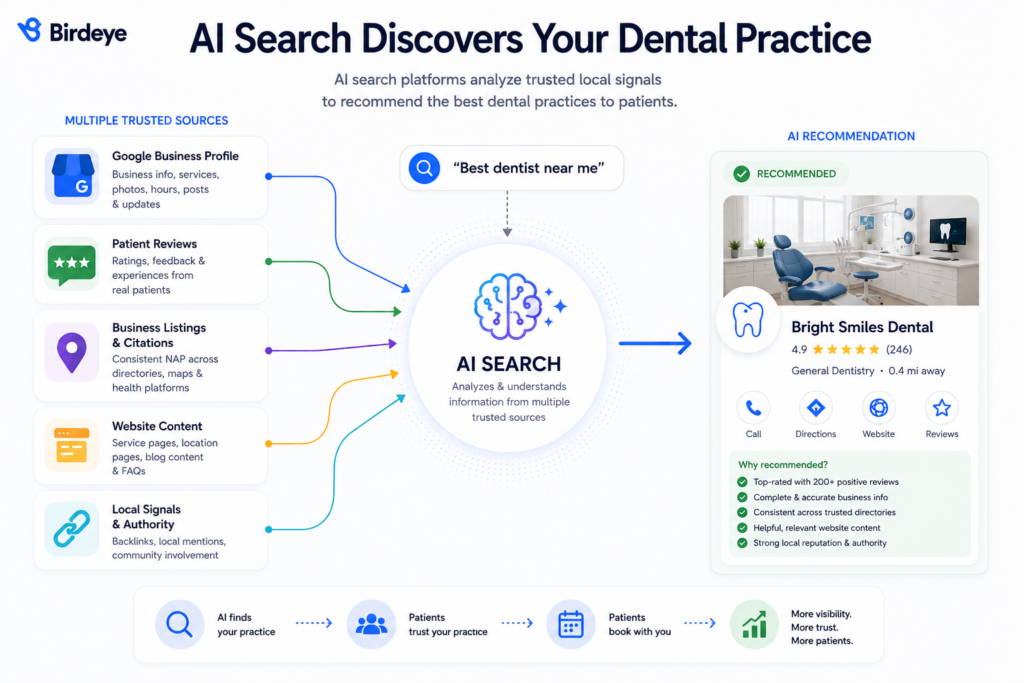
Patients are no longer relying only on traditional search engines to find a dentist. Many now use AI-powered search platforms like ChatGPT, Gemini, and Perplexity to improve their visibility on AI search, compare providers, explore treatment options, and discover local dental practices before booking an appointment.
According to Birdeye's State of AI Search 2026 report, AI search rewards clarity, structure, and consistency over content volume or the number of directory listings, making accurate business information and high-quality patient reviews essential to improving AI visibility.
That means the work you’ve already done to strengthen your local SEO also helps improve your visibility in AI-powered search experiences.
How to strengthen your AI search visibility
As AI search continues to evolve, keep these best practices in mind:
- Maintain accurate business information across every online profile.
- Publish helpful, well-structured content that answers common patient questions.
- Build a steady stream of authentic patient reviews.
- Keep your website updated with accurate service and location information.
- Monitor how your practice appears across AI search platforms.
As patient discovery continues to evolve, visibility should extend beyond traditional search rankings.
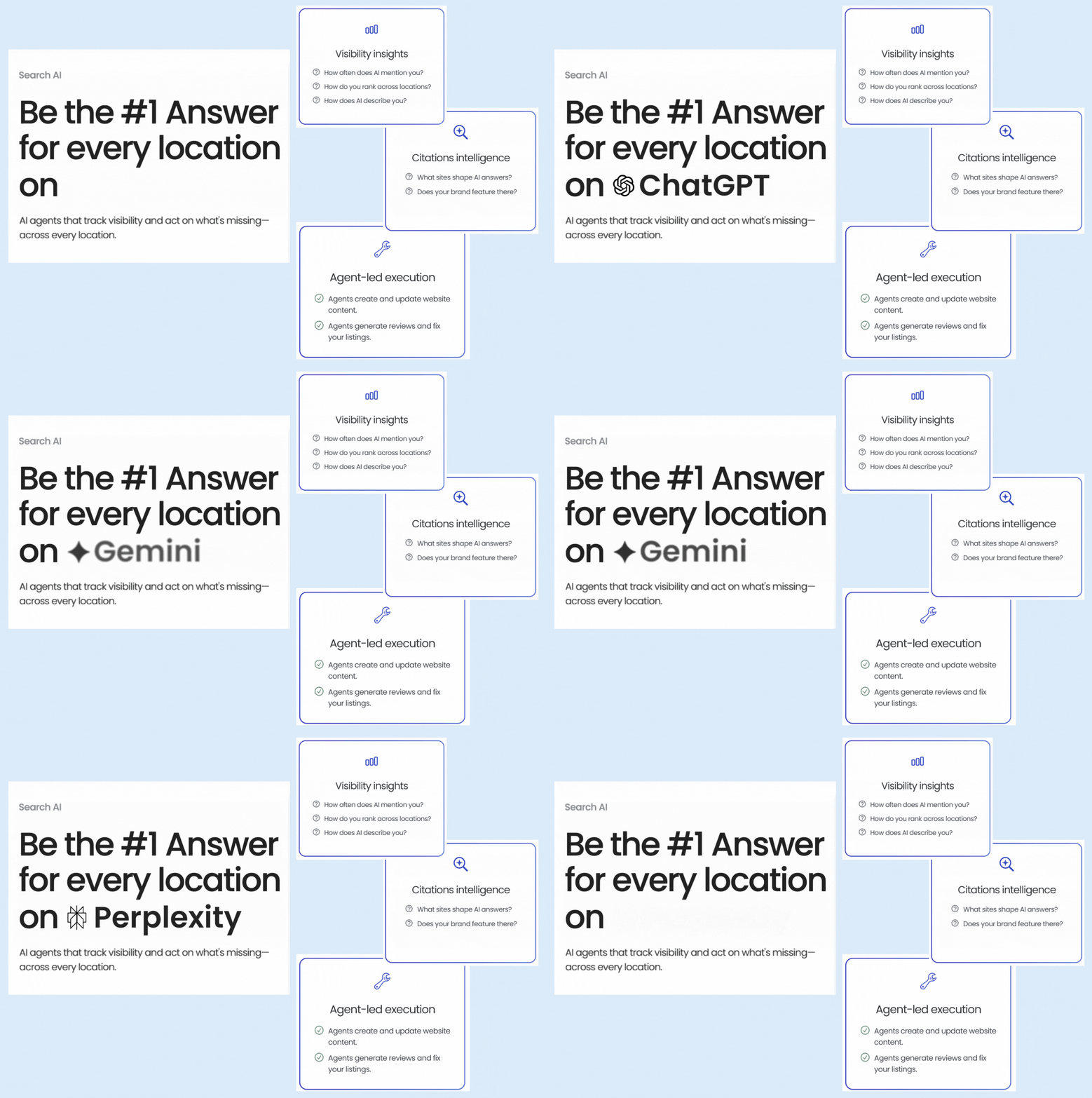
Birdeye’s Search AI helps multi-location brands monitor how they appear across ChatGPT, Gemini, Perplexity, and other AI search platforms by tracking AI rankings, citations, sentiment, and brand mentions. Teams can identify visibility gaps, understand why they occur, and prioritize improvements from a single dashboard.
Frequently asked questions about local SEO for dentists
Most dental practices begin seeing improvements within 3–6 months. Results depend on your competition, website, reviews, Google Business Profile, and the consistency of your SEO efforts.
Optimize your Google Business Profile, maintain consistent business information, earn patient reviews, create local content, and keep your website updated with accurate service and location details.
There’s no ideal number. Focus on earning authentic reviews consistently and responding to them. A steady flow of recent reviews is more valuable than a large number collected at once.
Costs vary based on your practice size, number of locations, and SEO goals. Many practices combine in-house efforts with SEO tools or agency support for long-term growth.
Both have value. Google Ads deliver immediate visibility, while local SEO builds long-term organic traffic and sustainable patient acquisition. Together, they create a stronger marketing strategy.
Patients increasingly use AI platforms like ChatGPT and Gemini to research local providers. Strong local SEO helps improve your visibility in both traditional and AI-powered search experiences.
Standardize business information, create unique location pages, monitor reviews, and manage every Google Business Profile consistently. Centralized tools help maintain accuracy across locations.
Google Business Profile optimization, consistent business information, patient reviews, local citations, relevant website content, quality backlinks, and a mobile-friendly website all influence local rankings.
Maximize your dental practice’s local SEO with Birdeye
Building and maintaining a strong local SEO strategy becomes increasingly complex as dental organizations grow. Managing Google Business Profiles, business listings, patient reviews, AI search visibility, and local performance across multiple locations often requires significant time and coordination.
Birdeye builds AI agents for multi-location brands that need trust, consistency, and control at scale. Powered by AI coworkers at every location, Birdeye helps marketing, operations, and customer experience teams manage reviews, listings, messaging, social media, surveys, and AI search visibility from a single platform. With support for 200+ review sites and 3,000+ integrations, Birdeye is trusted by enterprise brands, including Sutter Health, Sun Auto, Caesars Entertainment, and Aspen Dental..
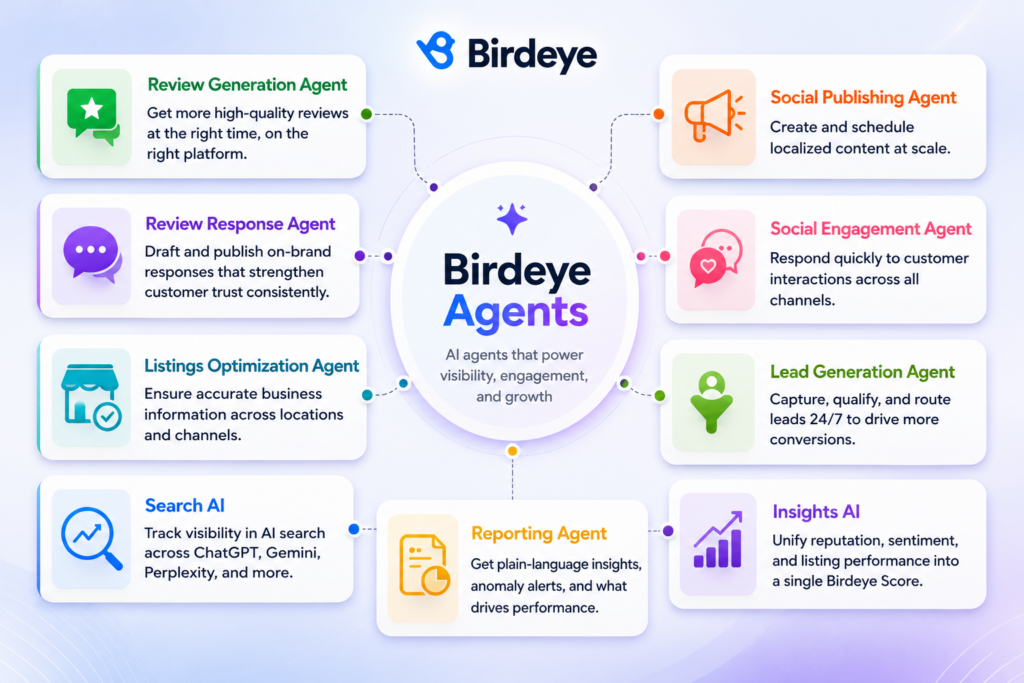
With Birdeye, dental organizations can:
- Generate and respond to patient reviews with Review Generation Agent and Review Response Agent.
- Keep business information accurate across major directories using the Listings Optimization Agent.
- Monitor AI search visibility, citations, brand mentions, and sentiment with Search AI.
- Track performance across locations with Reporting Agent and Insights.
- Capture and convert more patient inquiries with the Lead Generation Agent and AI-powered Marketing Automation.
Whether you’re managing 100 locations or 1,000+, Birdeye helps your team improve local visibility, strengthen patient trust, and scale marketing efforts more efficiently.
Ready to improve your local SEO strategy? Schedule a demo to see how Birdeye helps dental organizations attract more patients across every location.
The post Local SEO for dentists: The complete guide (2026) appeared first on #1 Agentic Marketing Platform for Multi-Location Brands.