Best A/B Testing Tools in India (2026)


India is now the world’s second-largest home for A/B testing software companies, behind only the US (Tracxn, 2026). This guide compares the best A/B testing tools for Indian D2C and SaaS teams, four of which are built by Indian founders, plus the global platforms Indian companies actually run.
Each entry covers who it fits, INR pricing where it exists, and mobile-first performance. Convert Experiences, an A/B testing, experimentation, and personalization platform built for CRO teams, is one of them.
Why does an Indian D2C founder still reach for an expensive global tool by default? Usually, because no one told them four of the best A/B testing tools were built by Indian founders, in rupees, for mobile-first traffic.
This guide starts there, then covers the global platforms used widely in India, including Convert Experiences, the A/B testing and experimentation platform that publishes this blog.
What Is A/B Testing, and Does It Work for Indian D2C Brands?
A/B testing compares two versions of a web page, app screen, or user flow to see which one drives more of an outcome you care about, like add-to-carts or checkouts.
For Indian D2C brands, this works because you are already paying for the traffic. Margins are thin, most of your visitors arrive from paid social or search, and the majority shop on a phone over a patchy connection. Every rupee spent sending people to a page that converts poorly is a rupee wasted. A/B testing recovers some of that spend without raising your ad budget.
Himanshu Gaur, CRO at OptiPhoenix, a conversion rate optimization agency that runs experimentation for Indian D2C brands, frames the payoff plainly:
At the ₹50–300 Cr mark, you’ve got the traffic volume to actually hit statistical significance quickly. It’s like a cheat code: you get a multiplier on the traffic you’re already paying for, which drops your CAC and pads the bottom line almost instantly.
Himanshu Gaur
This shouldn’t be misunderstood, though. A/B testing shouldn’t be thought of as a quick win. In fact, Himanshu says that’s the first mistake he sees brands making. Brands hand a testing tool to an overloaded product manager, run two or three button-color tests expecting revenue to double, then quit when it doesn’t. He counters that real experimentation compounds. “It’s a compound interest account, not a lottery ticket.”
1. VWO (Wingify)
- Founded: 2010 (New Delhi)
- Best for: Mid-market to enterprise teams running a steady program in ecommerce, SaaS, travel, and media who need a full-funnel testing suite
- Starting price: Custom, not publicly listed (30-day free trial)
What is VWO?
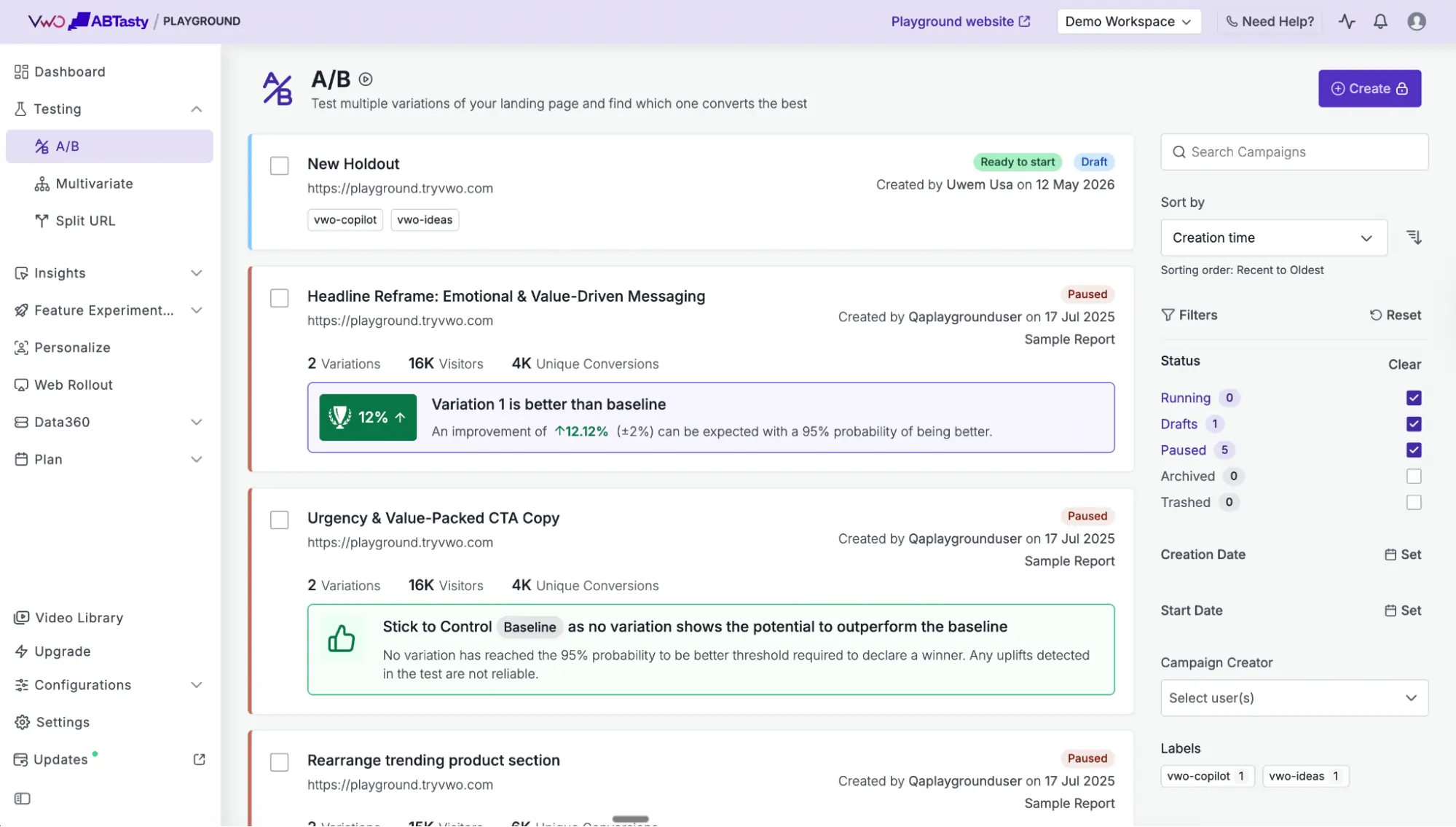
VWO is a full-stack experimentation platform covering A/B testing, multivariate testing, heatmaps, and session recordings. Marketing and product teams run client-side tests through its visual editor, with server-side testing available when changes live deeper in the stack.
It is the most prominent A/B testing tool built in India, and the answer to the question Indian buyers ask most: yes, VWO is Indian.
Wingify, its parent, was founded in New Delhi in 2010 by Paras Chopra and stayed bootstrapped for over a decade. Singapore-based Everstone Capital acquired a majority stake in January 2025, and in January 2026, VWO agreed to merge with Paris-based AB Tasty under Everstone’s ownership. The combined company serves more than 4,000 customers and is headquartered in New Delhi, with VWO co-founder Sparsh Gupta as CEO. So VWO today is a global platform with Indian roots and Indian leadership, under majority PE ownership.
Key features
- Visual editor for client-side tests, plus server-side for backend changes
- Heatmaps and session recordings to see where users click, scroll, and drop off
- Targeting rules to segment by behavior, geography, and custom attributes
- Bayesian stats engine with funnel and segment views
FYI, VWO moved pricing behind account registration in 2026. The public page lists a free trial only. Figures are no longer published on the official site.
2. Zoho PageSense
- Founded: 2018 (Chennai; Zoho Corporation, founded 1996)
- Best for: Small to mid-size teams and lean marketing functions in ecommerce and SaaS who want A/B testing bundled with heatmaps, funnels, and session recordings, or teams already inside the Zoho ecosystem
- Starting price: From ₹480/month (Professional, billed annually) for 10K monthly tracked users. A/B testing starts on the Enterprise plan at ₹1,177/month (billed annually). Free trial available for 15 days, plus a Forever Free plan for up to 5K monthly tracked users.

What is Zoho PageSense?
Zoho PageSense is a conversion optimization platform that combines A/B testing, heatmaps, funnel analysis, form analytics, and session recordings in one tool. Teams build test variations in a drag-and-drop visual editor, then target them to predefined or custom visitor segments.
It is built by Zoho Corporation, the Chennai-headquartered software company founded by Sridhar Vembu in 1996 and known for running its entire product suite without outside funding. For Indian buyers already using Zoho CRM, Books, or the wider suite, PageSense slots into the same account. Indian businesses can purchase Zoho products in INR with GST invoicing through Zoho India, though the PageSense pricing page itself lists rates in USD.
Key features
- Visual editor with segment targeting and goal tracking
- Heatmaps, scroll maps, and attention maps per page and per variation
- Funnel and form analytics to find where visitors drop off in flows and forms
- Session replay of real visitor sessions to spot friction
3. CustomFit.ai
- Founded: 2017 (Bengaluru)
- Best for: Small to mid-size D2C and ecommerce teams using Shopify, WooCommerce, and BigCommerce stores and marketers who want no-code A/B testing and personalization without dev time
- Starting price: From $59/month (Core, billed annually, equivalent to ₹4,634/mo) for up to 10K monthly visitors, billed in USD. 14-day free trial available.
What is CustomFit.ai?
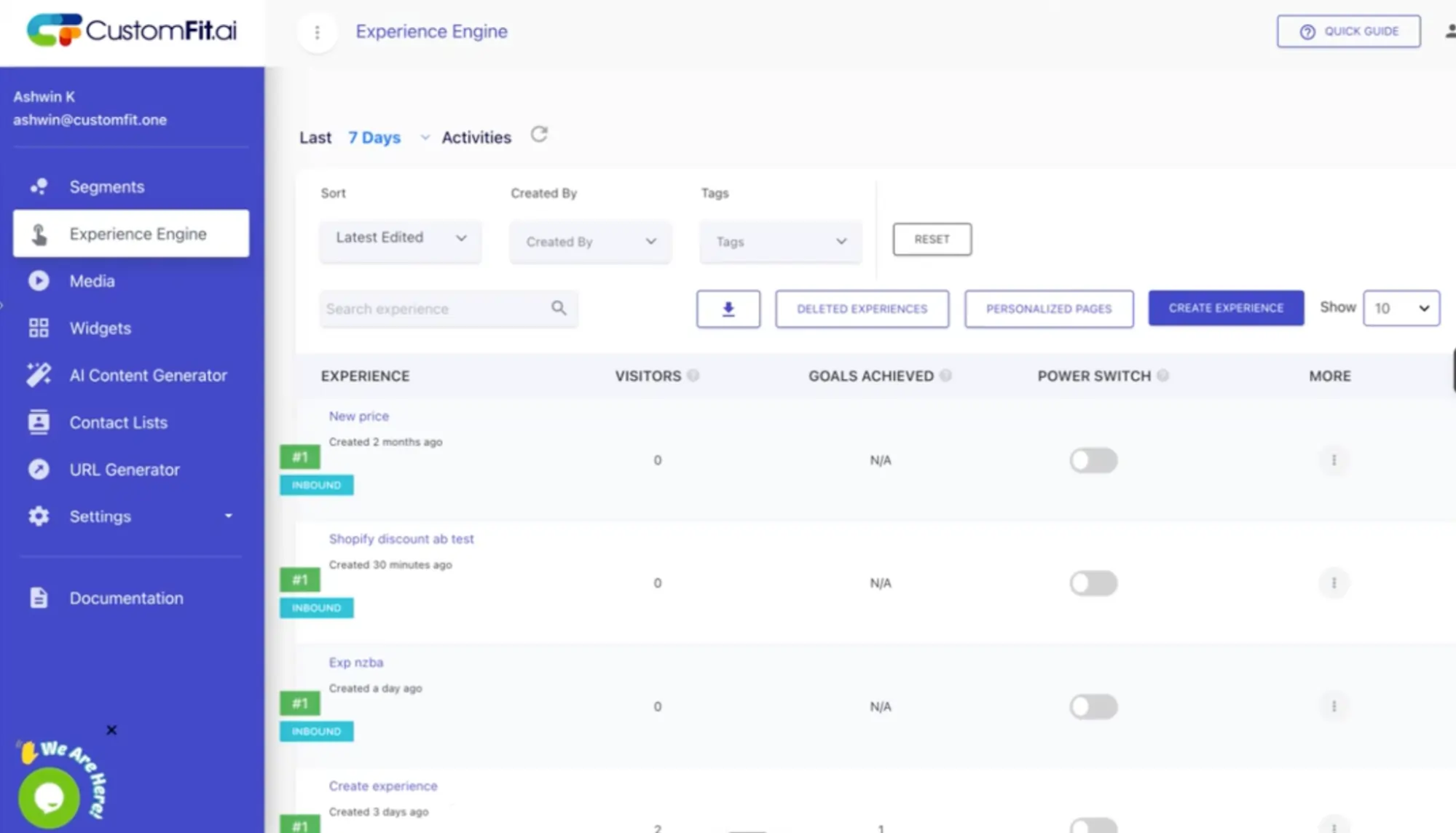
CustomFit.ai is a no-code A/B testing and website personalization platform built for D2C and ecommerce brands. You add a lightweight script, then run tests and personalize any part of a page (product pages, home page, checkout) through a visual editor, without a developer. It was founded in Bengaluru in 2017 by Ashwin Kumar.
For Indian D2C teams on Shopify, its draw is speed and simplicity, not local billing. Merchants repeatedly note that experiments go live instantly with no flicker and no hit to site speed, which matters when most of your traffic is on a phone. Despite being Indian-built, CustomFit bills in USD, so the rupee-billing advantage isn’t available with them.
Key features
- No-code visual editor for A/B, split URL, and multivariate tests across any page
- AI-powered personalization by location, device, referral source, and visitor behavior
- A library of pre-built widgets, including shoppable video reels and product carousels
- Lightweight script with flicker-free rendering, built for page speed
4. FreshMarketer (Freshworks)
- Founded: 2015 as Zarget (Chennai); acquired by Freshworks in 2017
- Best for: Small teams and solopreneurs in D2C and SaaS and marketers who want A/B testing bundled into email and marketing automation rather than a standalone testing tool
- Starting price: From ₹1,249/agent/month (Growth, billed annually). A/B testing, heatmaps, and personalization are paid add-ons on top of this. Free trial is available, plus a free plan at ₹0.

What is FreshMarketer?
FreshMarketer is the marketing automation and CRO product inside Freshworks, combining A/B testing, split URL testing, heatmaps, session replay, and funnel analysis with email, SMS, and journey automation. The testing tools are genuinely easy to pick up, though they sit alongside the marketing suite rather than forming a dedicated experimentation platform.
Its India story is the reverse of VWO’s. It began as Zarget, a CRO startup founded in Chennai in 2015, which Freshworks acquired in 2017 and rebranded as FreshMarketer. Freshworks itself started in Chennai in 2010, moved its headquarters to California, and now trades on Nasdaq. So FreshMarketer is Indian-built at its roots, now a product line within a US-headquartered public company.
Key features
- Visual editor for A/B and split URL tests, with auto-allocation to winning variations
- Heatmaps, scrollmaps, and session replay to read on-page behavior
- Funnel analysis to find where visitors drop off
- Built into Freshworks marketing automation: email, SMS, WhatsApp, and journeys
Indian teams don’t only buy local. Several global platforms have real footholds here, whether through enterprise sales teams, agency familiarity, or sheer brand recognition. Here’s how the main ones fit, starting with ours.
5. Convert Experiences
- Best for: Mid-market to enterprise growth teams and CRO agencies in ecommerce and SaaS who want full-stack testing with predictable, flat-rate pricing
- Starting price: From $299/month (billed annually, equivalent to ₹28,280/mo) for 100K monthly tested users. 15-day free trial available.

What is Convert Experiences?
Convert Experiences is a full-stack A/B testing, experimentation, and personalization platform built for CRO professionals, growth marketers, and agencies. It runs A/B, multivariate, and split URL tests through a visual editor and five code editors, with server-side testing for changes deeper in the stack.
For Indian teams, there are three things to note: Convert does not bill in INR, but its pricing is flat-rate and region-friendly. That is, one price for the full feature set, no per-module charges, and GST applied at checkout based on your billing location. Heatmaps and session recordings don’t draw down your tested-user quota, and bots are filtered out before they consume it, so you pay for qualified visitors rather than inflated traffic. The tracking script is built for mobile-first performance, with anti-flicker rendering and SPA packages that keep Core Web Vitals intact.
Key features:
- Full-stack A/B, multivariate, and split URL testing, client-side and server-side
- Heatmaps and session recordings to inform your testing program with behavioral insights
- Flat-rate pricing on tested users, with no feature gating or per-module charges
- Privacy-first by default with a GDPR-grade foundation that maps well to the principles of India’s DPDP Act, with no data reselling
- Access to Convert-vetted agency partners, including India’s OptiPhoenix
Disclosure: Convert is our product, so read this entry knowing that. We’ve held it to the same checks as every other tool here.
6. Adobe Target
- Best for: Large enterprises already on Adobe Experience Cloud in retail, banking, and media and teams running A/B, multivariate, and AI-driven personalization at scale
- Starting price: Custom enterprise quote. Adobe doesn’t publish list pricing. No free trial.
What is Adobe Target?
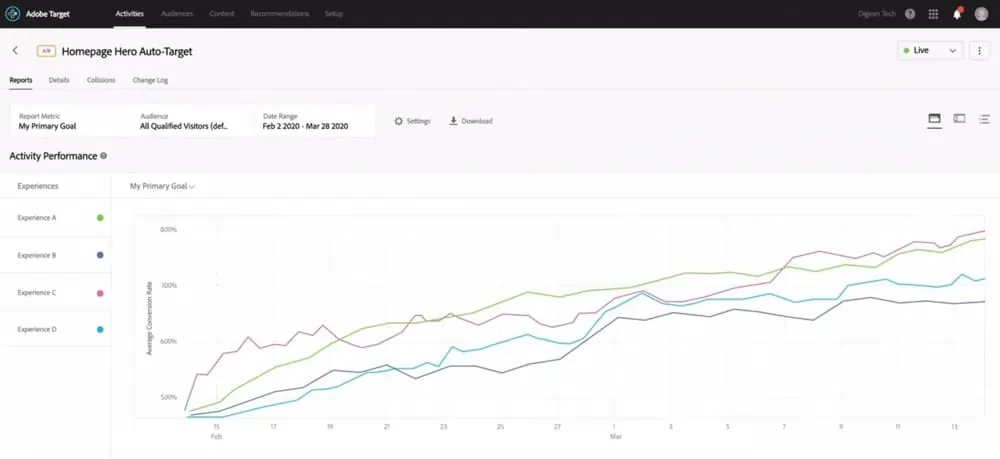
Adobe Target is the experimentation and personalization engine inside Adobe Experience Cloud. It runs A/B tests, multivariate tests, and AI-driven personalization through Adobe’s Sensei machine learning, and it works tightly with Adobe Analytics and the rest of the Adobe stack.
In India, the clearest named user is Tata CLiQ, which runs A/B tests and geo-personalization on Adobe Target to refine web banners and product hierarchies. It’s a fit for teams already standardized on Adobe, rather than a lean D2C brand picking a first testing tool.
Key features:
- A/B, multivariate, and experience targeting from one interface
- AI-driven personalization and automated traffic allocation via Adobe Sensei
- Deep integration with Adobe Analytics, Real-Time CDP, and Campaign
- Omnichannel testing across web, mobile apps, and other digital channels
7. Amplitude
- Best for: Product-led teams with engineering resources in fintech, SaaS, media, and consumer apps, especially teams testing inside apps, not just web pages
- Starting price: Free plan available. Paid plans start at $49/month for 300K monthly tested users (billed annually, equivalent to ₹4,634/mo). There’s a 30-day free trial as well.

What is Amplitude?
Amplitude is a product analytics platform with built-in experimentation. Its strength is app-level behavioral analysis: cohorts, funnels, retention, and feature experiments aimed at product and growth teams rather than marketers running page tests.
In India, its best-documented user is Disney+ Hotstar, now JioHotstar, which used Amplitude to drive retention and engagement across markets. It suits product-led teams with in-house engineering, less so a marketing-led D2C shop.
Key features:
- Behavioral product analytics: cohorts, funnels, retention, and user journeys
- Feature and web experimentation with a strong statistics engine
- Session replay to see how users actually move through a product
- Predictive cohorts that flag users likely to churn
8. Optimizely
- Best for: Large enterprises and digital teams in media, software, and ecommerce who need full experimentation plus content and feature management
- Starting price: Custom enterprise quote. No free trial.
What is Optimizely?
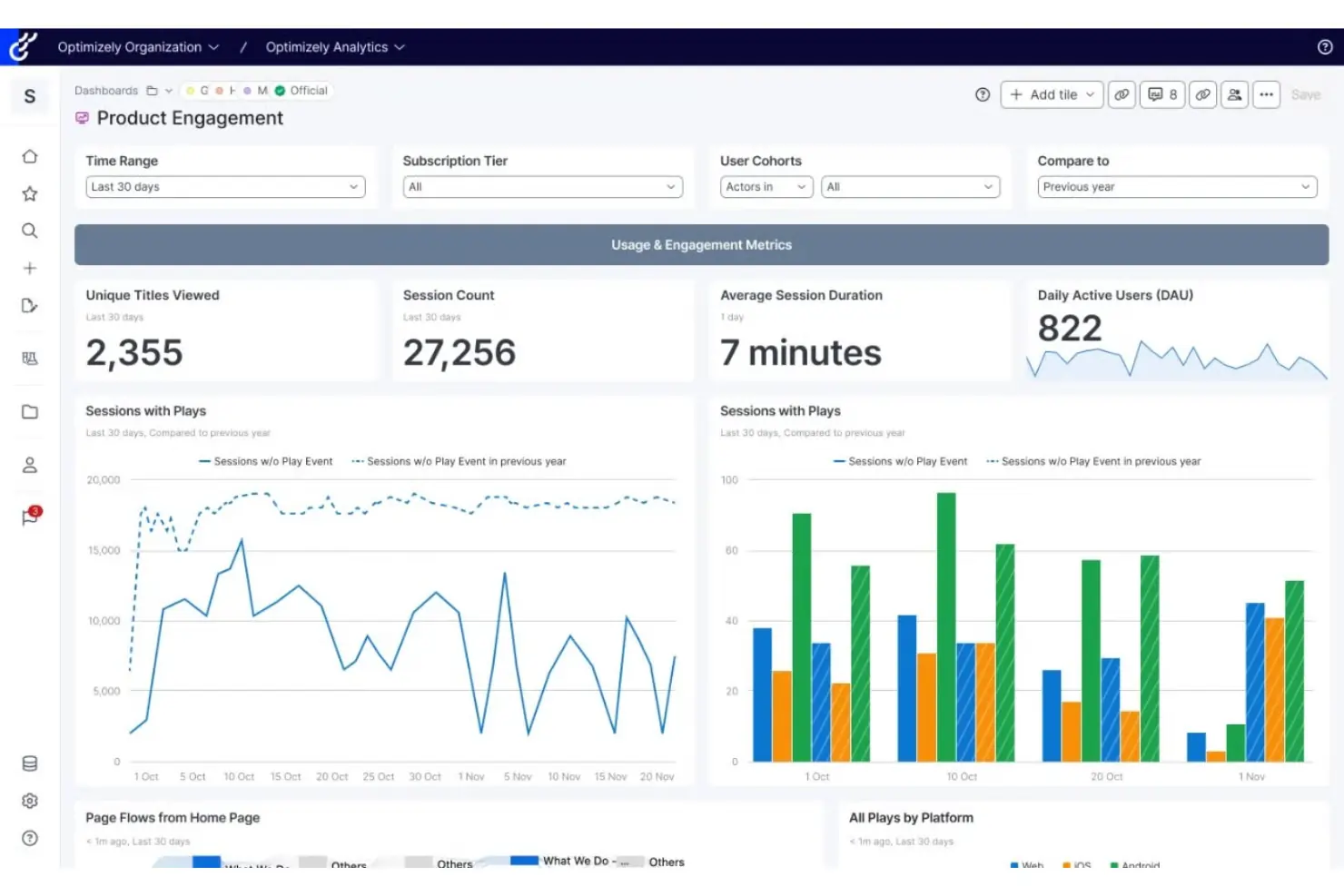
Optimizely is one of the longest-running experimentation platforms, now part of a wider digital experience suite that spans content management, A/B testing, and feature experimentation. It’s built for large teams running structured programs across web and product.
Its Indian presence is the quietest of the tools mentioned here. Optimizely sells into India through enterprise channels. It fits large enterprises with the budget and team to run a mature program.
Key features:
- Web and feature experimentation with server-side testing
- Content management and personalization in one connected suite
- Program tools for managing experiments across large teams
- Statistical engine built for high-traffic, high-volume testing
Here’s every tool in this guide side by side: where it’s built, whether you can pay in rupees, and where it fits. Shortlist from the table, then read the full profile for the detail.
| S/N | Tool | HQ / Founded | Indian-built | Starting price (billed annually) |
Free trial | Best for | |||||||||||||||||||||||||||||||||||
|---|---|---|---|---|---|---|---|---|---|---|---|---|---|---|---|---|---|---|---|---|---|---|---|---|---|---|---|---|---|---|---|---|---|---|---|---|---|---|---|---|---|
| 1 | VWO | New Delhi / 2010 | Yes | Custom, not publicly listed | 30 days | Mid-market to enterprise teams running a steady program in ecommerce, SaaS, travel, and media | |||||||||||||||||||||||||||||||||||
| 2 | Zoho PageSense | Chennai / 2018 | Yes | From ₹480/mo but A/B testing available from ₹1,177/mo | 15 days + free plan | Small to mid-size teams wanting testing bundled with heatmaps and funnels, or those already in the Zoho suite | |||||||||||||||||||||||||||||||||||
| 3 | CustomFit.ai | Bengaluru / 2017 | Yes | From $59/mo (billed in USD, equivalent to ₹5,580/mo) | 14 days | Small to mid-size D2C on Shopify/WooCommerce wanting no-code testing without dev time | |||||||||||||||||||||||||||||||||||
| 4 | FreshMarketer | Chennai, then US / 2015 (as Zarget) | Yes | From ₹1,249/agent/mobut testing is a paid add-on | Yes + free plan | Small teams wanting testing bundled into email and marketing automation | |||||||||||||||||||||||||||||||||||
| 5 | Convert Experiences | Delaware, USA / 2009 | No | From $299/mo (billed in USD, equivalent to ₹28,280/mo) | 15 days | Mid-market to enterprise teams and CRO agencies wanting full-stack testing with flat-rate pricing | |||||||||||||||||||||||||||||||||||
| 6 | Adobe Target | California, USA / 2009 | No | Custom enterprise quote | No | Large enterprises already on Adobe Experience Cloud, testing at scale | |||||||||||||||||||||||||||||||||||
| 7 | Amplitude | San Francisco, USA / 2012 | No | From $49/mo for 300K MTUs (billed in USD, equivalent to ₹4,634/mo) | 30 days + free plan | Product-led teams with engineering testing inside apps, not just web pages | |||||||||||||||||||||||||||||||||||
| 8 | Optimizely | New York, USA / 2010 | No | Custom enterprise quote | No | Large enterprises running mature, structured programs across web and product |
Source: All prices are from each vendor’s official pricing page, billed on an annual basis, retrieved June 2026: VWO (vwo.com/pricing), Zoho PageSense, (zoho.com/pagesense/pricing.html), CustomFit.ai (customfit.ai/pricing), FreshMarketer (freshworks.com/marketing-automation/freshmarketer/pricing), Convert (convert.com/pricing), Amplitude (amplitude.com/pricing), Adobe Target and Optimizely: enterprise quote, no public list price. All currency conversions pulled from in June 2026.
Use these four questions to decide:
What’s your budget, and does INR billing matter?
If predictable rupee pricing is a hard requirement, your real shortlist is short. Zoho PageSense bills in INR with GST; FreshMarketer does too. Several India-built tools don’t: CustomFit charges in USD, and Convert, though built for region-friendly flat-rate pricing, bills in USD as well. So “Indian-built” and “pay in INR” are two separate questions, and the table above answers them separately.
This matters more in India than the headline rate suggests. As Himanshu Gaur puts it:
Indian e-commerce is wildly seasonal. Think Diwali, Big Billion Days, and massive end-of-season spikes.
A USD-overage model literally penalizes you with massive tech bills just because your marketing campaign worked. Having predictable, fixed INR pricing removes the currency exchange anxiety and makes getting CFO approval a hundred times easier.
Himanshu Gaur
How much traffic do you have, and how heavy is the tool?
Most of your buyers are on a phone, often on a patchy connection. A testing script that adds load time or flickers will cost you conversions before the test even runs. Tools built for light scripts and anti-flicker rendering protect the mobile experience, while heavier suites can undercut it.
Does your team have developers?
If engineering sprints are already hijacked by product work, a no-code tool like CustomFit or tools with a visual editor like Zoho, Convert, or VWO keeps testing in marketing’s hands. If you have in-house engineers and test inside an app, a product-led tool like Amplitude fits better.
Are you DTC or SaaS?
DTC brands on Shopify lean toward the no-code, ecommerce-native tools. SaaS teams running server-side experiments need full-stack platforms like Convert or VWO.
Match those four answers against the table above, and the shortlist usually writes itself.
Should Indian Brands Run CRO In-House or Work With an Agency?
It depends on what you can actually staff.
Building in-house works if you can ring-fence the people for it. That means a dedicated strategist, someone who can design the experiences, and developer time that doesn’t get pulled onto product bugs every sprint.
Himanshu is blunt about where this breaks down:
The biggest bottleneck I hear is, “We have ideas, but dev takes three months to build the test”.
Himanshu Gaur
When experimentation competes with the product roadmap for the same engineers, it always loses.
If you can protect that capacity, in-house gives you compounding institutional knowledge. If you can’t, an agency buys you speed. You get a team that ships tests in days, has run the playbook across dozens of brands, and doesn’t wait on your sprint cycle. For most early and mid-stage Indian D2C brands, that trade favors an agency until testing volume justifies a full internal team.
Here’s what that looks like in practice. Himanshu points to OptiPhoenix’s work with SAADAA, a Jaipur-based clothing brand whose mobile traffic from paid social was bouncing before it converted.
The team tested moving trust signals, delivery estimates, and a sticky add-to-cart button to the top of the product page, and pushed the heavy copy into accordions. By his account, the redesign lifted add-to-cart by 14% and checkouts by 8%.
There’s a wider signal worth noting. Indian experimentation is shifting from buying a tool to building a culture around it. In April 2026, Convert and OptiPhoenix ran an in-person experimentation roundtable for Indian D2C brands in Jaipur. Five more cities asked for their own.
The market is ready to stop just buying tools and start building a culture. Founders want actionable playbooks, not another software pitch.
Himanshu Gaur
That maturity is the real context for the in-house-versus-agency question. A few years ago, there was barely an ecosystem to hire into. Now there’s a growing bench of Indian specialists, vetted agencies, and a community forming around the practice, which makes the agency route more credible than it used to be, and the eventual in-house hire easier to find.
How We Evaluated These Tools
We judged every tool on five things that matter specifically to an Indian buyer:
- India availability and INR billing: Whether the tool sells into India, and whether you can actually pay in rupees with GST, rather than only in USD.
- Mobile-first performance: Script weight, anti-flicker rendering, and impact on Core Web Vitals, because most Indian traffic is on mobile devices over a variable connection.
- Pricing transparency: Whether the vendor publishes its prices openly. Every figure here comes from the vendor’s own pricing page, retrieved June 2026. Where a tool hides pricing behind a sales call, we say so.
- Testing depth: Client-side and server-side testing, plus supporting tools like heatmaps and session recordings.
- Fit for lean teams: No-code editors, onboarding, and support, since most Indian D2C teams run testing without a dedicated CRO department.
Where a number came from a practitioner rather than a public source, we’ve attributed it to that person rather than presenting it as independent data.
Zoho PageSense and FreshMarketer both bill in INR with GST invoicing through their Indian entities. Most other tools, including VWO’s published plans, CustomFit.ai, and Convert Experiences, bill in US dollars, though Convert applies GST at checkout based on your billing location. “Built in India” and “billed in INR” are separate questions. Some Indian-built tools still charge in USD.
VWO is Indian-built and headquartered in New Delhi, founded in 2010 by Paras Chopra under the parent company Wingify. Singapore-based Everstone Capital acquired a majority stake in January 2025, and in January 2026, VWO agreed to merge with Paris-based AB Tasty. The merged company stays headquartered in New Delhi with VWO co-founder Sparsh Gupta as CEO, so its product and leadership roots remain Indian under majority private-equity ownership.
For a Shopify D2C brand, a no-code tool that won’t slow a mobile site is usually the strongest fit. CustomFit.ai is purpose-built for Indian D2C on Shopify, with no-code testing and flicker-free rendering, though it bills in USD. Zoho PageSense suits teams wanting INR billing, and Convert Experiences fits brands that need full-stack testing with flat-rate pricing.
A poorly built testing tool can slow a site or cause visible flicker, which costs conversions before a test even runs, and this matters most for India’s mobile-first, often bandwidth-constrained traffic. Lightweight tools with anti-flicker rendering, such as Convert Experiences and CustomFit.ai, are designed to protect Core Web Vitals. Always check a tool’s script weight and anti-flicker method before committing.
Run testing in-house only if you can ring-fence a dedicated strategist, a designer, and developer time that won’t get pulled onto product work. Otherwise, an agency is usually faster, since it can ship tests in days and brings a proven playbook. Most early and mid-stage Indian D2C brands are better served by an agency until their testing volume justifies a full internal team.
Start by picking one high-traffic page, usually a product page or checkout, and one clear metric like add-to-cart or completed purchases. Choose a tool that matches your budget and team, run a single well-formed test to completion, and let results compound from there. Effective experimentation is continuous rather than a one-off fix.


Mobile reading?
Uwemedimo Usa
Conversion copywriter helping B2B SaaS companies grow.

How Was This Blog Written
This article was created by Uwemedimo Usa, Content Writer at Convert, with editorial review by…
How Was This Blog Written
This article was created by Uwemedimo Usa, Content Writer at Convert, with editorial review by…
This article was created by Uwemedimo Usa, Content Writer at Convert, with editorial review by Carmen Apostu, Editor at Convert.
To develop it, we used the following sources of input:
- Interviews with: Himanshu Gaur, CRO at OptiPhoenix
- Primary sources reviewed: Vendor product documentation and official pricing pages (retrieved June 2026); company press releases and TechCrunch reporting on ownership and funding; Tracxn market data; published vendor case studies (Adobe for Tata CLiQ, Amplitude for Disney+ Hotstar/JioHotstar); India’s DPDP Act 2023 and its 2025 implementation rules
- Internal expertise used: Convert research team (fact-checking and source verification)
- AI assistance was used for: Outline generation, summarizing source notes, checking structure, transcribing audio drafts, editing for clarity, and metadata alternatives.
- AI was not used for: Original expert judgment, final recommendations, drafting, statistical claims, source verification, customer quotes, product claims, or final editorial approval.
Every factual claim was reviewed by Ahmed Abbas of the Convert research team. Any claims involving product functionality, pricing, or customer results were checked against each vendor’s official pages and primary-source reporting. The SAADAA experiment figures are attributed to Himanshu Gaur as practitioner testimony rather than presented as independently verified data.
![clip_image012[1]](https://seoservicesguru.net/wp-content/uploads/2026/07/Ecommerce-Category-Page-Design-Best-Practices-Examples-and-Tests-That.jpg)