The industry has been chanting “human-in-the-loop” for three years. Almost nobody built it in.
Human-in-the-loop refers to the practice of maintaining human oversight at critical decision points, so AI outputs can be reviewed, corrected, or redirected when needed. Although the concept became a staple of AI strategies from 2023 onward, many organizations treated it as reassurance rather than a requirement for system design.
Summary
The phrase "human-in-the-loop" appeared in nearly every AI strategy document, keynote deck, vendor pitch, and board presentation over the past few years. Leadership nodded, and procurement was reassured. Yet, teams frequently deployed AI agents without embedding meaningful oversight into their operational workflows.
Today, the difference is becoming clear: the brands seeing the best results are not removing humans from the process. They are intentionally deciding where human judgment adds the most value.
This blog explores why human-in-the-loop should be treated as a core product feature rather than a fallback and how enterprise brands can combine AI speed with human judgment to achieve better business outcomes.
Table of contents
- Summary
- How human-in-the-loop became a talking point instead of a system
- What the latest data says about AI oversight and governance
- Why multi-location brands carry more risk here
- What human-in-the-loop looks like when it is built into the workflow
- Why building human oversight now creates a competitive advantage
- Birdeye is built for agentic scale with human control still intact
- FAQs about human-in-the-loop in AI marketing
- Human-in-the-loop only works if it is built into the system
How human-in-the-loop became a talking point instead of a system
Human-in-the-loop (HITL) originated in machine learning as a practical concept. It described how people improve AI answer engines by reviewing outputs, correcting mistakes, and providing feedback that helps models perform more accurately over time. It was never intended to be a marketing slogan, but rather an operational approach for building more reliable AI.
As generative AI entered the mainstream, the phrase quickly spread beyond technical teams. It appeared in vendor presentations, board discussions, procurement checklists, and AI strategy documents. For many organizations, it became a shorthand for responsible AI, but the rhetoric often outpaced actual implementation.
Instead of asking how human oversight would work, many organizations focused on whether a human was involved at all.
That distinction matters because those are two very different things.
Presence is not the same as practice.
According to Strata.io’s 2026 AI governance guide, many organizations confuse the two. A person might technically be “in the loop,” but without clear responsibilities, escalation paths, or training on when to challenge an AI decision, oversight becomes little more than a checkbox. The guide also warns against automation complacency, where reviewers gradually trust AI outputs without applying enough scrutiny.
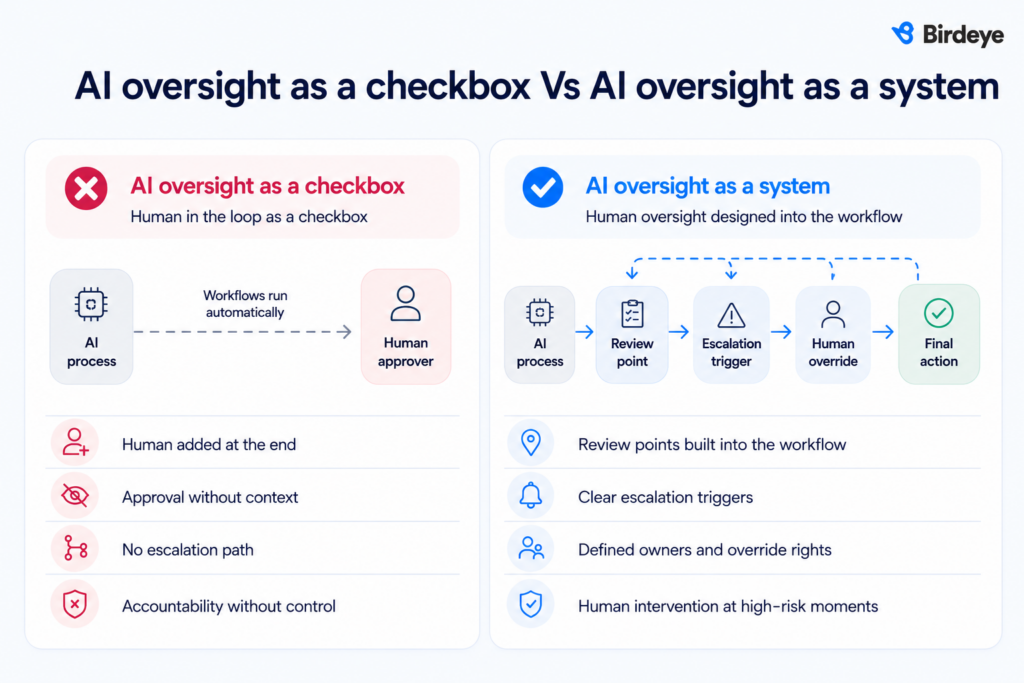
Meaningful oversight requires more than assigning a reviewer to approve AI-generated work. It requires designing decision points where humans have the context, authority, and confidence to intervene when necessary.
When oversight exists only on paper, it simply transfers accountability without giving people the control needed to prevent mistakes. That is also why this is a fixable problem. The industry did not get the principle wrong. It simply allowed the conversation to move faster than the operational discipline could support.
What the latest data says about AI oversight and governance
The conversation around human-in-the-loop has moved beyond theory. Recent research indicates that organizations treating governance as an afterthought are more likely to struggle with AI at scale.
The evidence comes from three different directions:
First, project success. In June 2025, Gartner predicted that more than 40% of agentic AI projects will be cancelled by the end of 2027. It noted that many initiatives remain driven by hype rather than practical business value, with poor risk controls identified as one of the key reasons projects fail. The challenge is no longer proving that AI can work. It is building the governance needed to deploy it reliably across the enterprise.
Second, customer trust. Klaviyo’s 2026 AI Consumer Trends research, based on a December 2025 survey of 8,000 consumers across eight countries, found that 32% of consumers said visible AI-generated marketing reduced trust in a brand, while only 7% said it increased trust.
The message is clear. Customers judge the experience they receive, not the technology behind it. AI-generated mistakes, inconsistent messaging, or impersonal interactions can quickly erode confidence, even when the underlying automation performs as intended.
Finally, governance itself. Gartner’s 2026 Market Guide for Guardian Agents makes perhaps the most important observation for marketing leaders. As VP Distinguished Analyst Avivah Litan explains:
“The rapid acceleration and increasing agency of AI agents necessitates a shift beyond traditional human oversight. As enterprises move towards complex multi-agent systems that communicate at breakneck speed, humans cannot keep up with the potential for errors and malicious activities.”
What Litan is saying is not that human oversight is optional. It is that relying on humans to catch everything at the speed AI agents operate is an inadequate design. Oversight has to be built into the system through guardrails, escalation rules, and decision points that allow humans to intervene where their judgment has the greatest impact.
Why multi-location brands carry more risk here
For a single business, an AI mistake may affect one customer interaction. For a multi-location brand, the same mistake can be repeated hundreds or thousands of times before anyone notices. This multiplier effect makes human-in-the-loop oversight increasingly vital as AI deployments scale.
Three realities make human oversight essential:
1. Scale multiplies mistakes, not just outputs
When an AI agent is deployed across hundreds of locations using the same instructions, a flaw is replicated just as efficiently as a success. A poorly written prompt, an incorrect policy, or an inappropriate response does not stay isolated. It is repeated across every location using that configuration until someone intervenes.
2. Local context cannot always be inferred by AI
Every location has circumstances that are difficult to capture in data alone. A store may be dealing with a staffing shortage, a franchise dispute, a local event that attracted negative publicity, or a temporary service disruption. These situations shape how a brand should communicate, yet they may not be visible to an AI agent. Human-in-the-loop (HITL) judgment provides the context to pause, approve, or adjust automated actions before they reach customers.
3. Regulated industries have little room for error
For healthcare, dental, financial services, legal, and senior living organizations, AI decisions can affect customer trust, compliance, and business reputation. They can increasingly affect regulatory obligations. For example, Article 14 of the EU AI Act requires high-risk AI platforms to include mechanisms that enable effective human oversight, with key provisions applying from August 2026. Human review is no longer just a best practice. In many cases, it is becoming an expectation built into AI governance.
For multi-location organizations, the challenge is not deciding whether to keep humans involved. It is deciding where their judgment has the greatest impact before AI operates at enterprise scale.
What human-in-the-loop looks like when it is built into the workflow
If human-in-the-loop is a design principle, what does it look like in practice?
According to the FP&A Trends 2026 governance guide, human oversight should be built into an AI agent’s architecture from the beginning, not added after deployment. That means designing three mechanisms into every workflow: approval gates, escalation triggers, and override protocols.
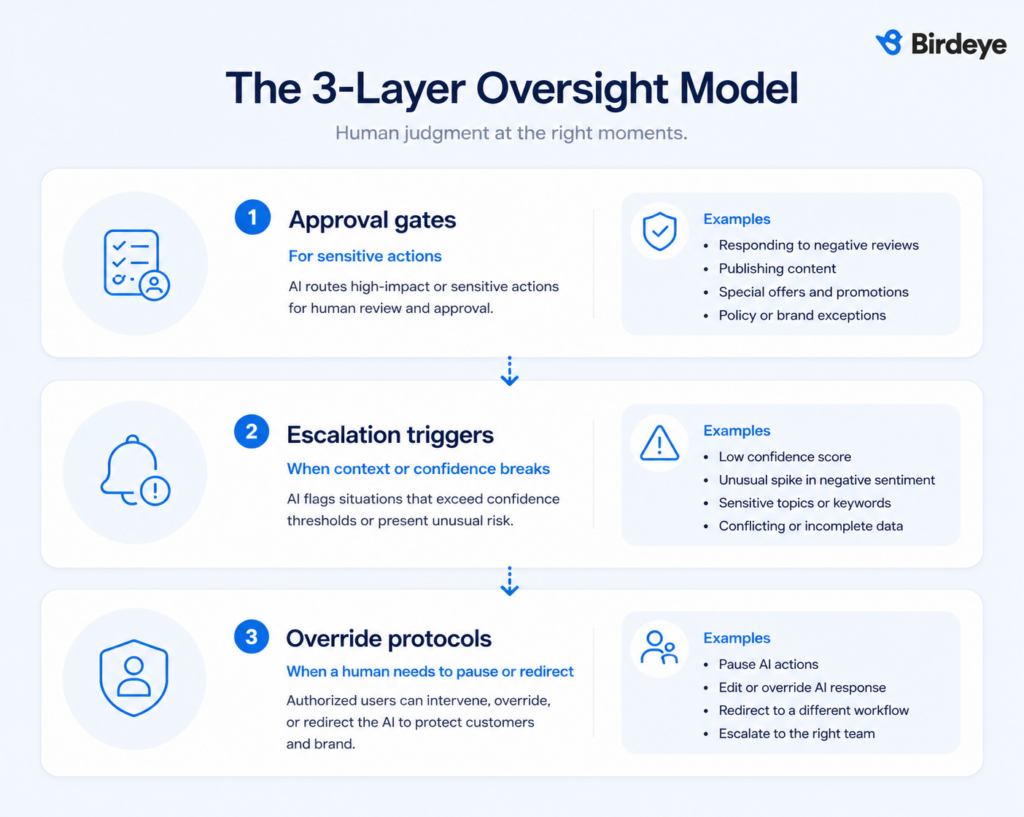
Approval gates
Not every AI-generated action requires human review. The goal is to identify the moments where autonomous action creates unnecessary risk.
For a multi-location brand, approval gates are most valuable for situations such as:
- Crisis or reputation-sensitive responses
- Customer complaints above a defined sentiment threshold
- Content for regulated industries such as healthcare or financial services
- Communications from locations already flagged for operational or reputational issues
What matters is that someone is clearly responsible for reviewing the action before it reaches the customer.
Escalation triggers
AI should also know when not to act.
Escalation triggers are predefined conditions that tell the system to pause and request human input. Examples include:
- An unusual spike in negative reviews at one location
- Legal terminology in a customer message
- Content that may be culturally or locally sensitive
Instead of guessing, the agent should route the task to the right person.
Override protocols
Finally, every AI deployment needs a steering wheel.
Override protocols define who can pause, redirect, or stop an agent when circumstances change. They ensure teams can respond quickly without shutting down every automated workflow across the organization.
This is where governed agentic platforms differ from basic AI tools. Rather than retrofitting human review after deployment, these platforms embed approval workflows, escalation paths, and operational controls directly into the system. For enterprise brands, that distinction determines whether AI operates autonomously or responsibly.
Once those controls exist, human-in-the-loop stops being a brake on AI adoption. It becomes part of the operating model that allows AI to scale safely.
Why building human oversight now creates a competitive advantage
The strongest case for human-in-the-loop is no longer risk reduction. It is the creation of a competitive advantage.
As agentic AI becomes standard across marketing, speed alone stops being a differentiator. Most brands will be able to automate content generation, review responses, campaign execution, and customer interactions. True market differentiation will come from brands that can scale those systems without losing trust, consistency, or control.
Human oversight creates competitive advantage in three ways:
1. Helps brands scale AI faster and with less internal resistance
Gartner’s research on agentic AI suggests that organizations that treat risk controls and oversight as afterthoughts are more likely to stall, cancel, or constrain AI deployments as complexity increases. In practice, that means brands with stronger governance can keep expanding AI use cases while competitors are still stuck resolving exceptions, rebuilding trust, or adding controls after something goes wrong.
2. Reduces the operational drag caused by preventable mistakes
AI can move quickly, but one poor response, off-brand campaign, or inaccurate customer interaction can trigger reviews from legal, compliance, and leadership. Teams with built-in review points, escalation triggers, and clear ownership spend less time firefighting and more time improving performance. Over time, that creates a real speed advantage.
3. Makes automation sustainable at scale
Machine Learning Mastery’s 2026 analysis points to a more durable model for enterprise agentic adoption: AI execution supported by guardrails and human judgment at key moments. The goal is not to slow automation down. It is to create a system the business trusts enough to keep scaling across channels, teams, and workflows.
This way, human oversight stops being a compliance exercise. It becomes part of how a brand protects quality, maintains momentum, and gets more value from AI than competitors who optimized only for speed.
Birdeye is built for agentic scale with human control still intact
If human-in-the-loop is going to work at enterprise scale, it cannot live outside the platform. It has to be part of how the system operates. That is especially true for multi-location brands managing reviews, listings, social, AI search visibility, and customer interactions across hundreds and thousands of locations.
Birdeye gives enterprise teams AI coworkers at every location- Jay, Myna, and Robin that employ specialized AI agents while retaining complete oversight, permissioning, and tiered approvals.
Instead of managing fragmented point solutions, enterprise teams can manage their entire multi-location marketing workflows through governed agents that combine execution with human control. In practice, that looks like this:
Review Response Agent
When a customer leaves a review, Birdeye’s Review Response Agent interprets the text for sentiment, intent, and urgency. It applies Brand AI and Industry AI context to draft a tailored response that aligns with the business’s tone.
Where humans stay in the loop: The response does not have to go live automatically. Teams can configure the workflow so agents can route the drafts to an approval queue, where local staff or central teams can review, edit, and approve the response before it is published. This turns a time-consuming writing task into a simple approval step.
Listings Optimization Agent
Birdeye’s Listings Optimization Agent monitors businesses’ digital profiles across platforms such as Google, Apple, Yelp, and 100+ listing sites to identify inconsistencies and surface optimization opportunities.
Where humans control the change: Instead of making uncontrolled live edits, the agent can surface field-level recommendations for review. Local managers or corporate teams can approve updates before changes are pushed across the listings ecosystem.
Social Publishing Agent
Birdeye’s Social Publishing Agent identifies relevant content opportunities and helps create localized social calendars across locations. This reduces the manual work involved in planning and publishing at scale.
Where humans approve what gets published: The built-in approval workflows allow marketing teams to review upcoming posts before they go live. Managers can approve content individually or in bulk, keeping execution efficient without sacrificing control.
Social Engagement Agent
Managing comments and direct messages across hundreds and thousands of locations can quickly become unmanageable. Birdeye’s Social Engagement Agent helps by screening comments, filtering spam, and drafting contextual replies to prospective customers.
Where human oversight comes in: To safeguard brand compliance, replies generated by the social engagement agent can be routed through approval workflows before publishing. Higher-intent or more complex interactions can be escalated to human team members with the full context attached.
The same principle extends across Birdeye’s wider agent ecosystem, including agents for review generation, lead generation, audience segmentation, template design, reporting, and more.
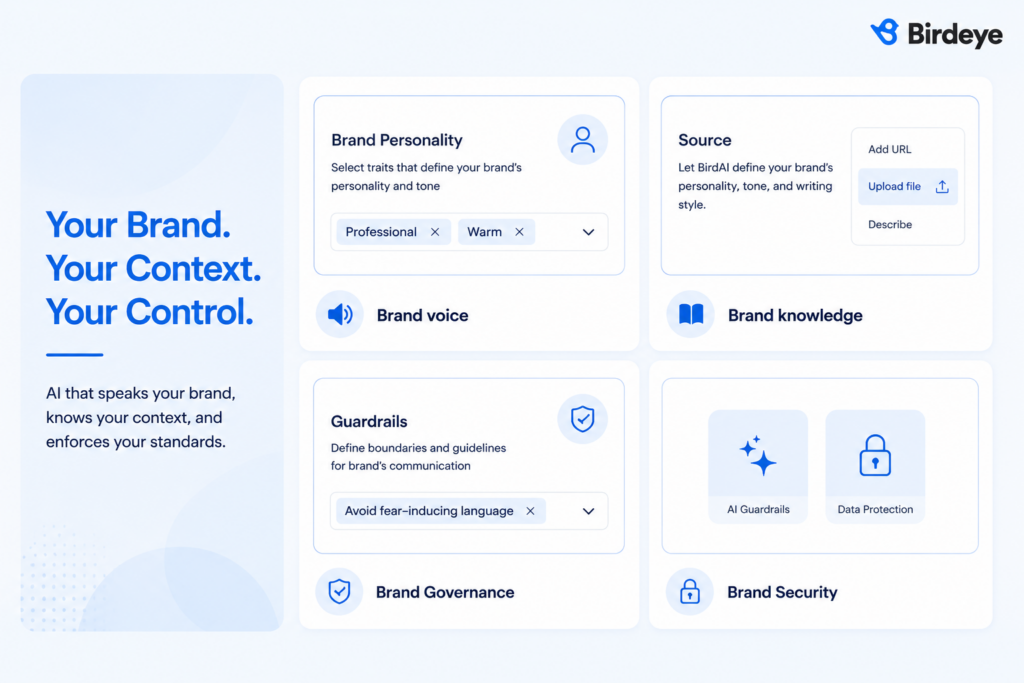
Birdeye’s model reflects the real requirement of enterprise AI adoption: Use AI agents to increase speed and scale, while keeping the governance architecture needed to review, approve, pause, or redirect activity when human judgment is required.
That is what makes human-in-the-loop a feature rather than a fallback.
FAQs about human-in-the-loop in AI marketing
Human-in-the-loop means keeping people involved at key points in an AI workflow where judgment, review, or intervention is needed. In marketing, that usually applies to sensitive responses, regulated content, or situations where AI lacks enough context to act safely on its own.
Agentic AI can make decisions and take action with less human input, which increases both speed and risk. Human-in-the-loop helps brands decide where AI can act independently and where a person should review, approve, or override the action.
Manual approval means a person reviews work before it goes live. Human-in-the-loop is broader. It includes approval gates, escalation triggers, and override controls that define when and how people step into the workflow.
No. Approval is one control. Real governance also includes escalation, permissioning, audit trails, and exception handling.
Multi-location brands operate at a scale where one AI mistake can be repeated across hundreds of locations before anyone notices. They also deal with local context, operational issues, and reputational risks that a generalized AI system may not fully understand.
Human-in-the-loop only works if it is built into the system
Before your next agent deployment, ask three questions: What are the approval gates? What are the escalation triggers? Who holds the override? If those answers do not exist yet, the problem is not the technology. It is the design.
The industry got the principle right early. Human-in-the-loop was never the wrong idea. What most organizations failed to do was turn it into a working system with clear controls, responsibilities, and intervention points.
The brands that will win from here are not the ones talking most confidently about autonomous AI. They are the ones finally building the systems to support it.
If you are evaluating how to scale agentic marketing with built-in governance, request an enterprise demo of Birdeye to see how approval workflows, brand guardrails, and human oversight can work at multi-location scale.

The post The industry has been chanting “human-in-the-loop” for three years. Almost nobody built it in. appeared first on #1 Agentic Marketing Platform for Multi-Location Brands.