This is clear evidence that experimentation is now a core part of modern growth strategies.
With competition increasing, continuously testing product pages, promotions, and checkout flows is essential, not optional.
But with countless platforms offering similar capabilities, determining the right A/B testing tool can be challenging.
This guide compares the best A/B testing tools for eCommerce businesses in 2026, helping you to choose a platform that supports continuous experimentation and drives measurable growth.
Even small changes to the experience can greatly influence eCommerce conversions. Testing tools let teams test different product pages, navigation flows, promotions, and checkout experiences while tracking how real users react. Some of the main benefits are:
1. Boost conversion rates
A/B testing helps teams validate changes that directly influence purchases. Experiments can compare variations such as:
Product images or descriptions
“Add to Cart” button placement or design
Pricing displays or discount messaging
Checkout layouts
Teams can determine which changes actually drive more purchases or engagement by examining test results and statistical significance.
2. Understand customer behavior at scale
Conversion optimization depends on understanding how shoppers actually interact with an online store.
Behavioral analytics tools like heatmaps, session recordings, and funnel analysis are included in many testing platforms. These tools show where visitors leave or hesitate during the buying process.
These insights help teams identify friction points before launching new experiments.
Teams often rely on ideas like “we should change this” or “we should add new products,” but the most effective way to move forward is to test those assumptions. What teams really need is proof of concept backed by data, so every change is measured against its actual impact and aligned with business goals, rather than implemented on instinct.
Cameron Calder, Founder at Hype Digital (Source: VWO Podcast)
3. Support continuous experimentation across teams
For businesses already running experimentation programs, A/B testing tools provide the infrastructure to run multiple tests, analyze test performance, and scale conversion rate optimization efforts across the entire eCommerce store without disrupting site performance.
Non-technical users can quickly start experimenting with features such as visual editors, audience segmentation, and client-side testing. Product and engineering teams can use server-side testing and feature flags to test backend changes.
4. Continuously remove friction from the buying journey
eCommerce growth often comes from improving small moments across the purchase path.
Over time, these improvements lead to smoother journeys and higher rates of purchase completion.
Explore which elements you should A/B test to remove friction and maximize your eCommerce store’s performance.
5. Increase ROI from existing traffic
Acquiring traffic is expensive. A/B testing helps eCommerce businesses generate more value from the visitors they already have.
Even small improvements to product pages, promotions, or CTAs can increase average order value, conversion rates, and customer lifetime value, delivering compounding gains over time.
VWOAB Tasty
Dynamic Yield
Convert Experiences
Kameleoon
Omniconvert
Shogun
Unbounce
Sr. No.
Tool Name
Features
Pricing
1
VWO AB Tasty
Advanced audience and behavior targeting, segmentation, personalization, multi-armed bandit testing, mutually exclusive campaigns, flexible test triggers, built-in code editor, editable statistical parameters, continuous experiment health checks, guardrail metrics, in-app commenting for cross-team collaboration, seamless integrations with 40+ platforms, and scalable capabilities for project management and behavioral analysis.
Available on request
2
Dynamic Yield
Multi-touch campaigns, multi-armed bandit testing, server-side capabilities, feature experimentation, segmentation, and seamless workflow for personalization
AI-powered targeting, widgets studio, multi-armed and contextual bandit algorithms, segmentation with 45+ native criteria, AI-personalization, 30+ integrations with 3rd party analytics, CRM, CDP, CMS, etc.
A/B testing plans starting from $112/month, billed annually.
1. VWO AB Tasty
VWO AB Tasty is an end-to-end experimentation platform that enables eCommerce businesses to run A/B tests, multivariate tests, split URL tests, and feature tests across web, mobile, and server-side environments. It helps teams analyze visitor behavior, uncover insights, and optimize digital experiences while delivering personalized experiences for specific audience segments.
Powered by its Bayesian SmartStats engine, VWO ensures reliable experiment results and faster decision-making.
The platform’s AI capabilities help automate key tasks of the experimentation process, including idea generation, variation creation, targeting, and report segmentation.
Noteworthy features
Product & checkout optimization → test pricing, layouts, trust signals, shipping info, and flows
Revenue-driven metrics tracking → track revenue per visitor (RPV), AOV, add-to-cart rate, and conversions
Behavioral insights → heatmaps, session recordings, and funnels to identify friction points
Audience targeting & segmentation → based on behavior, device, traffic source, and user intent
Server-side testing → experiment with pricing, discount logic, and backend features
Others: A/B testing, multivariate testing, split URL testing, adaptive traffic allocation, mutually exclusive campaigns, built-in code editor, voice-of-the-customer surveys, real-time reporting with guardrails, integrations with 40+ tools, and collaboration features.
Pricing
It varies by the number of monthly tracked users (MTU) and platform. Visit VWO’s pricing page for detailed plans. You can request a demo to see how the platform works and supports your eCommerce business.
Pros & Cons
Pros
Cons
Behavioral insights connect qualitative and quantitative data, while flexible targeting enables tailored tests based on traffic source, device type, or user behavior.
Lacks native merchandising or recommendation engine
Dynamic Yield is an enterprise-grade experience optimization platform that combines personalization with experimentation for large digital businesses. Alongside its omnichannel personalization capabilities, it enables teams to run A/B, multivariate, and split URL tests across web, mobile, and email experiences, with support for both client-side and server-side experimentation.
Its centralized Experience OS helps teams collect and activate customer data in one place, making it easier to run experiments and optimize user experiences across the customer journey.
Noteworthy features
Omnichannel experience orchestration
Multi-armed bandit testing
Server-side capabilities and feature experimentation
Segmentation and predictive targeting
AI decision engine (AdaptML)
Product recommendations and personalization
Performance analytics and reporting
Pricing
Pros & Cons
Pros
Cons
A/B and multivariate testing capabilities support continuous optimization, while seamless integrations with the tech stack simplify workflows.
Requires a strong data setup and resources to fully leverage personalization capabilities
3. Convert Experiences
Convert Experiences is a platform for running and analyzing experiments across the eCommerce customer journey. It offers an affordable full-stack solution that supports A/B, multivariate, split, multipage, and full-stack experiments, enabling teams to validate frontend and backend changes through server-side testing.
With feature flags and advanced segmentation, teams can test product updates and checkout changes on web platforms without compromising site performance or data privacy.
Noteworthy features
Visual editor
Code editor
Advanced audience targeting with 40+ filters
Multi-page personalization
Dynamic content personalization
Post segmentation
Customization
Unified QA overlay
AI Wizard
Pricing
A 15-day free trial is available.
Paid plans start at $299/month, billed annually.
Pros & Cons
Pros
Cons
The platform integrates easily with analytics tools and supports robust testing programs.
Native integrations with behavioral analytics tools, such as heatmaps and session recordings, are missing.
4. Kameleoon
Kameleoon is an experimentation and personalization platform that enables eCommerce teams to run A/B, multivariate, and split URL tests across web, mobile, and server-side environments, all within a single unified platform.
Its prompt-based experimentation allows teams to quickly generate ideas, build tests, and launch experiments without heavy developer involvement.
Noteworthy features
AI-powered targeting and personalization
Product recommendations and journey-based optimization
Multi-armed and contextual bandit algorithms
Segmentation with 45+ targeting criteria
Feature flags and server-side experimentation
Integrations with analytics, CRM, CDP, and CMS tools
Pricing
Starts at $495/month.
Custom plans are available.
Pros & Cons
Pros
Cons
A/B tests can be launched without developer support using the visual editor, while the PBX tool enables more complex experimentation.
Relies on third-party tools for behavior analysis rather than offering native capabilities.
5. Omniconvert
Omniconvert is a digital experience optimization platform built for direct-to-consumer (D2C) brands looking to improve customer journeys across acquisition, conversion, and retention. It supports A/B, split URL, and stack testing on web platforms, enabling teams to experiment with and optimize user experiences. Through its Reveal product, teams can segment customers using RFM analysis, track lifetime value, and identify patterns in retention and revenue.
Noteworthy features
A/B testing and split URL testing
Visual editor and code editor
Advanced segmentation and targeting
Cohort analysis and RFM-based customer segmentation
Customer lifetime value (LTV) tracking
Surveys and feedback collection
Google Analytics integration
Multi-device testing
Pricing
Pros & Cons
Pros
Cons
The visual editor enables real-time changes without developer support, speeding up the CRO process.
Advanced targeting and personalization features come with a slight learning curve.
6. Shogun
Shogun A/B testing is designed for Shopify merchants who want to run experiments quickly without relying on developer support. It supports A/B testing on web storefronts, allowing teams to launch experiments across themes, product pages, and collections directly within the Shopify admin.
Its native integration enables faster test setup and execution, making it easier to validate design, content, and layout changes at scale.
Noteworthy features
A/B testing for Shopify storefront pages
Visual editor for creating variations
Audience segmentation
Goals and reporting
Integration with Shopify themes and sections
AI features for the Shopify section building
Pricing
A/B testing features start at $39/month.
A free starter plan is available.
Pros & Cons
Pros
Cons
Enables reliable testing and homepage scheduling for BigCommerce, with growing capabilities in segmentation and personalization.
Limited to Shopify and BigCommerce
7. Unbounce
Unbounce is a conversion-focused landing page builder that integrates testing directly into its design workflow. It supports A/B and multivariate testing on web pages, making it ideal for eCommerce brands running paid media campaigns that need to quickly build, test, and optimize dedicated landing pages without developer support.
Noteworthy features
Drag-and-drop (WYSIWYG) page builder
A/B testing for landing pages
Smart Traffic (AI-based visitor routing)
Conversion tracking and goal measurement
Integrations with marketing and analytics tools
Performance insights and reporting
Pricing
A/B testing plans starting from $112/month, billed annually.
Pros & Cons
Pros
Cons
The intuitive drag-and-drop builder lets teams quickly create conversion-optimized pages without coding, while A/B testing helps deliver more targeted experiences.
Some limitations when working with pre-built Unbounce templates.
Choosing the right A/B testing tool for eCommerce comes down to whether it can support continuous improvements across product pages, checkout, and promotions.
1. Multi-campaign experimentation
eCommerce teams often need to test changes across product pages, checkout flows, and promotional banners simultaneously.
A robust experimentation platform should support A/B testing, multivariate testing, and split URL testing so teams can evaluate different versions of layouts, product images, copy, or CTAs to identify what drives the most conversions.
The ability to run multiple experiments simultaneously, with safeguards such as mutual exclusion, ensures that campaigns do not conflict with one another.
2. Integration capabilities
Integrations with eCommerce platforms such as Shopify, WooCommerce, or Magento make it easier to deploy experiments directly on product pages, carts, and checkout flows.
Integrations with analytics, CRM, and marketing tools also help connect experimental results to key business metrics such as revenue per visitor, average order value, and customer lifetime value, enabling teams to evaluate the true impact of optimization efforts.
3. Reporting and analysis
Experimentation platforms should provide dashboards that highlight metrics such as improvement in conversion rate, revenue impact, and the probability that a variation outperforms others. Post-test segmentation enables teams to break down results by audience groups, traffic sources, device types, or behavior, uncovering deeper insights into how different segments respond to each variation.
4. Personalization
Tools that combine A/B testing with personalization help teams to tailor experiences based on visitor attributes such as location, device, browsing behavior, or purchase history, improving relevance and engagement.
For example, returning customers may see personalized product recommendations, while new visitors might see onboarding offers or first-time discounts. This ensures that shoppers encounter more relevant content and promotions throughout their buying journey.
5. Visual WYSIWYG editor
A visual editor allows marketers and growth teams to create and modify test variations without relying heavily on developers. This significantly reduces implementation time and accelerates experimentation cycles.
6. Advanced segmentation and targeting
Effective experimentation depends on delivering the right variations to the right users. Advanced targeting capabilities enable tests to be segmented by traffic source, device type, geography, visitor behavior, or customer segments.
7. Technical support
Reliable technical support is critical, especially for teams running large experimentation programs. Access to responsive support, documentation, and onboarding assistance ensures teams can troubleshoot issues and maintain experiment velocity.
8. Pricing flexibility
Pricing models should align with your traffic volume and experimentation maturity. Many platforms price based on monthly tracked users, experiment volume, or feature tiers, so it’s important to choose a solution that scales with your growth.
9. Statistical models
The best software shouldn’t just give you a “winner” in 24 hours; it should use rigorous Bayesian or Frequentist engines that account for the “long game” of eCommerce seasonality.
10. AI-based features
AI-powered capabilities can make a real difference by helping teams run experiments faster, reduce manual effort, and scale optimization more easily.
AI is already reshaping experimentation by helping teams move faster, whether it’s generating ideas, writing code, or understanding what needs to be tested. Tools like GPT and similar AI platforms can support everything from inspiration to partial implementation, reducing the time it takes to build and launch experiments. As a result, AI is set to play a crucial role in making experimentation more efficient and scalable.
Anirban Chakraborty, Founder at ConvertPolo (Source: VWO Podcast)
The right setup depends on your experiment’s goals and what you want to test. Integrating an A/B testing tool into an eCommerce stack usually follows three paths: client-side, server-side, or native platform integration.
1. Client-side integration
This is the most common integration method for eCommerce. It uses a JavaScript “snippet” to modify the store’s front end in the visitor’s browser to dynamically modify page elements for different test variations.
Implementation steps:
Add the testing tool’s (e.g., VWO) JavaScript snippet to the section of your store.
Enable asynchronous loading to prevent page-load delays, though most modern tools are optimized to reduce flicker when rendering test variations.
Define conversion goals such as Add to Cart clicks or Thank You page visits in the tool’s dashboard.
Server-side integration occurs before the page is even sent to the user’s browser. This requires an SDK (Software Development Kit) or API connection.
Implementation steps:
Install the experimentation tool’s SDK (e.g., for Node.js, Python, or PHP) directly into your store’s backend code.
When a user requests a page, the backend application uses the SDK to determine which experiment variation the user should see before the page is generated.
The SDK or API sends backend events, like completed transactions, directly to the testing tool for analysis.
Best for testing:
Pricing strategies
Checkout logic
Search or recommendation algorithms
Performance-sensitive features
3. Platform-specific native apps
For Shopify and BigCommerce users, many tools offer native apps that automate the integration process.
Implementation steps:
Download and install the tool directly from the Shopify or BigCommerce app marketplace.
The app automatically injects the necessary scripts and tags and identifies standard eCommerce events such as view_item or add_to_cart.
Some tools, like Shogun, allow you to create A/B tests directly within your page-builder interface without ever touching the code.
VWO supports integrations with a wide range of analytics platforms, CMS tools, eCommerce systems, and customer data platforms, making it easier to connect experimentation with your existing tech stack. Explore the full list of eCommerce integrations VWO offers.
Running experiments is only useful if the right metrics are tracked. The following KPIs help determine whether an experiment truly improves store performance.
1. Conversion rate
Conversion rate measures the percentage of visitors who complete a desired action, such as making a purchase or adding a product to the cart. It is one of the most direct indicators of whether a test variation improves the shopping experience.
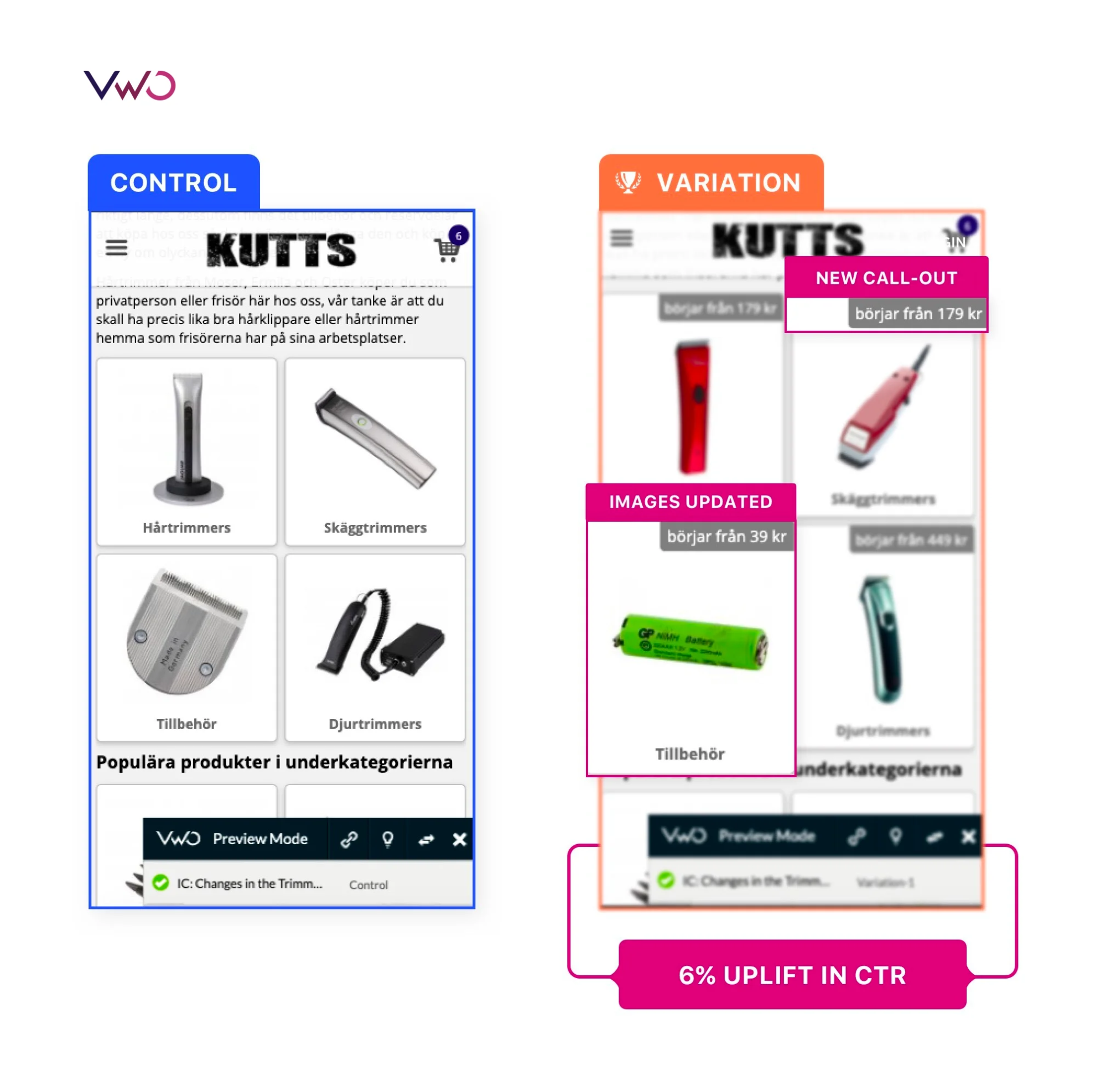
Example: Swedish grooming brand Kutts improved its eCommerce conversion rate by 6% using VWO Testing, optimizing category page layouts and adding pricing callouts that drove more clicks and purchases.
2. Average order value (AOV)
Average order value tracks how much customers spend per transaction. Experiments on product recommendations, bundles, pricing displays, or promotions can significantly influence this metric.
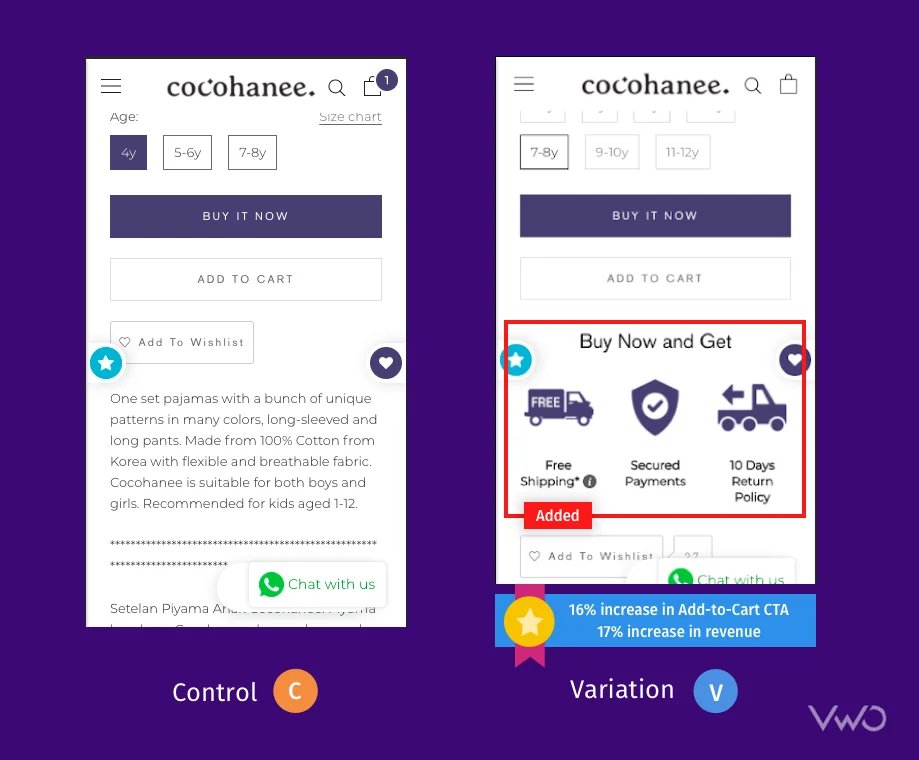
Example: Kidswear brand Cocohanee used VWO to test key UX improvements, including displaying shipping details and simplifying navigation. These changes not only improved conversions but also led to a 17% increase in average order value (AOV) and higher engagement and transaction volume.
3. Revenue per visitor (RPV)
Revenue per visitor combines conversion rate and average order value into one metric, making it easier to understand the true revenue impact of your experiments.
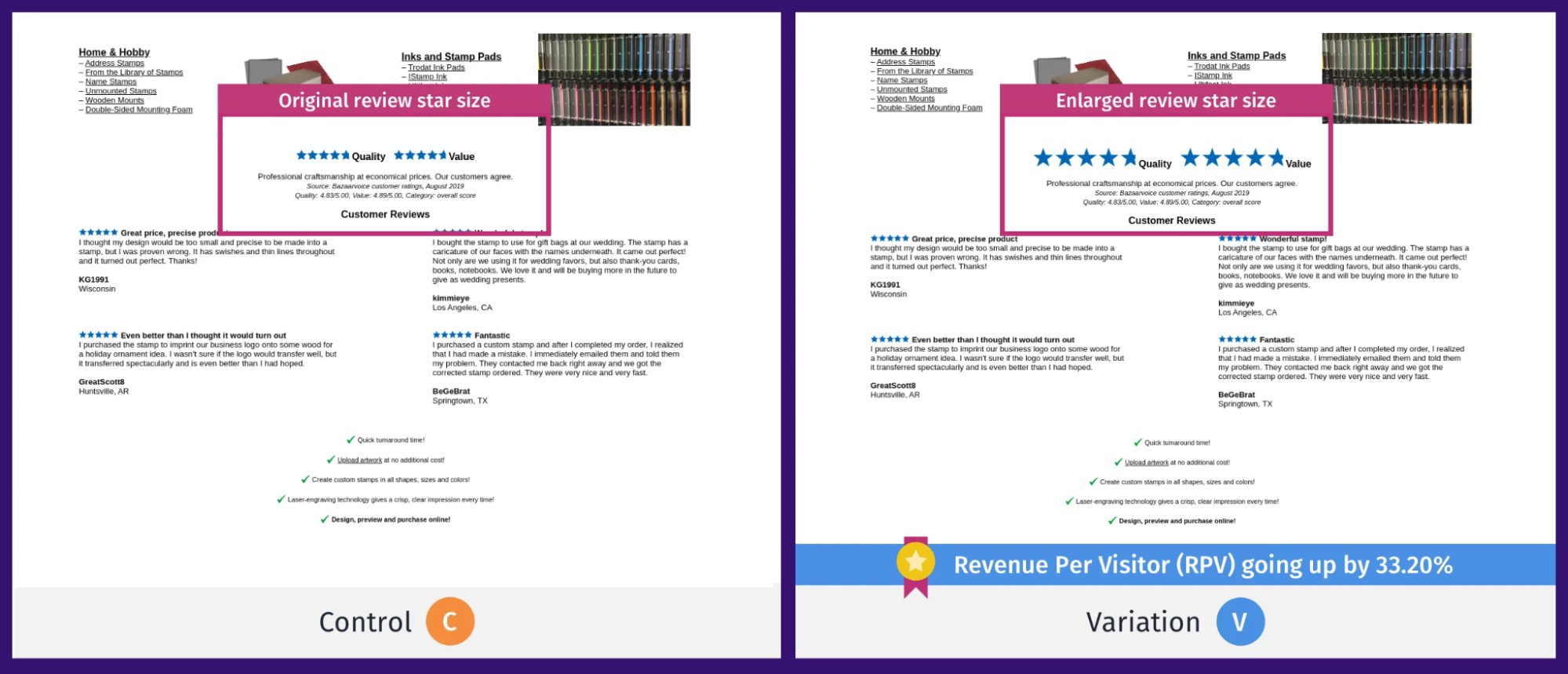
Example: Custom stamp retailer RubberStamps.net found its revenue per visitor (RPV) was low because positive homepage reviews appeared below the fold and were rarely seen. By testing larger review star ratings above the fold with VWO, the brand achieved a 33.2% increase in RPV, a 6.1% lift in conversion rate, and a 25.6% increase in average order value.
4. Cart abandonment rate
Cart abandonment tells you how many shoppers get as far as adding items to their cart but leave before buying. Testing checkout design, shipping messaging, or payment options can help reduce this rate.
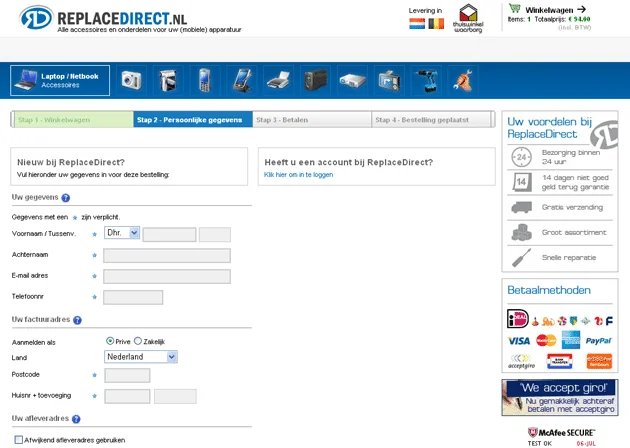
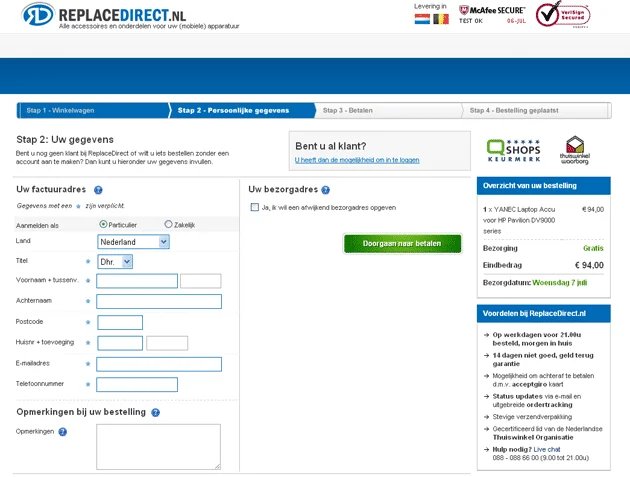
Example: Dutch eCommerce retailer ReplaceDirect found that many shoppers abandoned their carts due to uncertainty around final costs. Using VWO, the team tested a simplified checkout with a clear order overview and fewer form fields. The redesign reduced cart abandonment by 25% and increased total sales by 14%, without any additional marketing spend.
Replace Direct – Control
Replace Direct – Variation
5. Checkout completion rate
This KPI tracks the percentage of users who successfully complete checkout after beginning the process. Improvements in form design, trust signals, or payment flow can positively impact this metric.
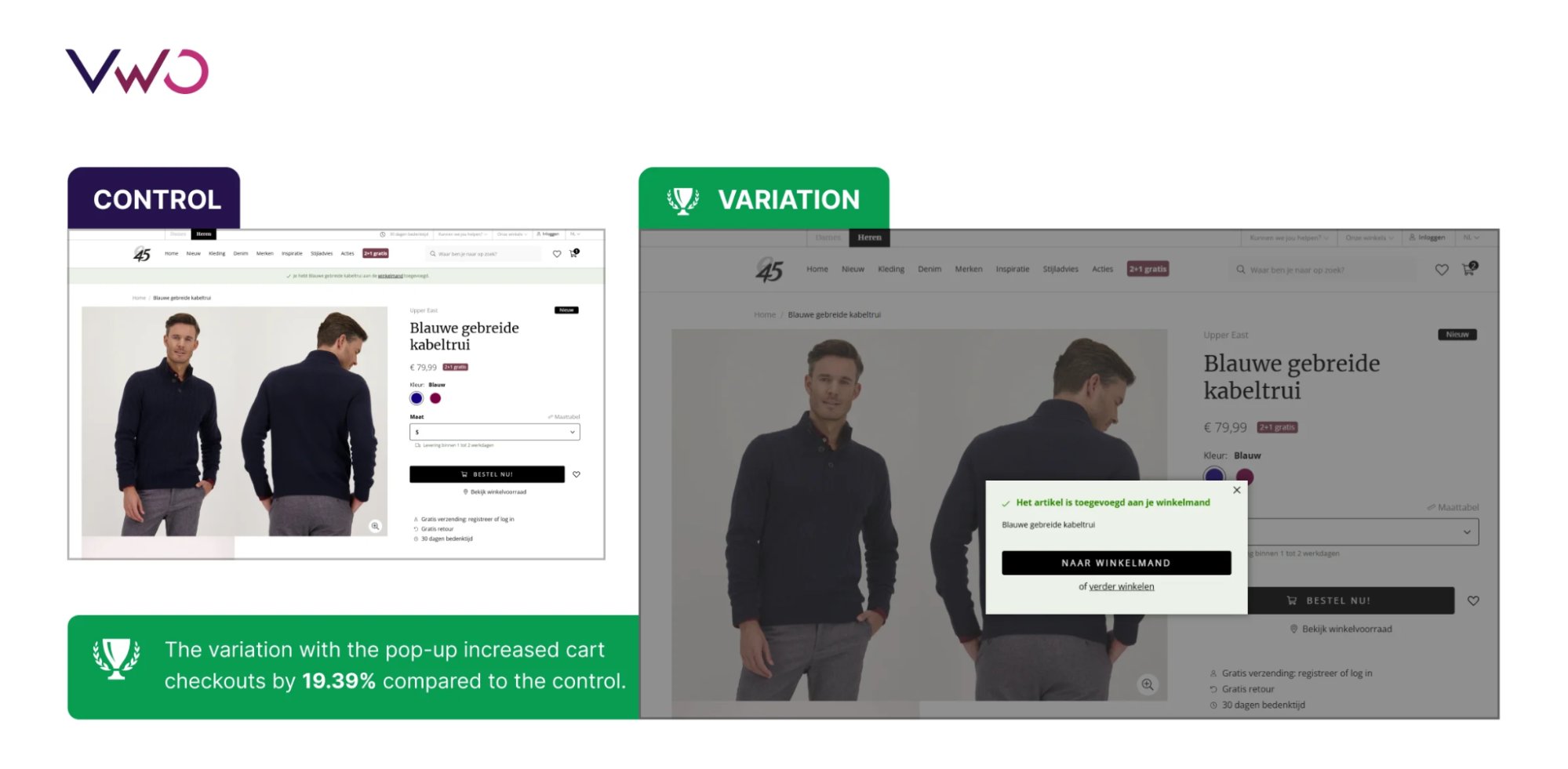
Example: Digital marketing agency Us utilized VWO to help eCommerce brand e5 replace a subtle add-to-cart notification with a prominent pop-up confirmation. This simple adjustment clarified the user journey, resulting in improved checkout progression and a 19.39% increase in checkout completion rate.
6. Customer lifetime value (CLV)
Customer lifetime value estimates the total revenue a customer generates over time. Some experiments, such as loyalty programs, subscription offers, or post-purchase experiences, can influence long-term value beyond the initial transaction.
7. Click-through rate (CTR)
Click-through rate measures how often users click on specific elements such as product recommendations, banners, or promotional offers. It helps evaluate engagement with different design or messaging variations.
Example: Digital agency Trinity Insight tested a redesigned “buy box” for its client, Taylor Gifts, placing key purchase information closer to the add-to-cart CTA. Using VWO to run the experiment across thousands of dynamic product pages, the improved layout helped shoppers make quicker decisions and led to a 10% increase in click-through rate (CTR) for the add-to-cart button.
Wrapping it up
A/B testing tools help eCommerce businesses identify what truly drives conversions, revenue, and better customer experiences. The right platform should make it easy to run experiments, analyze user behavior, and scale optimization across product pages, promotions, and checkout flows.
VWO AB Tasty provides a unified experimentation platform that enables eCommerce teams to test, analyze, and optimize digital experiences across web, mobile, and server environments.
Request a demo to see how we can help accelerate experimentation and improve your eCommerce performance.
FAQs
Which A/B testing tools work best with Shopify?
Several experimentation platforms integrate well with Shopify. Popular options include VWO, Convert Experiences, and Shopify-native tools such as Shogun or Intelligems. These tools allow merchants to run experiments on product pages, pricing, and checkout flows while integrating directly with Shopify themes and analytics.
Are there free A/B testing tools for eCommerce?
Yes. Some experimentation platforms offer free plans or trials, and there are also open-source options. Tools like GrowthBook provide a free, open-source version, while platforms such as VWO may offer limited free trials so teams can test features before committing to a paid plan.
Can A/B testing tools slow down an eCommerce website?
A/B testing tools can slightly affect page speed if client-side scripts are implemented poorly, sometimes causing a brief “flicker” before the variation loads. However, most modern experimentation platforms minimize this impact using asynchronous scripts that load in parallel with the page. For example, solutions like VWO SmartCode are designed to run experiments without noticeably affecting website performance.
Introducing our second book: The 2027 CEO’s and Founder’s Pocket Guide to Growth And as a subscriber, you can reserve a free copy—ebook or paperback. Traffic is more expensive. Margins…
Agentic shopping was slated to be the next big thing to revolutionize the way people discover and buy products online. So far it hasn’t lived up to its promise. For…
Product adoption happens when the user starts using it habitually because it delivers value and helps them accomplish their goals. To adopt the product, the user first needs to recognize…
FREE website strategy session with one of our experts to discuss your conversion goals and suggest strategies to double your sales. Others charge up to $500 for this.)” data-persona-qualified='(By the…
Win Reports help you grow your business by showing our methodology at work. Each Win Report showcases a real-world test, sharing the research, insights, and techniques that led to the…
Interview with Andrea Bronzini There’s the experimentation everyone talks about. And then there’s how it actually happens. We’re hunting for signals in the noise to bring you conversations with people…