AI SEO Services: What Should Know Before Hiring an Agency
AI SEO Services
AI SEO services are getting attention for a simple reason: search is changing faster than most marketing teams can comfortably track.
A few years ago, SEO mainly meant ranking higher in Google’s blue links. Today, businesses also have to think about AI Overviews, Bing Copilot, ChatGPT-style answer engines, Perplexity-like research tools, conversational search journeys, and large language models that summarize information instead of simply listing pages.
That sounds exciting. It also sounds messy.
For business owners, CMOs, and SaaS marketers, the real question isn’t, “Should we use AI for SEO?” Most serious teams already are. The better question is, “Which AI SEO services are useful, which ones are hype, and which ones could quietly damage our search visibility?”
That distinction matters.
Google’s own guidance still emphasizes helpful, reliable, people-first content rather than content created mainly to manipulate rankings. Google also warns that large-scale AI-generated pages without added user value may violate its scaled content abuse policy. (Google for Developers)
So yes, AI can help with SEO. But AI SEO is not a shortcut around strategy, technical quality, brand authority, editorial judgment, or user trust.
A good AI SEO agency should help your business become easier to find, easier to understand, and easier to trust across both traditional search engines and emerging AI search experiences. A weak agency will simply produce more pages, more keywords, and more dashboards while calling it “generative engine optimization.”
There’s a big difference.
Why AI SEO Services Are Suddenly Everywhere
AI SEO services are growing because search behavior is changing.
Users no longer always search in short keyword fragments. They ask longer questions. They compare options. They expect direct answers. They use AI tools to summarize vendor choices, explain technical topics, compare software, evaluate pricing models, and build buying shortlists.
For example, a SaaS buyer may not only search:
project management software for agencies
They may ask:
best project management software for a 25-person agency with client approvals, time tracking, Slack integration, and monthly billing
That type of query is more specific, more contextual, and closer to a real buying conversation.
Google’s AI Overviews are designed to give users a synthesized snapshot with links for further exploration. (Google Search – A new kind of help) Bing has also moved AI visibility into webmaster reporting, with AI Performance in Bing Webmaster Tools showing when sites are cited in AI-generated answers across Microsoft Copilot experiences. (Bing Blogs)
That means SEO reporting is no longer limited to rankings, clicks, and impressions. Businesses now have to ask:
- Are we visible in AI-generated answers?
- Are our pages clear enough for AI systems to understand?
- Are we being cited when buyers ask comparison-style questions?
- Does our content explain entities, use cases, features, limitations, and proof points clearly?
- Are our pages trustworthy enough to be used as a source?
This is where AI SEO services enter the picture.
But here’s the catch: AI search optimization doesn’t replace SEO fundamentals. Google’s AI optimization guidance still connects generative AI features to the broader search experience, technical accessibility, useful content, and clear page structure. (Google for Developers)
In other words, AI SEO is not magic. It’s better SEO with stronger semantic structure, clearer topical coverage, improved technical foundations, and smarter workflow automation.
What AI SEO Services Actually Mean
The phrase AI SEO services can mean several different things depending on the agency selling it.
Some agencies use AI to speed up normal SEO tasks. Others optimize content for AI search features. Some build large-scale programmatic SEO systems. A few focus on LLM visibility, brand mentions, entity recognition, and answer-engine citations.
A serious AI SEO service usually includes a mix of the following.
AI-assisted keyword and intent research
This includes finding not only keywords, but also the questions, objections, comparisons, and decision triggers behind those keywords.
For example, instead of stopping at:
CRM software for small business
A stronger AI SEO workflow may map related search behavior around:
- best CRM for service businesses
- CRM with email automation
- HubSpot vs Zoho for small teams
- CRM implementation cost
- CRM for sales pipeline tracking
- how to choose CRM software
- CRM data migration checklist
That mapping helps content serve the entire buying journey instead of chasing isolated search terms.
Semantic content strategy
AI SEO services should identify the topics, entities, subtopics, and relationships your site needs to cover to become a trusted source.
For a cybersecurity SaaS company, that may include:
- endpoint detection and response
- zero trust architecture
- SOC 2
- SIEM integrations
- threat intelligence
- attack surface management
- incident response workflows
- compliance reporting
- managed detection and response
The goal is not keyword stuffing. The goal is topical completeness.
Search engines and AI systems need enough context to understand what your company does, who it serves, what problems it solves, and how your expertise connects to broader industry concepts.
AI search optimization
AI search optimization focuses on making your content easier to retrieve, summarize, cite, and trust in AI-assisted search experiences.
That can include:
- concise answer blocks
- clear definitions
- comparison sections
- source-backed claims
- structured headings
- original examples
- author expertise
- schema markup
- crawlable HTML
- entity-rich explanations
- product and use-case clarity
This is where terms like generative engine optimization, answer engine optimization, and LLM SEO often appear.
However, businesses should be careful. These labels sound new, but most of the durable work still depends on quality content, technical SEO, strong information architecture, reliable sourcing, and brand authority.
SEO automation workflows
AI can help automate repetitive SEO tasks, including:
- content brief creation
- SERP analysis
- metadata drafting
- internal link suggestions
- content gap clustering
- schema recommendations
- log file pattern analysis
- redirect mapping
- title testing
- content refresh prioritization
This can save time. It can also create quality problems if nobody validates the output.
A useful AI SEO agency should use automation to improve expert work, not replace it.
Content production and optimization
AI can support content creation, but the output still needs editorial control.
Good agencies use AI to:
- research topic angles
- build outlines
- identify missing subtopics
- draft first-pass sections
- simplify complex explanations
- create comparison tables
- generate FAQ ideas
- improve internal linking
- update outdated information
But the final content still needs human review, source validation, brand voice, commercial judgment, and subject-matter expertise.
That is especially important for B2B, SaaS, finance, health, legal, insurance, cybersecurity, and other higher-trust categories.
Traditional SEO vs AI SEO vs Generative Engine Optimization
The SEO industry loves new labels. Some are useful. Some are packaging.
To avoid confusion, here’s the practical difference.
| Area | Main Goal | Typical Focus |
|---|---|---|
| Traditional SEO | Rank in search results | Keywords, technical SEO, backlinks, content quality, crawlability |
| AI SEO | Use AI to improve SEO execution and visibility | Automation, semantic strategy, content optimization, technical analysis |
| AI Search Optimization | Improve visibility in AI-assisted search | Answer clarity, sourceability, entity coverage, structured content |
| Generative Engine Optimization | Get cited or referenced by generative search systems | LLM-readable explanations, authority signals, topical depth |
| LLM SEO | Improve brand/entity visibility in large language model responses | Brand mentions, entity associations, authoritative content, third-party validation |
These areas overlap heavily.
A company does not need five separate strategies. It needs one search visibility strategy that accounts for both traditional search and AI-mediated discovery.
The foundation remains familiar:
- Make pages crawlable.
- Serve useful content.
- Answer real questions.
- Demonstrate expertise.
- Build a coherent site structure.
- Use structured data accurately.
- Avoid manipulative scaled content.
- Keep important information accessible in HTML.
Google’s SEO Starter Guide still frames SEO around helping search engines understand content and helping users find useful pages. (Google for Developers) That principle still holds.
What has changed is the format of discovery.
Search engines increasingly summarize, compare, and synthesize. That means your content needs to be not only rankable, but also quotable, explainable, and contextually trustworthy.
How AI Search Changes the Buyer Journey
AI search changes the buyer journey because users can gather more information before visiting a website.
In traditional SEO, the journey often looked like this:
- User searches a keyword.
- User scans results.
- User clicks several pages.
- User compares manually.
- User submits a form or buys.
In AI-assisted search, the journey may look more like this:
- User asks a detailed question.
- AI summarizes the topic.
- AI references a few sources.
- User refines the question.
- AI compares vendors, features, risks, or tradeoffs.
- User clicks fewer but more intentional links.
- User arrives with stronger expectations.
That shift matters for business content.
A buyer may reach your website later in the journey, but with more context. They may already know your competitors. They may already understand basic definitions. They may already have a shortlist.
This makes thin landing pages weaker.
If your page only says, “We provide innovative AI-powered solutions,” it gives both users and AI systems very little to work with.
A better page explains:
- who the product is for
- what problem it solves
- how it works
- what it integrates with
- what makes it different
- when it is not the right fit
- what implementation looks like
- what proof supports the claims
- how it compares to alternatives
This is especially important for SaaS marketers.
AI systems are good at summarizing patterns. If your site does not clearly define your category, use cases, features, integrations, pricing logic, and differentiation, AI search systems may rely on third-party sources instead.
That could mean your own brand narrative gets shaped by review sites, listicles, forums, competitors, or outdated pages.
What a Strong AI SEO Agency Should Actually Do
A strong AI SEO agency should not start by promising more content.
It should start by diagnosing how your business is understood by search engines, AI systems, and buyers.
That requires a blend of technical SEO, content strategy, analytics, conversion understanding, and entity-based thinking.
1. Audit your current search visibility
The agency should examine:
- indexed pages
- crawl errors
- canonical issues
- duplicate content
- thin pages
- outdated pages
- internal linking gaps
- structured data
- Core Web Vitals
- sitemap and robots.txt
- JavaScript rendering issues
- search console performance
- content decay
- ranking distribution
- branded vs non-branded visibility
This is not glamorous, but it is essential.
If your website has poor crawlability, broken templates, duplicate metadata, or important content hidden behind scripts, AI SEO tools will not solve the real problem.
Technical accessibility matters because AI search systems still depend heavily on retrievable, indexable, understandable web content.
2. Map entities and topical authority
A good AI SEO agency should identify the concepts your business must be associated with.
For a B2B payroll software company, those may include:
- payroll compliance
- tax filings
- employee classification
- benefits administration
- contractor payments
- time tracking
- HRIS integration
- multi-state payroll
- wage and hour rules
- payroll automation
The agency should then map which pages support those entities.
This helps answer questions like:
- Does the site explain the category clearly?
- Are important use cases covered?
- Are comparison queries addressed?
- Are product pages supported by educational content?
- Are glossary or guide pages internally linked?
- Are commercial pages connected to high-intent informational pages?
Topical authority is not created by publishing random blog posts. It is built through structured coverage of related concepts that support a clear business category.
3. Improve content for AI readability
AI-readable content is not robotic content.
It is content that is structured, specific, and easy to interpret.
That means:
- clear headings
- direct definitions
- concise summaries
- useful examples
- comparison tables
- named entities
- source-backed statements
- descriptive internal links
- accurate schema
- visible author and company information
- updated dates where relevant
For example, a weak section says:
Our platform helps teams work better with advanced automation.
A stronger section says:
Our platform helps B2B SaaS sales teams automate lead routing, CRM updates, renewal reminders, and pipeline reporting. It connects with Salesforce, HubSpot, Slack, and Google Workspace, making it useful for teams that manage high-volume inbound leads.
The second version is easier for users, search engines, and AI systems to understand.
4. Build content around real buyer questions
Commercial investigation searches are often messy.
Buyers ask:
- What is the best option?
- How much does it cost?
- What are the risks?
- Is this better than hiring in-house?
- How long does implementation take?
- What tools are needed?
- How do I compare vendors?
- What mistakes should I avoid?
An AI SEO agency should create content that answers these questions honestly.
That includes comparison pages, buying guides, use-case pages, integration pages, implementation checklists, pricing explainers, ROI pages, and competitor alternatives where appropriate.
The goal is not to trick buyers into a demo. The goal is to help them make a better decision and see your business as a credible option.
5. Create a defensible content system
Many businesses already have too much content. The problem is that it is scattered, outdated, duplicated, or not tied to revenue.
A strong agency should create a content system with:
- pillar pages
- supporting guides
- comparison pages
- product-led use-case pages
- glossary definitions
- case studies
- help content
- internal link rules
- refresh schedules
- editorial quality standards
- source validation steps
This system should make your site easier to navigate and easier to understand.
That matters for SEO, AI search visibility, and user engagement.
6. Use AI tools with human validation
AI can speed up research and execution. But final decisions should not be delegated blindly.
The agency should have a human review process for:
- factual claims
- legal or compliance-sensitive statements
- product descriptions
- competitor comparisons
- statistics
- schema markup
- medical, financial, legal, or insurance topics
- technical implementation details
- brand positioning
This is not optional.
Google’s guidance allows useful AI-assisted content, but warns against scaled content that lacks value or is created mainly for ranking manipulation. (Google for Developers)
A good agency should be comfortable explaining exactly where AI is used and where human review happens.
Where SEO Automation Tools Help
SEO automation tools are useful when they remove repetitive work and improve consistency.
They are not useful when they create a flood of low-value pages.
Here are the areas where automation usually makes sense.
Keyword clustering
AI tools can group keywords by intent, topic, and funnel stage.
For example:
- informational: “what is AI search optimization”
- commercial: “best AI SEO agency”
- comparison: “AI SEO vs traditional SEO”
- transactional: “hire AI SEO services”
- implementation: “AI SEO strategy for SaaS”
This helps avoid creating ten pages that all compete against each other.
Content brief generation
AI can help generate structured briefs that include:
- target audience
- search intent
- key questions
- competitor coverage
- missing subtopics
- internal link targets
- suggested schema
- angle recommendations
- conversion objective
But briefs still need editorial judgment.
A brief that simply copies competitor headings is not strategy. It is imitation.
Internal link suggestions
AI can analyze page topics and recommend relevant internal links.
This is useful for large sites, especially SaaS blogs, documentation hubs, ecommerce catalogs, and programmatic SEO sites.
Internal links help users discover related content and help search engines understand page relationships.
Metadata testing
AI can create variations of title tags and meta descriptions.
Useful, yes. Final approval, still needed.
A title should reflect the actual page. Overpromising for clicks can hurt trust and may increase pogo-sticking when users do not find what they expected.
Content refresh prioritization
AI can help identify pages that need updates based on:
- traffic decline
- outdated dates
- changed product features
- ranking drops
- broken links
- missing sections
- outdated screenshots
- new competitor coverage
For established sites, content refresh often produces better ROI than publishing new articles.
Technical SEO monitoring
Automation can flag:
- broken canonicals
- missing titles
- duplicate H1s
- redirect chains
- orphan pages
- schema errors
- slow templates
- broken internal links
- noindex mistakes
- sitemap problems
This is one of the safest uses of automation because the output is diagnostic. The fixes still require technical judgment.
Where AI SEO Automation Becomes Risky
AI SEO becomes risky when speed replaces strategy.
The biggest danger is not that AI writes badly. The bigger danger is that AI makes it easy to publish too much average content too quickly.
Risk 1: Scaled content without real value
Publishing hundreds of similar pages with swapped keywords, cities, industries, or software categories can look efficient. It can also create a thin-content footprint.
Google’s spam policies warn against scaled content abuse when pages are generated at scale to manipulate rankings rather than help users. (Google for Developers)
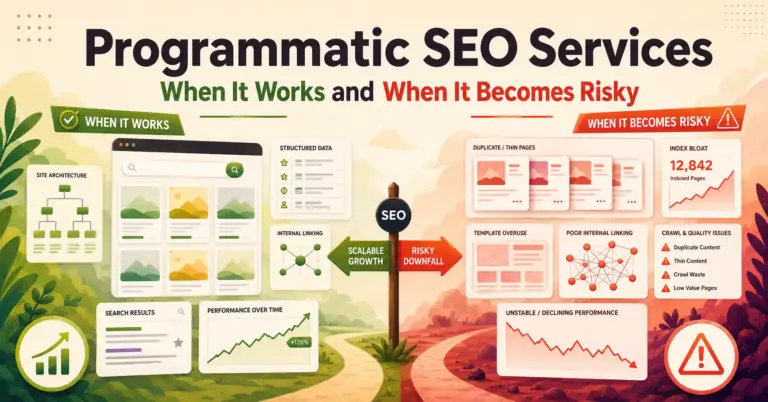
That does not mean programmatic SEO is always bad. It means programmatic SEO needs unique value.
Good programmatic pages may include:
- original data
- location-specific details
- product-specific information
- dynamic comparisons
- user tools
- calculators
- verified sources
- genuine local or industry context
- helpful filtering
- practical next steps
Bad programmatic pages simply replace one word in a template.
Risk 2: Factual hallucinations
AI tools can produce confident but false information.
That is dangerous for:
- healthcare
- finance
- insurance
- legal topics
- cybersecurity
- tax
- compliance
- enterprise software comparisons
- pricing claims
- product integrations
If an agency cannot explain how it validates factual claims, do not trust it with your brand.
Risk 3: Generic thought leadership
Many AI-generated articles sound polished but say nothing.
They use phrases like:
- “In today’s digital landscape”
- “Businesses must stay ahead of the curve”
- “AI is revolutionizing everything”
- “Unlock your potential”
- “Leverage cutting-edge solutions”
That style may fill a page, but it does not build authority.
Strong content has specificity. It names problems. It explains tradeoffs. It gives examples. It helps the reader make decisions.
Risk 4: Poor differentiation
AI often averages existing information.
If an agency relies too heavily on AI-generated drafts, your content may sound like every competitor.
That is a problem in competitive B2B markets.
Your content should reflect:
- your positioning
- your product experience
- customer objections
- sales team insights
- implementation lessons
- internal expertise
- original frameworks
- real examples
- competitive nuance
AI can assist, but it cannot invent your company’s real market knowledge.
Risk 5: Misleading AI SEO metrics
Some agencies may sell “AI visibility” dashboards without explaining what the data means.
AI search results can vary by query phrasing, location, personalization, freshness, and interface design. Recent research has also found that AI Overviews and traditional search results may retrieve substantially different sources. (arXiv)
So, AI visibility tracking can be useful, but it should not be treated like a perfect replacement for Search Console, analytics, CRM attribution, or revenue reporting.
What LLM SEO Means in Practical Terms
LLM SEO refers to improving how large language models understand, associate, and retrieve information about your brand, products, and expertise.
It is not only about your own website.
Large language models and AI search systems may draw signals from:
- your website
- documentation
- product pages
- review sites
- comparison articles
- knowledge bases
- social discussions
- forums
- press mentions
- business directories
- third-party profiles
- public datasets
- industry publications
That means LLM SEO has two major parts.
On-site clarity
Your own website should clearly explain:
- who you are
- what category you belong to
- what your product or service does
- who it is for
- what problems it solves
- how it compares to alternatives
- what integrations or technologies it supports
- what proof supports your claims
- how users can take the next step
This helps search systems and users understand your business directly from your site.
Off-site corroboration
Your brand should also be represented consistently across trusted third-party sources.
For SaaS companies, that may include:
- G2
- Capterra
- Product Hunt
- Gartner Digital Markets
- GitHub
- Crunchbase
- industry podcasts
- partner directories
- integration marketplaces
- customer case studies
- analyst mentions
- review platforms
For local businesses, it may include:
- Google Business Profile
- Bing Places
- Apple Business Connect
- Yelp
- industry directories
- local chamber listings
- local news mentions
- review platforms
For B2B services, it may include:
- Clutch
- DesignRush
- GoodFirms
- agency directories
- partner certifications
- conference pages
- guest expert content
- client testimonials
AI systems tend to work better when the same entity relationships are repeated consistently across reliable sources.
For example:
Company X is a SOC 2 compliance automation platform for B2B SaaS companies.
That message should not appear only once on your homepage. It should be reinforced across product pages, about pages, case studies, comparison pages, integration pages, and credible third-party profiles.
AI Search Optimization for SaaS, B2B, and Local Businesses
Different businesses need different AI SEO strategies.
A local dental clinic, a cybersecurity SaaS company, and a B2B consulting firm should not buy the same AI SEO package.
SaaS companies
SaaS SEO often depends on category clarity, use-case depth, product-led content, integrations, alternatives, and comparison queries.
AI SEO services for SaaS should focus on:
- category pages
- use-case pages
- feature pages
- integration pages
- competitor alternative pages
- pricing explainers
- implementation guides
- product-led blog content
- documentation SEO
- review-site consistency
- entity-rich product descriptions
- demo and trial conversion paths
For SaaS, the content should connect educational topics to product value without turning every article into a sales pitch.
Example:
An article on “customer onboarding automation” should explain workflows, metrics, tools, risks, and implementation steps. Then it can naturally show how the product supports onboarding sequences, CRM sync, user segmentation, and lifecycle emails.
That is useful. It is also commercially relevant.
B2B service companies
B2B service SEO depends heavily on trust.
An AI SEO agency working with a B2B service firm should strengthen:
- service pages
- case studies
- industry pages
- problem-solution pages
- process explanations
- team expertise
- comparison content
- procurement-friendly content
- objection-handling pages
- thought leadership with substance
Service buyers want to know:
- Can you solve my problem?
- Have you done this before?
- What does the engagement look like?
- How do you measure success?
- What risks should I expect?
- Why should I choose you over an in-house hire or another agency?
A good AI SEO strategy answers these questions before the sales call.
Local businesses
For local businesses, AI SEO is closely tied to local SEO.
Important assets include:
- Google Business Profile
- local landing pages
- service area pages
- reviews
- local citations
- FAQs
- location-specific content
- business categories
- photos
- opening hours
- appointment links
- service descriptions
- local schema
AI can help structure and refresh local content, but it should not create fake local relevance.
A page targeting “emergency plumber in Austin” should include real service details, neighborhoods served, licensing information where relevant, emergency availability, pricing factors, customer expectations, and clear contact options.
Generic city-swapped content is weak.
Ecommerce brands
Ecommerce AI SEO should focus on:
- product descriptions
- category page copy
- buying guides
- comparison pages
- review summaries
- faceted navigation control
- schema markup
- inventory-aware SEO
- internal search data
- product attribute optimization
- image alt text
- merchant feed consistency
AI can help enrich product data at scale, but it must stay accurate.
Incorrect materials, dimensions, compatibility, or safety details can create user trust and return-rate problems.
How to Evaluate an AI SEO Agency Before Hiring
Hiring an AI SEO agency requires more scrutiny than hiring a traditional content vendor.
Many agencies are rebranding normal SEO services as AI SEO. Others are selling automation-heavy packages that may create long-term risk.
Here is how to evaluate them properly.
Look at their diagnostic process
Ask what they do before creating content.
A serious agency should mention:
- technical SEO audit
- analytics review
- Search Console review
- competitor analysis
- content inventory
- keyword and intent mapping
- entity analysis
- internal link audit
- conversion path review
- brand positioning review
- CMS and template limitations
- structured data validation
If they jump straight into “we’ll publish 40 articles per month,” be cautious.
Ask how they use AI
You want a clear answer.
Good answer:
We use AI for clustering, briefs, first-pass research, internal link suggestions, metadata variations, and content refresh analysis. Human strategists and editors validate claims, align content with brand positioning, and review final output before publication.
Bad answer:
Our AI creates SEO-optimized articles automatically.
That second answer sounds efficient, but it usually means low editorial control.
Review their examples
Do not only ask for traffic screenshots.
Ask for:
- live URLs
- before-and-after content examples
- technical fixes
- content strategy maps
- schema examples
- internal linking examples
- reporting samples
- ranking improvements
- conversion impact
- AI visibility tracking methodology
Look for specificity.
A real agency can explain why each page exists, what intent it serves, and how it supports the business model.
Check their understanding of AI search
Ask how they define:
- AI SEO
- generative engine optimization
- LLM SEO
- answer engine optimization
- AI search optimization
They do not need perfect academic definitions. But they should understand the difference between content automation and AI search visibility.
They should also be honest about uncertainty.
AI search is still evolving. No agency can guarantee that your brand will be cited by AI Overviews, ChatGPT, Copilot, Gemini, or any specific LLM system for every target query.
Evaluate their technical competence
AI SEO still depends on technical SEO.
Ask whether they can evaluate:
- JavaScript rendering
- crawl budget
- canonical tags
- robots directives
- structured data
- sitemap quality
- pagination
- faceted navigation
- duplicate content
- Core Web Vitals
- server-side rendering
- international SEO
- log files
- indexation patterns
If an agency only understands content generation, it may miss the technical problems holding your site back.
Assess their editorial standards
Ask about:
- source validation
- expert review
- fact-checking
- plagiarism checks
- tone and brand voice
- claims approval
- legal/compliance review
- update cadence
- content pruning
- performance review
This is especially important for regulated or high-trust categories.
Red Flags to Avoid
Some AI SEO offers look impressive but carry serious risk.
“We publish hundreds of AI articles per month”
Volume is not automatically bad, but scale without quality control is dangerous.
Ask:
- Who reviews the content?
- What unique value does each page provide?
- How are claims validated?
- How do you prevent duplicate intent?
- How do you avoid thin scaled content?
- How are pages internally linked?
- How do you decide what not to publish?
If the agency cannot answer, walk away.
“We guarantee AI Overview citations”
No agency can honestly guarantee this.
AI-generated search features are dynamic. Source selection can change. Query wording matters. Interface changes matter. Search systems update constantly.
A good agency can improve your eligibility and sourceworthiness. It cannot control AI systems.
“Backlinks are no longer needed”
This is too simplistic.
Brand authority, third-party mentions, links, citations, reviews, and trusted references still matter. The form of authority may evolve, but credibility signals have not disappeared.
“Technical SEO is dead”
No.
If search systems cannot crawl, render, index, and understand your content, your visibility suffers.
Technical SEO remains foundational.
“We use proprietary AI prompts”
Prompts are not a strategy.
A good SEO program depends on research, architecture, positioning, technical execution, editorial standards, measurement, and iteration.
Prompts may help execution. They are not a defensible moat by themselves.
“We optimize only for LLMs, not Google”
This is usually a misunderstanding.
AI search and traditional search overlap. Google’s own AI guidance still frames generative AI optimization as part of the broader search experience. (Google for Developers)
Ignoring traditional SEO fundamentals is not advanced. It is careless.
Questions to Ask Before Signing a Contract
Before hiring an AI SEO agency, ask these questions.
Strategy questions
- How do you define AI SEO services?
- What parts of your process use AI?
- What parts are handled by human strategists or editors?
- How do you choose which pages to create?
- How do you prevent keyword cannibalization?
- How do you map topics, entities, and search intent?
- How do you support commercial investigation queries?
- How do you balance traffic goals with lead quality?
Content questions
- Who writes and edits the content?
- How are factual claims validated?
- Do you interview subject-matter experts?
- How do you make content specific to our product or service?
- How do you avoid generic AI-written content?
- How do you handle regulated or sensitive topics?
- How often do you refresh content?
- Do you prune outdated or underperforming content?
Technical questions
- Do you audit crawlability and indexation?
- Do you validate structured data?
- Can you work with JavaScript-heavy sites?
- Do you review site architecture?
- Do you identify orphan pages?
- Do you fix duplicate metadata and canonical issues?
- Do you monitor Core Web Vitals?
- Do you coordinate with developers?
AI search questions
- How do you track AI visibility?
- Which AI search platforms do you monitor?
- How do you test prompts and query variations?
- How do you distinguish citations from mentions?
- How do you report uncertainty?
- How do you improve sourceworthiness?
- How do you optimize for answer clarity?
- How do you handle changing AI search behavior?
Reporting questions
- What metrics do you report monthly?
- Do you separate branded and non-branded growth?
- Do you connect SEO work to pipeline or revenue?
- Do you report conversions by page type?
- Do you show pages created, updated, merged, or removed?
- Do you provide technical issue logs?
- Do you explain what changed and why?
- Do you provide next-step priorities?
A good agency will welcome these questions. A weak one will try to rush you into a package.
What AI SEO Should Cost
AI SEO pricing varies widely.
The cost depends on:
- website size
- market competitiveness
- technical complexity
- content volume
- content depth
- industry risk
- number of stakeholders
- analytics setup
- CMS complexity
- international requirements
- level of expert review
A small local business may need a focused monthly package. A B2B SaaS company may need a full content and technical SEO program. An enterprise site may require cross-functional work across engineering, content, analytics, product marketing, and compliance.
The cheapest option is rarely the safest option.
That does not mean every business needs an expensive retainer. It means the scope should match the risk and opportunity.
A practical AI SEO engagement may include:
Starter audit
Best for businesses unsure what they need.
Includes:
- technical SEO audit
- content gap review
- AI search visibility snapshot
- competitor review
- prioritized roadmap
Strategy and implementation retainer
Best for companies ready to execute.
Includes:
- monthly content strategy
- technical fixes
- content creation
- content refreshes
- internal linking
- schema improvements
- reporting
SaaS growth program
Best for product-led or B2B SaaS.
Includes:
- use-case pages
- feature pages
- comparison pages
- integration pages
- BOFU content
- documentation SEO
- review-site optimization
- AI visibility tracking
Programmatic SEO buildout
Best for marketplaces, directories, tools, databases, and location/category pages.
Includes:
- template strategy
- data source validation
- unique value requirements
- indexation controls
- internal linking system
- schema templates
- quality safeguards
- crawl monitoring
For programmatic SEO, the quality bar must be high. A large number of pages can help only when each page genuinely serves a distinct user need.
How to Measure AI SEO Performance
AI SEO measurement should combine traditional SEO metrics, AI visibility metrics, and business metrics.
Do not rely on one dashboard.
Traditional SEO metrics
Track:
- organic clicks
- impressions
- average position
- indexed pages
- crawl errors
- ranking distribution
- traffic by landing page
- branded vs non-branded traffic
- search query growth
- featured snippet presence
- rich result eligibility
These metrics still matter.
AI visibility metrics
Track:
- brand mentions in AI answers
- citations in AI-generated responses
- visibility across query variants
- competitor presence in AI answers
- source pages cited
- answer sentiment
- accuracy of AI summaries
- platforms monitored
- prompt categories tested
Treat this data as directional, not absolute.
AI answers can vary. Still, directional trends are useful.
Engagement metrics
Track:
- scroll depth
- time on page
- assisted conversions
- internal link clicks
- content pathing
- demo clicks
- form starts
- newsletter signups
- return visits
- comparison page engagement
These metrics help show whether content is actually useful.
Business metrics
Track:
- qualified leads
- pipeline influenced
- demo requests
- trial starts
- sales-qualified opportunities
- customer acquisition cost
- conversion rate by content type
- revenue influenced by organic search
For SaaS and B2B companies, traffic alone is not enough.
The real question is: does organic visibility attract the right buyers?
Practical AI SEO Workflow for Businesses
A strong AI SEO process usually follows this sequence.
Step 1: Diagnose
Start with technical and content visibility.
Review:
- what is indexed
- what ranks
- what converts
- what is outdated
- what is missing
- what competitors cover
- where AI systems mention competitors
- where your brand lacks clarity
Step 2: Define business priorities
SEO should support business goals.
For example:
- more enterprise demos
- more local service calls
- more product trials
- more marketplace listings
- more qualified inbound leads
- more visibility for a new category
- stronger comparison visibility
- reduced reliance on paid ads
Without a business goal, SEO becomes content production for its own sake.
Step 3: Build the topic map
Map:
- core categories
- subtopics
- pain points
- use cases
- comparisons
- integrations
- buyer questions
- objections
- decision criteria
- supporting educational content
This becomes the foundation for your content architecture.
Step 4: Fix technical blockers
Before scaling content, fix:
- indexation problems
- duplicate pages
- broken templates
- missing canonicals
- slow pages
- JavaScript rendering problems
- orphan pages
- poor internal links
- invalid schema
- sitemap issues
This improves the performance of everything published later.
Step 5: Upgrade existing content
Often, the fastest wins come from improving pages you already have.
Update:
- outdated posts
- underperforming commercial pages
- thin product pages
- weak comparison pages
- missing FAQs
- unclear headings
- old screenshots
- unsupported claims
- weak internal links
Step 6: Create new strategic pages
Only then create new content.
Prioritize pages that support:
- high-intent queries
- product use cases
- buyer comparisons
- category education
- competitor alternatives
- implementation questions
- industry pain points
Step 7: Strengthen entity signals
Make sure your brand, products, services, authors, and categories are described consistently.
Use:
- About page
- author pages
- organization schema
- product schema where appropriate
- sameAs profiles
- third-party profiles
- review platforms
- partner directories
- case studies
- press mentions
Structured data can help search engines understand page information, but Google notes that its structured data documentation is the definitive source for Google Search behavior, even though schema.org vocabulary is commonly used. (Google for Developers)
Step 8: Measure and refine
Review performance every month.
Look at:
- what moved
- what did not
- which pages convert
- where rankings improved
- where AI visibility changed
- what competitors gained
- what needs consolidation
- what needs refresh
- what should be removed
AI SEO is not a one-time project. It is an operating system for search visibility.
Common Misconceptions About AI SEO Services
Misconception 1: AI SEO is only content generation
No. Content generation is only one part.
AI SEO may include technical audits, entity strategy, AI visibility tracking, internal linking, content refreshes, automation workflows, schema validation, and conversion optimization.
Misconception 2: More pages always mean more traffic
More pages can mean more traffic only if the pages are useful, distinct, crawlable, and aligned with real demand.
More weak pages can dilute quality and create maintenance problems.
Misconception 3: AI search makes websites less important
AI search changes how websites are discovered, but it does not eliminate the need for strong source content.
AI systems still need information to retrieve, summarize, compare, and cite.
Misconception 4: You need a separate GEO strategy from SEO
Not exactly.
Generative engine optimization is best treated as an extension of strong SEO. The content must be technically accessible, semantically clear, authoritative, and useful.
Misconception 5: AI tools can replace SEO experts
AI tools can speed up tasks. They cannot fully replace strategic judgment, technical diagnosis, editorial standards, product understanding, or business context.
The best teams use AI as leverage, not as autopilot.
AI SEO for Commercial Investigation Keywords
The topic of AI SEO services itself is a commercial investigation query.
That means users are not just looking for a definition. They are considering whether to buy, who to hire, what to avoid, and how to compare providers.
For commercial investigation content, the strongest pages usually include:
- definitions
- service breakdowns
- comparison sections
- pricing logic
- buyer checklists
- red flags
- questions to ask
- examples
- risks
- implementation guidance
- FAQs
- next steps
This article format works because it mirrors the buyer’s thought process.
A buyer searching “AI SEO services” likely wants to know:
- What are these services?
- Are they different from normal SEO?
- Do I need them now?
- What should an agency actually deliver?
- How do I avoid low-quality AI content?
- What should I budget?
- How do I measure results?
- What questions should I ask before signing?
Answering those questions builds trust.
That is also why commercial investigation content should avoid aggressive sales language. Buyers at this stage are skeptical. They want clarity, not pressure.
How AI SEO Supports Programmatic Advertising Monetization
For publishers and content businesses, AI SEO can also support better contextual advertising.
Programmatic advertising systems classify pages based on topic, audience, commercial relevance, and contextual signals. Clear, entity-rich content can help ad systems understand what the page is about.
For example, an article about AI SEO services may naturally attract advertiser categories such as:
- SEO software
- marketing automation platforms
- analytics tools
- content optimization platforms
- SaaS marketing services
- CRM software
- AI writing tools
- conversion optimization tools
- business consulting services
- B2B lead generation tools
But there is a line.
Content should not be written only to attract ads. That is how sites drift into made-for-advertising territory.
The best approach is simple: create genuinely useful content for a commercially valuable audience.
When the content is specific, helpful, and aligned with real buying intent, advertiser relevance follows naturally.
What Businesses Should Expect in the First 90 Days
AI SEO is not instant. The first 90 days should focus on clarity, foundations, and early execution.
Days 1–30: Audit and strategy
Expect:
- analytics review
- Search Console review
- technical audit
- content inventory
- competitor analysis
- keyword and intent mapping
- AI visibility baseline
- roadmap creation
The agency should identify quick wins and structural issues.
Days 31–60: Fixes and content upgrades
Expect:
- technical fixes
- metadata improvements
- internal link updates
- content refreshes
- schema validation
- priority page upgrades
- old content pruning recommendations
- initial content briefs
This stage often improves existing assets before creating many new ones.
Days 61–90: Strategic publishing and measurement
Expect:
- new commercial pages
- supporting informational content
- comparison content
- use-case pages
- reporting dashboard
- early ranking movement
- AI visibility tests
- next-quarter priorities
You may not see full results in 90 days, especially in competitive industries. But you should see better structure, better content quality, fewer technical issues, and clearer reporting.
FAQ: AI SEO Services
What are AI SEO services?
AI SEO services use artificial intelligence to improve SEO research, strategy, content optimization, technical analysis, automation, and visibility in AI-assisted search experiences. The best services combine AI tools with human strategy, editorial review, and technical SEO expertise.
What is an AI SEO agency?
An AI SEO agency is an SEO provider that uses AI tools and AI search optimization methods to improve organic visibility. A good AI SEO agency should handle traditional SEO fundamentals, technical audits, content strategy, AI-assisted workflows, entity optimization, and reporting.
Is AI SEO different from traditional SEO?
AI SEO builds on traditional SEO. Traditional SEO focuses on crawlability, rankings, content, links, and user experience. AI SEO adds automation, semantic analysis, AI search visibility, answer clarity, and LLM-focused entity signals.
What is generative engine optimization?
Generative engine optimization, often called GEO, is the practice of improving content so generative AI search systems can understand, retrieve, summarize, and potentially cite it. In practice, GEO overlaps heavily with strong technical SEO, helpful content, structured information, and brand authority.
What is AI search optimization?
AI search optimization is the process of making your website and brand more visible in AI-assisted search results, such as AI Overviews, Copilot-style answers, and other answer engines. It focuses on clear explanations, authoritative content, structured data, entity coverage, and source credibility.
What is LLM SEO?
LLM SEO focuses on how large language models understand and represent your brand, products, services, and expertise. It includes on-site clarity, consistent entity signals, authoritative third-party mentions, and content that clearly connects your brand to relevant topics.
Can AI-written content rank on Google?
AI-assisted content can perform if it is useful, accurate, original, and created for users. Google’s guidance focuses on content quality and helpfulness rather than whether AI was used. However, scaled AI-generated content without added value may violate spam policies. (Google for Developers)
Should I hire an AI SEO agency or use AI tools myself?
If you have SEO expertise, AI tools can help your team move faster. If you lack technical SEO, content strategy, analytics, or editorial resources, an agency may be more effective. The key is choosing an agency that uses AI responsibly rather than relying on automation alone.
How do I know if an AI SEO agency is legitimate?
Look for a clear process, technical SEO knowledge, content quality standards, transparent AI usage, realistic expectations, and reporting tied to business outcomes. Avoid agencies that guarantee AI citations, publish mass content without review, or ignore technical SEO.
What is the biggest risk of AI SEO?
The biggest risk is mistaking volume for value. AI makes it easy to create more pages, but search performance depends on usefulness, accuracy, authority, technical quality, and user satisfaction.
Conclusion
AI SEO services can be valuable, but only when they are built on real SEO fundamentals.
The businesses that win in AI search will not be the ones publishing the most automated content. They will be the ones with clear positioning, technically sound websites, useful content, strong entity signals, credible expertise, and a smart process for turning buyer questions into high-quality pages.
Before hiring an AI SEO agency, ask how they use AI, how they validate content, how they handle technical SEO, how they measure AI visibility, and how their work supports business outcomes.
Good AI SEO should make your website more useful, more understandable, and more trustworthy.
Everything else is packaging.