Mastering The Facebook Algorithm: A Business Leader’s Guide
If you want to succeed with your Facebook marketing strategy, you should know about the Facebook algorithm and how it works.
Over the years, the Facebook algorithm has undergone some changes that can make it more of a challenge to work with, but the right approach will help you maximize your reach on the platform.
In this article, Chanel Lapointe Allard, Social Media Manager, explores what the Facebook algorithm is, how it operates, and some tips for getting ahead with Facebook marketing.
TL;DR
- The algorithm on Facebook uses various signals to determine how to rank content in users’ feeds.
- The FB algorithm continues to evolve with changing Facebook guidelines and general algorithmic updates.
- Keeping up with the latest Facebook algorithm news can help you anticipate and adapt to any upcoming changes.
- You can optimize for Facebook algorithms with strategies like choosing the best time to post, determining the type of content your audience likes, and using short- and long-form video marketing.
What is the Facebook Algorithm?
The Facebook algorithm is an automated system using AI and machine learning to both filter and rank content based on factors like ranking signals and user behavior.
The algorithm consists of several rankings and machine learning models that determine what kind of content will appeal most to users. In the process, the algorithm selects the appropriate content for users via organic posts along with other types of Facebook content.
The FB algorithm is shorthand for multiple AI-powered ranking and recommendation systems working together, providing each user with a wholly personalized experience when exploring their feeds.
How Does the Facebook Algorithm Work?
The algorithm on Facebook uses a combination of AI and machine learning, along with ranking signals, to determine which content is best to show users.
The ranking signals the FB algorithm uses have changed over the years, with some new signals added, some eliminated, and others modified.
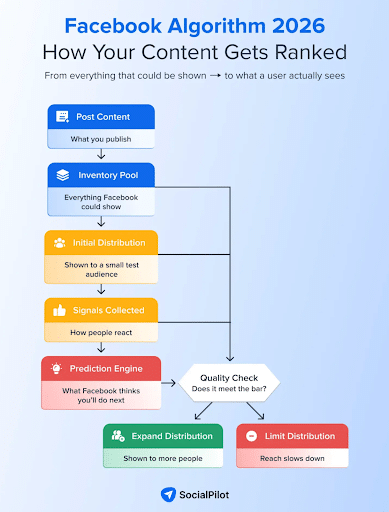
So, exactly how does the Facebook algorithm work? Here’s the Facebook algorithm explained in the following four simple stages:
- Eligible Inventory: Facebook starts by looking at the pool of all available posts, including content from people’s friends, groups, and pages they follow (or may be interested in).
- Signals: These are certain clues or data points about each post, including who posted it, the freshness of the post, and the kind of content the post features.
- Predictions: The algorithm also makes an educated guess to determine which content might perform best for each user, going by past user behavior.
- Final Ranking: This refers to the final order of the user’s feed, with the algorithm on Facebook giving each post a score based on the predictions, placing posts with the highest scores first on the screen.
To do well on Facebook and appeal to the algorithm, you’ll want to gain a deep understanding of your audience.
What kinds of posts do they interact with most? What content resonates most effectively? Answering these and other questions can help you succeed in your marketing efforts.
Using boosted posts that are highly targeted, you will further increase your chances of reaching the right people at the right time with posts.
Remember that audiences can control what the algorithm feeds them to an extent. For example, they can label certain pages as favorites, hide or snooze posts and pages, and hide ads due to irrelevancy or other issues.
In addition, know that Meta may apply safety, quality, originality, and recommendation-eligibility controls to influence the algorithm, and Meta does not currently publish every signal or those signals’ exact weight.
Expert Opinion on the Facebook Algorithm
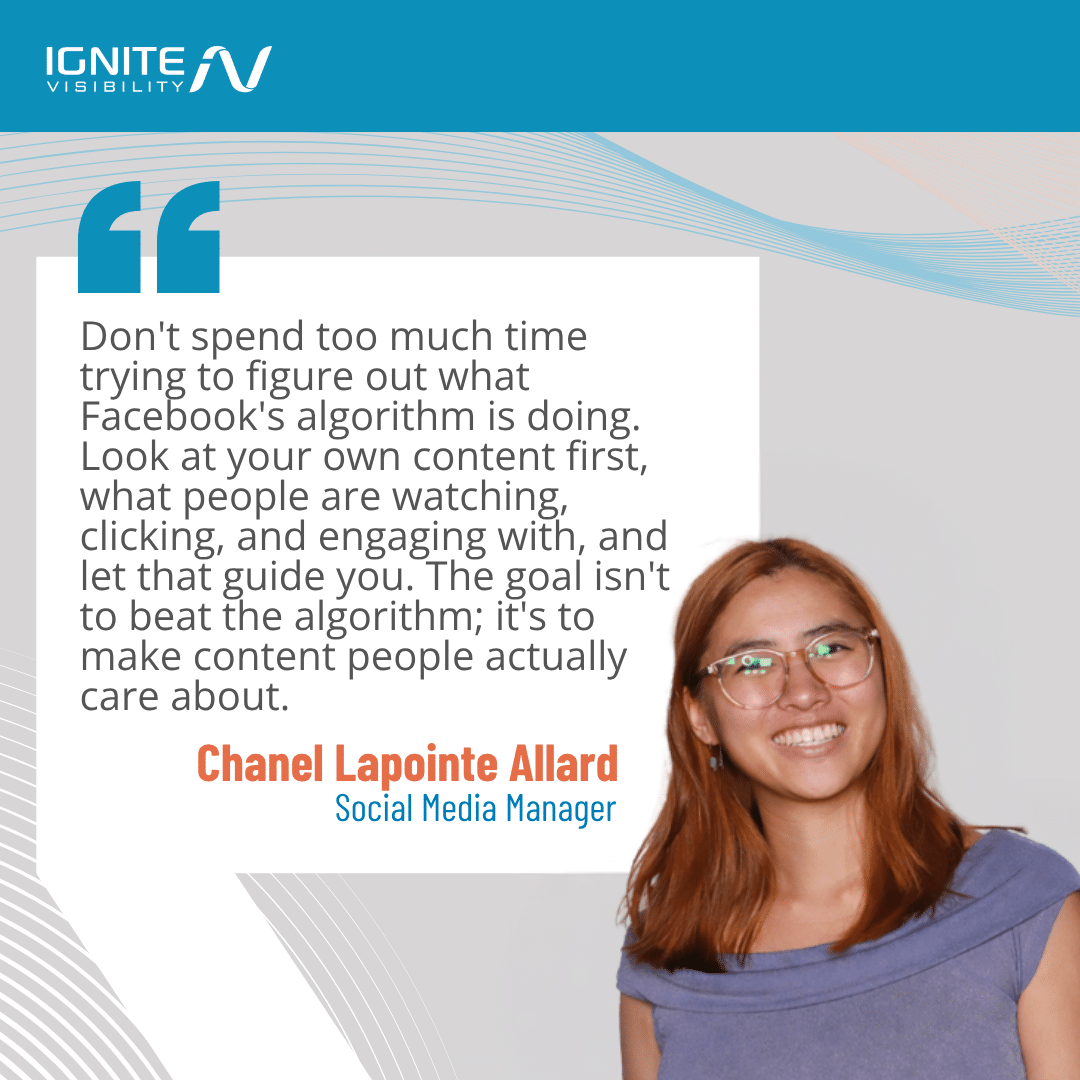
In my experience managing social media, one of the biggest mistakes I see brands make is trying to chase the Facebook algorithm instead of paying attention to what their audience is already telling them.
When I see reach or engagement change, don’t immediately assume there was an algorithm update. Look at the content first and see if we changed anything in regards to the topic or format. Did posting frequency change? Are people actively watching, clicking, engaging? If you look at the patterns, this usually tells you much more than trying to figure out what Facebook is changing on their end.
I also don’t think there’s one content format that will always outperform everything else. Video can be very effective on one platform, but it doesn’t mean that your whole content strategy should be focused on video.
My approach is to test a mix of different formats and topics. Look at performance by objective and build on what is consistently resonating. The goal isn’t to beat the algorithm, but to create content that people genuinely care about. Those signals give your content a better chance at reaching more people.
Which Facebook Ranking Signals Matter?
Multiple signals can play into ranking for the Facebook algorithm. These factors amy include:
Relationship and Source Signals
Signals here might include interactions users have with creators, e.g., friends, family, followed Pages, or groups they tag, message, or otherwise engage with frequently.
The FB algorithm could measure how closely users are connected to the person or publisher behind the content.
Past Viewing and Engagement Behavior
The algorithm also evaluates whether a user tends to like, comment on, or share posts from a particular source, along with how long they have spent reading or watching that source’s posts.
Content Signals
Additionally, the algorithm assesses whether a post is a photo, link, text, or video, favoring new posts over older ones to keep the feed fresh.
Apart from freshness and format, the algorithm looks at the particular topic and the post’s originality.
Post Engagement Signals
Content with more engagement in the form of long watch times, more shares, a high number of allows, many comments, and direct feedback will also perform better than posts with less engagement.
Negative Signals
Attempting to hide posts, users reporting a post, or users indicating that they’re “Not Interested” in a post can also serve as negative signals that might hurt your rankings.
Just remember that no single signal will guarantee any level of reach; you need to mix and match and continually test them to see what does best.
Feed vs. Reels: What Changes?
So, what is the difference between Facebook Feeds and Reels in the algorithm?
First, the Feed tends to include connected and recommended content, while Reels functions as Facebook’s unified video publishing and discovery format.
Reels, like feed posts, can reach non-followers based on interests.
It’s important not to confuse either Feeds or Reels with the Facebook Friends tab, which prioritizes friend-published content over Page recommendations.
The following is a little breakdown of both Feed and Reels content:
| Feature | Facebook Feed | Facebook Reels |
| Primary Format | Mixed; text, photos, links, videos | Short-form vertical 9:16 videos |
| Distribution Scope | Mostly connected via friends and pages followed | Global discovery from unconnected creators |
| Main Ranking Driver | Relationship and source signals | Content signals like watch time and interest |
| Negative Signals | “Hide post,” “unfollow,” and “snooze” | “Show less” and fast swipes away |
| Engagement Focus | Comments, shares, discussion threads | Likes, audio re-use, quick shares |
How Does the Facebook Reels Algorithm Work?
You might also want to use Facebook Reels in addition to traditional Facebook. Reels is a short-form video branch of Facebook that pushes brief videos into people’s feeds.
The Facebook feed algorithm for Reels works similarly to the broader Facebook algorithm, with AI and machine learning used to figure out which content to display based on engagement.
Posts with high engagement will get more reach via the Facebook Reels algorithm, while posts that people often hide or snooze won’t fare as well.
Facebook Reels is no longer relegated to short-form video, either, with longer Reels allowed to engage users for longer periods. Also in Facebook algorithm news as of 2025, Meta moved to a unified video player experience to improve discoverability.
Facebook now factors in watch behavior, interest matching, direct feedback, freshness, social context, and originality to rank Reels, regardless of video length.
To get the best results from Facebook Reels, it’s best to match video length to your idea and monitor retention to gauge performance over time.
What’s New? How the Facebook Algorithm Has Changed
Facebook no longer relies primarily on your social connections to decide what appears in the feed.
Today, Meta uses AI to recommend content based on what people watch, engage with, and spend time on. In fact, a significant portion of content in Facebook and Instagram feeds now comes from accounts users don’t follow.
That shift has changed how brands earn reach.
From Social Graph to Discovery Engine
Years ago, growing your Page followers was one of the best ways to increase visibility.
Today, Facebook’s recommendation system can show your content to people who have never heard of your brand. The algorithm looks at signals like watch time, engagement, viewing history, and content relevance to decide what deserves more distribution.
For marketers, that means follower count matters less than content quality. If your content keeps people watching and interacting, Facebook is more likely to recommend it to new audiences.
User Feedback Shapes What People See
Facebook also uses direct user feedback to refine recommendations.
When someone selects “Show More,” Facebook increases the ranking of that post and similar content. When they select “Show Less,” the platform reduces the likelihood of showing similar content in the future.
This creates a continuous feedback loop. Facebook is constantly adjusting recommendations based on what users engage with today, not what interested them years ago.
The takeaway is simple: create content people want to watch, engage with, and see more of. The stronger those signals, the more opportunities Facebook has to expand your reach.
What Can Reduce Facebook Reach?
How does Facebook operate when you do something that the algorithm doesn’t like? Generally, you could experience a penalty if you engage in any of the following behaviors that Meta explicitly discourages:
- Purchased or Coordinated Engagement: Buying likes or other types of engagement, or otherwise making a coordinated effort to drive engagement, can result in a penalty.
- Engagement Bait and Deceptive Clickbait: Purposefully deceiving audiences with misleading clickbait and other types of engagement bait can also lead to decreased AI visibility and ranking penalties.
- Duplicate or Minimally Edited Third-Party Content: Posting the same content multiple times to maximize exposure or failing to take any time to edit third-party content, such as neglecting to remove a watermark in some cases, could further hurt post performance.
- Irrelevant Captions and Excessive Hashtags: Captions and hashtags simply trying to stuff a post with as many keywords as possible will also do more harm than good in the long run.
- Repeated Negative Feedback, Hiding, and Reporting: Even policy-compliant content can still be ineligible for broad recommendations if the content gets repeated negative engagement in the form of “hide this post,” reports, or negative feedback.
Do Boosted Posts Help the Facebook Algorithm?
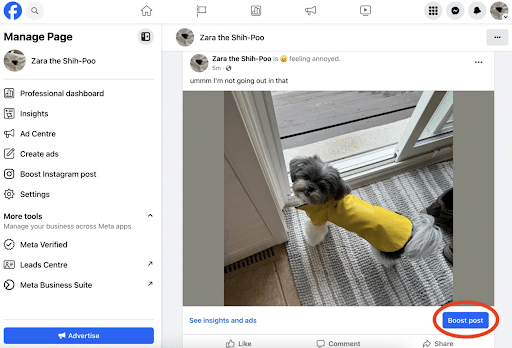
You may also wonder if boosted posts can help with organic performance, but while they can help expand reach, they are different from organic posts.
Here is the Facebook algorithm explained as it pertains to boosted posts:
Boosted posts are simply traditional organic posts that users turn into ads. As such, these posts won’t experience a direct enhancement in organic distribution, instead achieving better paid reach.
A simple boost might be ideal if you want to get your organic posts out there in the form of Meta ads, potentially supplementing other ads while indirectly improving organic performance through more engagement.
If you want to optimize paid ad targeting, objectives, testing, and attribution, it’s in your best interest to implement Meta Ads Manager.
Learn more about when to use boosted posts vs. ads to determine which is right for your strategy.
What to Do When Facebook Reach Drops
If you see a sudden decrease in the performance of your Facebook posts, take the following steps to identify the issue and remedy the situation:
- Do not immediately blame an algorithm update, as it could be due to certain issues with specific posts or accounts.
- Check your account status and recommendation eligibility.
- Review any negative feedback and policy issues to determine whether people’s reactions or compliance violations punished your posts.
- Compare content topics, formats, frequency, and posting times to confirm whether any of these factors affected your reach.
- Check whether paid support or campaign activity changed at any point.
- Make a single significant change at a time and retest, which could help reset Facebook’s algorithm in your favor.
Should Every Business Use Facebook?
No, not every business will benefit from using Facebook for their marketing.
To determine whether Facebook will help you with social media marketing, evaluate audience presence, business goals, creative capacity, competition, and acquisition economics.
Is your audience spending time on the platform? Are your competitors? Will posting on the platform help you reach audiences, and does your content align with the kind of content you often see on Facebook?
In the end, Facebook should earn its place in your marketing mix through measurable results; if it just doesn’t seem like a good fit, it may be best to look at other platforms for social media marketing.
Here’s a brief checklist to help ensure Facebook marketing is right for you:
- Is your target audience active on Facebook or Instagram?
- Can Facebook help you achieve goals like more website visits, leads, or sales?
- Do you have the budget to spend on Meta Ads and other Facebook content?
- Do you have time to respond to comments and messages through the platform?
- Can Facebook fit seamlessly into the customer journey?
Tips to Master the Facebook Algorithm and Increase Your Reach
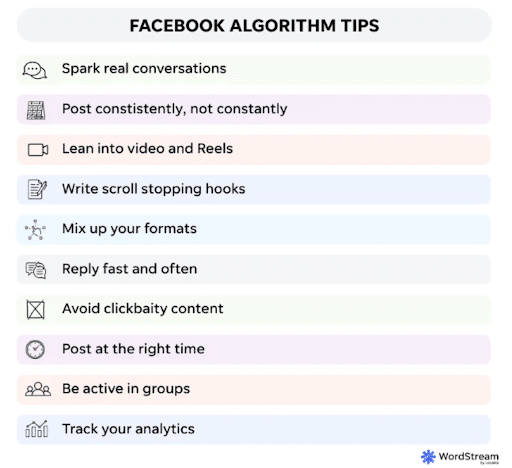
Want to succeed on Facebook by appealing to the platform’s algorithm and users? The following tips can help:
1. Know What Kind of Content Your Audience Likes
Keep in mind that Facebook wants to show people content that’s meaningful and informative. Think about what kinds of content fall under those categories according to your audience.
Meaningful content is content that inspires people to share it and engage with it through comments and likes while actively consuming the content. Meanwhile, informative content provides users with new information that users find interesting.
2. Remember, You Can’t Cheat the System
While you may want to find ways to manipulate the FB algorithm in your favor, there isn’t an effective way to “get around” the algorithm.
Attempts to manipulate the system could hurt you more than help in any way, leading you to struggle even more to get on top.
Black-hat techniques like buying comments or creating deceptive, clickbait-y content will likely just set you back.
Instead of manipulating the algorithm, it’s best to learn the ins and outs of its function and determine how to appeal to it. More specifically, you’ll want to figure out how to appeal to your audience on the platform with high-value content.
3. Choose the Right Time to Post
You should also determine the best time to post on Facebook based on when your audience is most active.
Some audiences may be more eager to consume Facebook content in the morning, for instance, or in the evenings after a day at work. Some may also take a break at midday to look at their feeds, such as during lunch hours.
When more people are online to see your content, this can lead to more engagement with it.
4. Use Video Content to Your Advantage
Video content is a powerful engine for driving engagement on Facebook. It grabs attention and encourages your audience to keep watching. You don’t always need to create brand-new content from scratch. Think about repurposing your existing assets to save time.
Do you have a successful YouTube video on your channel? Chop it into shorter, impactful clips for use on Facebook. These bite-sized videos often outperform static images or plain text. Live streaming is another great way to connect with followers. It creates real-time, authentic interactions that help build trust.
By mixing new videos with repurposed clips, you stay ahead of competitors who only post static content. Video keeps your brand fresh, relevant, and visible.
5. Empower Authentic Brand Advocacy
Your most powerful distribution channel isn’t your business page, it’s the people behind your brand. Instead of asking employees to “manufacture” engagement signals like likes or shares, empower them to be genuine brand advocates.
When your team shares your content because they genuinely believe in the message, it signals authenticity and trust to their personal networks. Encourage your employees to share company updates with their own context, perspective, or personal commentary.
This shifts the focus from artificial metric-boosting to real, human-to-human connection. When advocacy is organic and voluntary, it naturally expands your reach to new, relevant audiences who trust the source, creating much higher-quality engagement than any algorithm hack could provide.
FAQs About the FB Algorithm
1. Can you reset the Facebook algorithm?
If you’re wondering how to reset the Facebook algorithm, it may be possible to do so by curating who you follow, hiding any posts you don’t want people to see, and clearing your search behavior or watch history. However, for business pages, it’s impossible to truly reset the Facebook algorithm, requiring you to retrain it over time instead.
2. What are the most important Facebook ranking signals?
How does the Facebook algorithm work to rank posts? Facebook uses multiple signals to determine which posts to show in people’s feeds, including meaningful interactions, dwell time and completion rates, relationship and affinity, recency, and originality.
3. How is the Reels algorithm different from Feed?
How does Facebook operate differently between users’ Feeds and Reels? While the Feed relies heavily on relationship signals and people’s interests, Reels focuses almost exclusively on interest based on entertainment value and video completion rates.
4. Does boosting a post improve organic reach?
Boosting a Facebook post can improve visibility by turning an organic post into a paid ad, but it won’t directly increase organic reach. However, boosting a post can lead to more organic interactions as people like, comment, or share boosted posts.
5. Do hashtags increase Facebook reach?
While they once helped people find social media posts on platforms like Facebook, Instagram, and X, hashtags are now much less effective in influencing the algorithm. Today’s algorithm on Facebook uses AI to read and infer topics directly via content and video context instead of tags.
6. Does Facebook favor short or long videos?
At this time, Facebook tends to favor longer videos that yield high completion rates and watch time, but engaging short-form video content can still perform well on the platform, making a blend of both types of content ideal for optimum performance.
7. How can a business tell whether its content has been limited?
There are multiple signs indicating that the Facebook algorithm has limited your content’s reach and exposure, including sudden metric drops, flatlined post engagement, and a penalized account, the latter of which could result when in violation of community standards and policies.
8. Are Pages and professional Profiles ranked differently?
Facebook algorithms treat these channels differently, favoring personal and creator-led storytelling for professional profiles while practicing stricter filtering with standard business Pages.
The Bottom Line – Facebook Algorithm Success
Want to excel with your Facebook marketing strategy? Working with the Facebook algorithm is a critical step.
While Facebook isn’t a mandatory channel for every company, when it is a strategic fit, it enables businesses to
- Maximize their reach
- Take advantage of social signals
- Gain reviews from more customers
- Increase brand authenticity
- Connect directly with audiences
- Build a loyal following
Does all of this sound like a good strategy for you? You’ll want to develop one that works best for your business and helps you connect with your unique audience.
Learn more about our Facebook marketing services to find out what we can achieve for your brand on this platform.