Pulse vs Hotjar: Which Feedback Tool Is Right for Your Team?
Pulse and Hotjar overlap on a lot of the basics.
But spend more time with each one, and the differences become clearer. How they handle mobile, what the AI analysis actually surfaces, how the recent Hotjar-Contentsquare merger changes things, and whether either tool fits into your existing workflow without friction.
This comparison covers all of that, so you can stop going back and forth and make the call.

A quick comparison of Pulse vs Hotjar
| Feature | Pulse | Hotjar |
| Surveys & channels | Web, native mobile app (iOS, Android, React Native, Flutter), and link surveys. | Web, mobile site, and link surveys. |
| Targeting & triggers | Event-based, behavioral segments, and user attributes. No-code for most triggers. | URL, event-based, user attributes. Event triggers require developer setup. |
| AI analysis | Themes, sentiment, summaries. Focused entirely on feedback. | Sentiment, auto-tagging, summaries across surveys, and session replays. |
| Concept testing & user research | Unmoderated concept tests before building. | Moderated interviews + unmoderated usability tests via Engage (200K+ tester pool). |
| Experimentation loop | Connects directly to Testing and Personalize. | No native experimentation, but it integrates with third-party A/B tools. |
| Heatmaps & recordings | Not native but available via Insights (separate module). | Not part of the survey module. Available via Experience Analytics (separate module). |
| Pricing | 30-day free trial. Pricing based on MTU (monthly tracked user) volume. | Free plan available. |
Platform overview
Pulse and Hotjar both help teams understand user behavior, but they approach the problem from different angles.
What is Pulse?
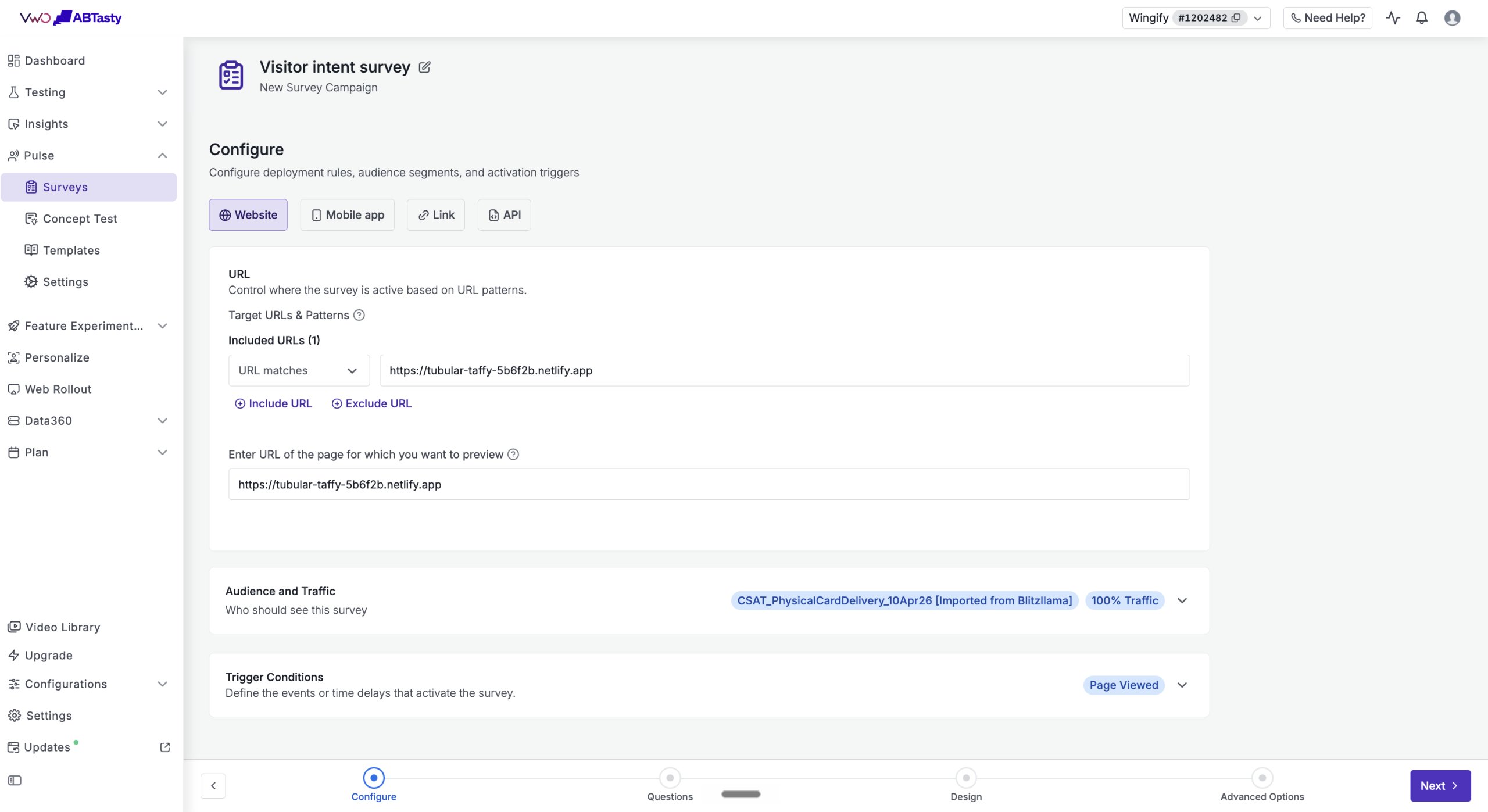
Pulse is a Voice of Customer (VoC) platform built to capture feedback at the moment users experience your product. It lets teams deploy micro-surveys across web, mobile app (iOS, Android, React Native, Flutter), and shareable links. The surveys are triggered by user behavior, page context, or custom events. The goal is to bridge the gap between what behavioral data shows and what users are actually thinking when they drop off, hesitate, or disengage.
Pulse also supports concept testing, letting teams collect design feedback from real users before investing engineering effort. AI analysis sits on top of all collected responses, auto-categorizing feedback into themes, sentiment, and actionable summaries.
Pulse is part of VWO AB Tasty, a full-stack experience optimization platform used by 3000+ businesses. That means teams using Pulse can connect qualitative feedback directly to Testing and Personalization to go from “users said this” to “we ran an experiment on it” without switching platforms.
What is Hotjar?
Hotjar started as a behavior analytics tool and built its reputation on making heatmaps and session recordings accessible to teams that didn’t want enterprise pricing or complexity. Over time, it added surveys, feedback widgets, and user interview capabilities, which helped it become a comprehensive user research platform.
In July 2025, Hotjar completed its full merger with Contentsquare, the enterprise experience analytics platform that acquired it in 2021. Hotjar no longer exists as a standalone product, as new signups go through Contentsquare.
Hotjar features are now organized across three separate product modules: Experience Analytics (heatmaps, recordings), VoC (surveys, feedback), and Product Analytics (funnels, retention). The surveys and feedback features that used to come bundled with a Hotjar subscription are now a separate paid module under the VoC tier.
Feature comparison
Both tools come with a solid set of features for understanding user behavior. Here’s how they stack up across the areas that matter most to teams evaluating either one.
i. Surveys and feedback collection
Pulse covers web, native mobile apps (iOS, Android, React Native, Flutter), and link surveys. You get a range of question types, including NPS, emoji ratings, opinion scales, and open text. VWO AB Tasty AI generates questions automatically, and multi-language support includes auto-translation via a Sync from English feature. Frequency controls let you decide whether a survey shows once, until a response, or regularly.
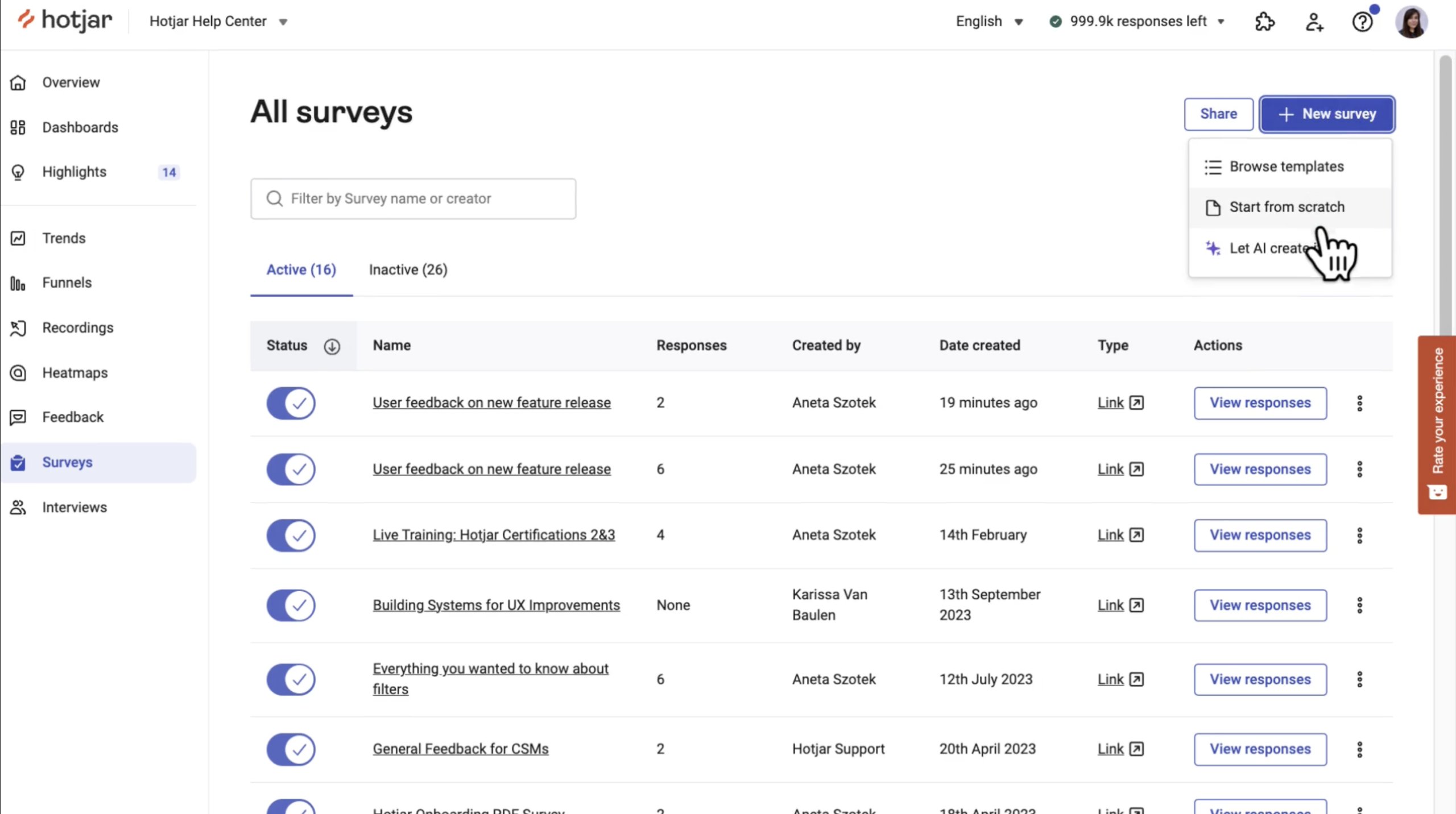
Hotjar offers six survey formats: popover, button, embedded, bubble, full-screen, and link. It also supports NPS natively, has AI-assisted survey creation, and includes a feedback widget for always-on passive feedback.
ii. Targeting and triggers
Pulse lets you segment users by attributes and behavior, and trigger surveys off custom events. The setup is designed to be no-code for most use cases, and mobile triggers work at the screen level or in-app event level via the SDK.
Hotjar supports URL targeting, JavaScript event-based triggers, and user attributes via its Identify API. The mechanics are similar to those of Pulse, but event-based targeting in Hotjar requires developer setup through its Events API.
Both tools let you filter survey responses by the same attributes you used to target, which is useful when analyzing results by segment.
iii. AI analysis and reporting
Pulse auto-categorizes responses into themes, sentiment, and trends. The output is designed to surface actionable insight quickly, so teams can move from raw feedback to a clear hypothesis without manually tagging hundreds of responses.
Hotjar’s AI covers survey summaries, sentiment analysis, automated response tagging, and session replay summaries. It also automatically maps web content and labels customer events during setup. Both tools do sentiment analysis and AI summaries well. The difference is scope: Hotjar’s AI covers behavioral data, error analysis, and feedback together. Pulse’s AI is focused entirely on feedback, which means it goes deeper on that specific layer.
iv. Continuous discovery and NPS programs
Pulse is built for always-on research, as you can run continuous NPS programs, onboarding surveys, adoption tracking, and friction detection without rebuilding surveys each time. Fatigue controls and survey orchestration are built in, so users don’t get hit with multiple surveys in the same session or within a set time window.
Hotjar supports NPS natively and is designed for continuous feedback programs. NPS scores feed into dashboards, and negative responses can be cross-referenced with session replays and journey analysis to understand what’s driving them.
The main difference: Pulse has explicit fatigue controls as a first-class feature. Hotjar relies more on the team to manage survey frequency manually.
v. Heatmaps and session recordings
Pulse doesn’t have heatmaps or session recordings natively. That capability lives in Insights, a separate module within the VWO AB Tasty platform. Teams using VWO AB Tasty end-to-end get both.
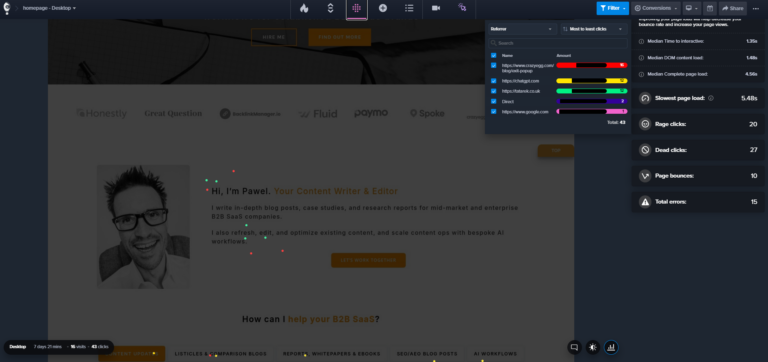
Hotjar’s heatmaps and session recordings sit in its Experience Analytics module, which is separate from the Voice of Customer module, where surveys live. So teams wanting both from Hotjar are also combining two separate products.
vi. Integrations and ecosystem
Pulse connects to 40+ tools, including GA4, Segment, HubSpot, Salesforce, Marketo, Amplitude, and Mixpanel.
Plus, the feedback from Pulse can feed directly into our Testing and Insights products, keeping the path from insight to experiment inside one platform.
Hotjar connects with HubSpot, Salesforce, Slack, Jira, and data warehouses, including AWS, Databricks, and Snowflake. The broader ecosystem advantage comes from the Contentsquare merger, which brings Heap’s product analytics and Contentsquare’s enterprise experience data under the same roof.
Which one should you choose?
Both tools do enough that the wrong choice isn’t obvious from the feature list alone. It comes down to what your team is actually trying to do and how your stack is set up.
When you should go for Pulse
- You need feedback that connects to action, not just a dashboard. Whether you’re using Pulse standalone or as part of VWO, the workflow goes from survey to insight to experiment without stitching tools together. Feedback themes become hypotheses. Hypotheses go into VWO Testing. Results get validated with a post-test survey. That loop is native, not bolted on.
- You’re building on mobile. Native SDK support for iOS, Android, React Native, and Flutter means you can survey users inside the app based on what they’re actually doing.
- You want to validate ideas before building them. Concept testing in Pulse gets you unmoderated design feedback from real users before any engineering effort is spent.
- You want continuous discovery without managing it manually. Fatigue controls and survey orchestration are built in, so always-on NPS, onboarding, and adoption programs run without you policing how often users get surveyed.
When you should go for Hotjar
- Your primary workflow is observation first, questions second. Hotjar’s strength has always been watching what users do, and the feedback tools were built to complement that.
- You need moderated or unmoderated user research beyond micro-surveys. Engage gives you access to 200,000+ participants, live interview hosting with AI transcription, and unmoderated usability tests.
- You want to connect survey responses to session recordings in one click. That feedback-to-behavior link is native to Hotjar and something Pulse doesn’t replicate without switching tools.
Final thoughts
Hotjar and Pulse are solving related problems, but they’re not the same tool. Hotjar, now inside Contentsquare, has evolved into a broader experience analytics platform. If your team needs session recordings, heatmaps, and live user interviews all in one place, that breadth is genuinely useful. Just go in knowing the modular pricing means the full picture costs more than it used to.
Pulse is built for teams that want to know why users behave the way they do, and then do something about it. The surveys are contextual, the targeting is precise, and the AI analysis does the heavy lifting on making sense of responses at scale.
Inside the VWO AB Tasty platform, it’s part of a loop that goes from observation to feedback to experiment without any duct tape holding it together.
If your priority is collecting feedback that actually informs what you build and test next, Pulse is worth a closer look. Book a demo for Pulse.