How to Start a Franchise That Excels in Your Industry

Have a replicable business model that you think could back a multi-location business? You might have a viable franchise on your hands. However, there are many aspects to consider when it comes to franchising, from budgeting and resource procurement to managing multiple locations.
According to the International Franchise Association (IFA), franchise output is expected to reach $921.4 billion in 2026 across 845,000 franchise establishments. If you want to learn how to start a franchise, now is the time.
In this blog, Mark Renehan, Vice President of Franchise Development, will explore how to start a franchise and all of what that entails, which could help you develop a clear vision for your business.
What You’ll Learn:
Developing A Franchise Of Your Own
Depending on the scalability of your business model and the competition in your industry, you may want to develop your own franchise.
To start with, various arrangements can legally count as a franchise, as long as it includes the following Federal Trade Commission (FTC) elements:
- Trademark: In these instances, franchisors give franchisees the right to operate, distribute services, or sell goods using the franchisor’s logo, trademark, service mark, or trade name.
- Significant Control or Assistance: These franchise arrangements involve franchisors maintaining significant control over, or significant assistance with, the franchisee’s method of operation.
- Required Payment: Franchisees must make a minimum payment to franchisors or franchise affiliates within the first 6 months of operation.
To determine which model is right for your business and for help maintaining legal compliance when learning how to franchise a business, seek out franchise counsel from an attorney or legal team with a focus on franchise law, including federal and state laws.
My Expert Opinion on How to Start a Franchise
Today, according to Statista, there are over 800,000 franchise businesses in the U.S. alone, and that number continues to grow.
There are many franchise industries that are trending today, and you might find that your business fits right in as you expand to new locations and target markets. Just keep in mind that not all businesses will benefit from franchising, in which case you might want to opt to develop new branches without actually turning your business into a franchise.
The marketing experts at Ignite Visibility have helped many franchise businesses get off the ground and achieve lasting success in their industries. One of our clients saw a 1,009% return on ad spend (ROAS) with a multi-unit growth strategy, while another experienced a 72.7% increase in leads with an 8% reduction in cost per lead (CPL).
If you have what it takes to become a franchisor and effectively manage multiple franchisees and locations, this model might be right for you. You can better determine whether franchising is a good move by considering criteria such as your industry’s compatibility with the franchise model, your company’s current financial health, and the size of your market.

Franchise Business Models: Licensing vs. Franchising
In learning how to start a franchise, you may also decide between licensing or franchising business models.
Here’s a brief look at each to help you make the right choice:
Licensing
Under this business model, businesses gain access to a franchise’s trademark, IP, patents, or other copyrighted materials for a set period and for a specific purpose, while paying royalties to the licensor.
Licensees typically gain the ability to operate their own businesses as long as they comply with the licensor’s specific license terms. In turn, licensors tend to have less control over operations than franchisors.
This model makes more sense if you would likely profit more from allowing third parties to use your intellectual property or solutions for their own purposes.
For example, a business like Microsoft licenses its software to global users, including businesses that rely on its solutions. At the same time, Microsoft retains control over the source code and earns money through subscriptions and licensing fees.
Franchising
Franchises also grant trademark licenses, but not every licensing company needs to franchise.
Franchises will need to meet FTC requirements and adhere to the Franchise Rule, as well as other federal and state franchise laws, whereas license agreements may involve trademark, copyright, patent, antitrust, consumer protection, and state law.
Franchisees must also pay initial fees, royalties, advertising contributions, and other charges that franchisors must disclose within their FDD.
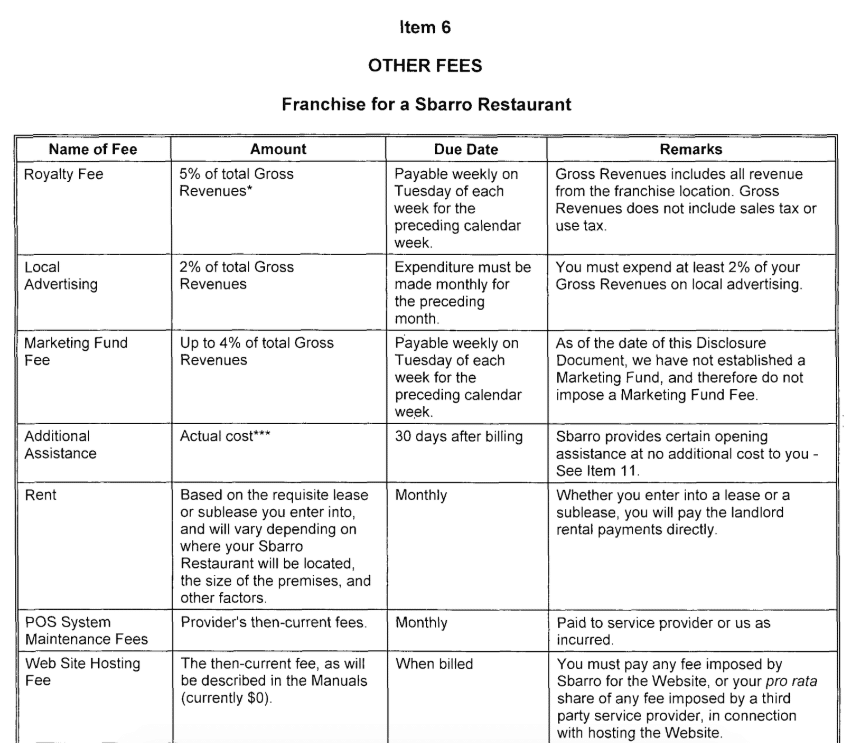
These costs and fees appear in Items 5, 6, and 7 of a Franchise Disclosure Document, which look like the following:
- Item 5: Initial Fees Paid to the Franchisor, such as the initial franchisee fee and pre-opening purchases
- Item 6: Other Fees, e.g., royalties, marketing and advertising fees, technology fees, and transactional fees
- Item 7: Estimated Initial Investment, including build-out and real estate, equipment and inventory, and working capital
Generally, if your business model is highly scalable and likely to thrive with multiple locations, you’d want to choose franchising instead of licensing.
Quick-service restaurant franchises like McDonald’s and Subway have highly scalable, replicable business models, as do fitness franchises such as Anytime Fitness and Crunch Fitness, where licensing alone wouldn’t be viable.
If you want to learn more about how to start a franchise or license, here’s a table to help you make the right choice:
| Feature | Franchising | Licensing |
| What Is It? | Grants rights for franchisees to use brands, systems, and trademarks to operate specific locations | Grants licensees the rights to intellectual property, like logos and patents |
| Control | Higher level of control for franchisors, who can manage operations, standards, and branding | Lower control over licensees |
| Support and Training | Involves more extensive training and ongoing support for franchisees | Little to no training, as licensees typically work independently |
| Fees | Upfront fees and ongoing royalties | Normally involves a one-time fee or royalties |
| Regulations | Highly regulated by FTC and state laws, with strict rules in place | Governed by general contract law |
| Risk | Lower risk for franchisors, but higher for franchisees | Lower risk for licensors and licensees, but there is some risk for the licensor |
| Examples | McDonald’s, Subway, Planet Fitness | Clothing brand labels, Disney |
In learning how to get a franchise started, you must also consider the risks of franchising vs. licensing. Franchising can entail lower overall risk, but that risk can vary significantly depending on capitalization, support obligations, unit economics, litigation, closures, and growth strategy.
Meanwhile, licensors and licensees can face lower risk in a licensing model, but there is potential risk for the licensor, including brand dilution and reputational damage, royalty and financial discrepancies due to licensee underreporting, and IP theft or reverse engineering.
Why Franchising Is a Scalable Business Model
As more and more businesses look to scale their operations and grow, there is an increasing number of franchises. IFA projects that the number of franchise establishments will increase from 832,521 to 845,000 this year, with total franchise GDP expected to reach $558.4 billion in 2026, up from $549.9 billion.
While this business model isn’t for every company, it could be the key to expansion if you have a highly scalable and proven business model.
Consider the benefits of franchising vs. growing a business with traditional branches, such as:
- The chance to expand your brand and rapidly increase recognition without steep upfront expenses.
- More time to focus on additional business opportunities as franchisees help run your business.
- Increased profitability through a combination of franchisee and royalty fees.
- Continually improve the franchise based on feedback from franchisees and their individual experience and expertise.
At the same time, there are certain key elements of franchising you need to consider, which will help determine precisely how to start a franchise, including:
- Branding: One major consideration is branding. You must maintain franchise brand consistency across all franchise locations, including creative design elements and your brand voice. However, that branding should be flexible to adapt to the needs of local markets at each location.
- Federal vs. State Legal Compliance: When learning how to start a franchise, franchisors must ensure their business and all franchise locations comply with both federal and state laws. On the federal side, franchises need to comply with laws like the FTC Franchise Rule, while state laws, such as New York’s laws around franchise regulation, may impose different requirements, including the need to register offerings with certain state-specific bureaus before offering or selling franchises.
- Operations: Franchises should ensure all franchises align with the overarching operational guidelines to maintain consistently high quality and the ideal customer experience across locations. In doing so, franchisors should provide franchisees with plenty of resources, including business systems and operating manuals.
As a franchisor, you will also have multiple responsibilities to consider, including:
- Establishing a clear business model that details all products or services, marketing and recruitment strategies, and operational procedures.
- Developing and providing legal documents to all franchisees, including a Franchise Disclosure Document (FDD) that serves as a pre-sale disclosure document detailing all financial requirements for franchisees before closing a deal.
- Agreements detailing the contract duration, all terms, fees, royalties, territory rights, training and support, operational standards, and other relevant details to both inform franchisees and keep them aligned with the franchisor.
- Offering continuous training and support for franchise management and franchise employees, with resources to help guide each franchise’s operations and marketing.
- Keeping branding and quality control consistent across the entire franchise.
- Safeguarding the brand and all intellectual property pertaining to the business.
- Helping franchisees select a site for a new location and assisting with development.
- Managing finances, including royalty fees and franchisee fees to potentially invest funding in enhancing individual locations or expanding operations.
- Maintaining compliance with state and federal legal requirements.
With the right approach to franchising, you could enjoy a long period of success as a franchisor while continuing to grow and connect with wider audiences.
How to Know When You’re Ready to Franchise: The Complete Franchise-Readiness Framework
Before learning how to start a franchise business, confirm whether your business is actually ready for franchising.
Here are some key indicators that it’s time to franchise:
Proven Unit Economics
To successfully launch a franchise, your business must already be profitable at the individual store level. Unit economics need to support the franchisee’s local profitability and your corporate royalty cut.
Documented Systems
A clear operations manual must also be in place, providing franchises with the guidance and support needed to operate their businesses while aligning them with the franchisor’s requirements. The result will be streamlined daily tasks, consistent product and service quality, and reliable customer service at each location.
Replicability
Franchisees should be able to easily replicate your business model and operations at every location, helping you maintain franchise brand consistency with an established brand voice and the same level of quality across all offerings and customer experiences.
Organic Demand
Customers and prospective franchisees must be eager to see or open your business in a specific area, or investors need to express interest in investing in your business as a franchise.
Protected Assets
You have registered trademarks, copyrights, or trade secrets, a secure brand name and logo, and proprietary methods.
Available Capital
Franchises will need sufficient funding to cover initial setup, FDD development, and support infrastructure.
Step-by-Step: How to Start a Franchise Business (From Concept to Launch)
So, if you want to learn how to start a franchise company, the following are some of the basic steps to get your business off the ground:
Step 1: Validate Your Business Model for Replication
Before you start with franchising, you need to determine whether your business model is conducive to franchising. You can do so by developing a proof of concept that demonstrates how your established business has developed a proven track record of success and viability as a potential franchise.
Your business model must also be highly scalable, with the ability for each location to replicate it. You can confirm this by analyzing everything from your operations and support systems to the entire supply chain, ensuring they can facilitate growth across multiple locations.
Also, conduct thorough market research to find out whether there’s sufficient demand to make franchising worthwhile.
Step 2: Maintain Legal Compliance
Another crucial step is ensuring the franchise remains compliant with all applicable franchise laws.
To maintain compliance on the state and federal level, you need to develop an in-depth Franchise Disclosure Document, or FDD, to provide franchisees with all of the necessary information about the franchisor and the franchise’s costs and fees.
If you want to know how to open a franchise with a compliant FDD, the following are all 23 of the items you will need to cover in your document:
- Item 1: Covers the franchisor’s background information, including details about the franchisor and its predecessors, parents, and affiliates
- Item 2: Details the previous five years of experience that individuals backing the franchise have, including directors and chief officers
- Item 3: Indicates any lawsuits involving the franchisor or its associated entities, along with any individuals listed in Item 2
- Item 4: Includes any history of bankruptcy affecting the franchisor and its associated entities and individuals
- Item 5: Specifies the fees and payments franchisees must pay for goods or services the franchisor offers before opening a business
- Item 6: Identifies fees, either occasional or recurring, required to operate the franchise
- Item 7: Details the franchisee’s initial investment to start operations, including inventory and rent
- Item 8: Lists sources for any goods and services franchises need, as well as the total revenue that suppliers may provide
- Item 9: Indicates the franchisee’s principal obligations based on the details of the franchise agreement
- Item 10: Indicates whether the franchisor offers financing and details financing arrangements
- Item 11: Shows where the franchisor details obligations to provide support to franchisees
- Item 12: Covers territory protections that franchisees may receive from franchisors
- Item 13: Lists all trademarks the franchisor owns
- Item 14: Details any of the franchisor’s patents and copyrights
- Item 15: Confirms whether the franchise needs to be directly involved in the franchise’s day-to-day operations
- Item 16: Describes restrictions in place for goods and services the franchisor offers
- Item 17: A chart relaying common provisions in the franchise agreement regarding the relationship between the franchisor and franchisee
- Item 18: Lists any public figures (e.g., spokespersons and celebrity backers) associated with the franchise
- Item 19: The only optional item, detailing past or projected financial performance
- Item 20: Charts indicating the number of all company-owned and franchise units that have existed for the past three years
- Item 21: Details all franchise financial statements, from the balance sheet to the cash flow statement
- Item 22: Lists proposed agreements for selling the franchise
- Item 23: A receipt for the FDD that potential franchisees must sign before receiving the actual FDD
Additionally, you must comply with the Franchise Rule under the Federal Trade Commission (FTC), which governs the sale and offer of franchises. For example, to adhere to FTC regulations, you will need to provide franchisees with an FDD at least 14 calendar days before signing a binding agreement or making a payment to the franchisor or affiliate in connection with the proposed sale.
Franchises may also provide financial performance representations detailing earnings. If franchises opt to make them, they will need a reasonable basis, written substantiation, and to maintain compliance with Item 19 (Financial Performance Representations) under C.F.R. 16 §436.5(s), e.g., “whether the representation is an historic financial performance representation about the franchise system’s existing outlets, or a subset of those outlets, or is a forecast of the prospective franchise’s future financial performance.
Step 3: Create Franchise Documentation and Training Systems
Create thorough documentation and training programs for both franchisees and staff who work under those franchisees.
For franchisees, you’ll want to provide an FDD, operational manual, and a franchise agreement, with structured training programs helping efficiently onboard your franchisees. Training should go over various critical topics, including operational procedures, marketing, and customer service.
Franchises should also have access to training manuals, videos, online modules, and more to continue their own training while also enabling them to effectively train new employees at each location.

Step 4: Develop Operational Manuals and Brand Standards
In keeping all locations aligned with the overarching franchise, put together a complete operational manual for franchisees to follow. This manual can go into daily operations, inventory management, quality control procedures, and customer service standards.
Also, be sure to detail brand standards for everything from store layouts and logo usage to interactions with customers, quality control, and marketing requirements.
To enable its franchisees to access critical training programs and continually develop, senior care franchise Griswold Home Care offers a comprehensive training program through CareAcademy, providing in-depth training for all caregivers at every location.
Step 5: Implement Franchise Marketing and Recruitment Strategies
To effectively launch your franchise, you will need strong franchise marketing efforts that connect with prospective franchisees.
A complete franchise marketing strategy could include online marketing, expos, industry publications, and more to build a relationship with valuable potential franchisees.
Your recruitment process should also be thorough to weed out low-quality franchisees, ensuring your franchise owners align with your company’s unique values and have the experience, expertise, and resources to successfully run your locations.
In learning how to franchise a business, here are some criteria to look for in the ideal franchisee:
- A minimum net worth and liquid assets to ensure franchisees meet all initial financial requirements
- Proof of capital to cover franchise fees, marketing, equipment, and real estate expenses
- A clean credit history demonstrating financial responsibility
- Experience in management, sales, or operations
- Experience in the specific industry
- Demonstrable leadership skills
- Soft skills, including superior customer service and adaptability
- Commitment to helping the franchise flourish in the long term
Digging even deeper into how to start a franchise business when interviewing franchisees, consider these best practices during the screening process:
- Prepare and segment questions around training, financial performance, and support
- Interview multiple top performers as well as new franchisees to get multiple perspectives
- Test the candidates’ local market knowledge to determine their understanding of the designated territory
Taking the right approach to the interview process will inform you of how to open a franchise with the ideal prospect.

Step 6: Market Your Franchise
As you discover how to franchise your business, you must also master franchise marketing and lead generation.
Each location should also have a location-specific marketing strategy that connects with local demographics through social media, geofencing, geotargeting, and other strategies.
There are plenty of digital and offline marketing strategies you can use to guide you on how to get a franchise started, such as:
- Local SEO and Google Business Profile development
- Content marketing with location-specific geo pages and other landing pages
- Expos and conventions that give you the chance to promote your franchise in person
- Social media marketing on platforms your audience uses
- Email and SMS text messages
- Mobile advertising and other pay-per-click (PPC) strategies
- Direct mail campaigns
- In-store events and promotions
- Local partnerships
- Print and media advertising
When trying to attract prospective franchisees with your marketing, be sure to appeal to search intent with your organic strategy, which will help you connect with the right audiences at every stage of the buyer’s journey, from looking up initial information about how to get into franchising to comparing the best franchise opportunities in their area.

McDonald’s example of franchise email marketing.
The Phased Franchising Roadmap
To further inform you on how to start a franchise company with each of these steps, implement the following roadmap:
| Phase | Steps to Cover |
| Assessment and Strategy |
|
| Structural and Legal Development |
|
| Infrastructure and Operationalization |
|
| Launch and Sales Execution |
|
How Much Does It Cost to Franchise Your Business?
So, how much does it cost to start a franchise, exactly?
In determining how much to start a franchise, let’s break down the potential costs of each major component:
- Franchise Counsel and Legal Documents: Often the largest upfront expense, these costs account for the total amount of money needed to work with an attorney to help draft your FDD and franchise agreement while ensuring consistent federal and state legal compliance.
- Audited Financial Statements: The FTC also requires franchisors to include any audited financial statements in FDDs demonstrating financial viability, which will entail paying a Certified Public Accountant (CPA) to conduct an open balance sheet audit.
- Trademark Work: Franchisors must own the franchise business’s intellectual property, which will require hiring a trademark attorney to conduct a thorough clearance search and file any necessary applications with the U.S. Patent and Trademark Office (USPTO) for securing national rights.
Manuals and Training: - State Filings: 14 “Registration States” like New York and California require franchises to submit their FDDs to state regulators for approval prior to advertising or selling franchises in those states, and other states may have certain laws and regulations around notice filings or business opportunity exemptions.
- Technology: The tech budget for a franchise will involve components like franchise management system (FMS) and customer relationship management (CRM) tools, along with unified point-of-sale (POS) systems and training tools.
- Franchise Development Marketing: Another cost factor will include marketing to find and attract prospective franchisees, with expenses like franchise recruitment websites, lead gen ads, and digital brochures to connect with viable candidates.
- Staffing and Field Support: Franchises will need to budget for salaries and hiring support staff when staffing individual locations.
- Working Capital: This cost accounts for the liquid cash available for franchisors to maintain operations, including the costs of construction and opening along with royalty fees that franchises pay to help offset corporate expenses.
- Annual Updates and Renewals: Every year, FDDs expire and require renewal, requiring franchises to update them within 120 days of the end of the fiscal year. These expenses also cover annual CPA audit updates and renewal fees paid to registration states.
There are plenty of examples of successful franchise startups out there to inspire you.
For example, Dave’s Hot Chicken is a recent quick-service restaurant that continues to expand across the country (and internationally after its establishment in 2017. The cost of owning one of these franchises is about $619,800 to $1,963,000. The company started with humble beginnings as a pop-up in East Hollywood, and has since expanded to 283+ locations in the U.S. alone.
Another up-and-comer is the cleaning franchise MaidThis, which capitalized on the niche market for Airbnb cleaning services. The company began in 2013 as a fully remote business specializing in vacation rental cleaning. Today, there are 20 franchises hitting local markets with a maximum initial cost of $60,000–$80,000 for franchisees.
Before starting a franchise business, here is a breakdown of the average costs you can expect:
| Factor | Cost Range |
| Initial Franchise Fee | $25,000 to $50,000 |
| Total Startup Investment | $100,000 to $300,000 |
| Working Capital for 3 to 6 Months | $20,000 to $100,000+ |
| Ongoing Royalties | 4% to 12% of gross sales |
| Marketing Fees | 1% to 5% of gross sales |
Pitfalls to Avoid When Starting a Franchise
The following are some issues that new franchises should avoid:
- Underestimating the Capital Required: One big mistake involves neglecting to take into account all the costs required to start up a franchise. Consider how much you would need to pay in your industry and set aside a budget to help you, along with potential financing options.
- Poor Franchisee Support: Give your franchisees all of the resources and training they need to be the best at their jobs, equipping them to contribute to lasting success for your brand.
- Legal Missteps: Consult a franchise lawyer or another legal expert to help you maintain compliance with FTC regulations and other relevant franchise laws.
- Weak Brand Differentiation: Take steps to set your brand apart with unique logos, selling propositions, branding materials, and business models. Otherwise, brands could fail to stand out; for instance, a gym franchise might use colors and images similar to competitors like Planet Fitness or Orange Theory, which could make it harder to stand apart, even with unique messaging and offers.
- Poor Growth Strategy: Franchisors could also attempt to expand too quickly as they learn how to start a franchise, keeping them from effectively establishing their brands and building financial stability.
- Territory Disputes: Franchises may also open up in areas where other competitors can easily open, which is why it’s important to establish exclusivity when opening and operating a franchise in a different country, state, or city.
- There are three main types of territory models, including exclusive, protected, and nonexclusive: Exclusive territory models give franchisees the sole right to operate and sell a franchise’s products or services within a specific geographic area, while protected territory models protect franchisees’ physical investments with more flexibility for franchisors to maximize market share, and nonexclusive territory models allow franchisees to sell at a specific location without any geographic protection for the surrounding area.
There are also plenty of ways to avoid making these and other mistakes when determining how to franchise a business, such as:
- Perform thorough due diligence
- Secure sufficient working capital
- Maintain brand consistency across all marketing and locations
- Master local marketing with local SEO and other strategies
- Establish clear operating systems that all franchisees must adhere to
- Conduct rigorous franchisee screening
FAQs on How to Start a Franchise
1. What is the first step to franchising my existing business?
So, how do you start a franchise with an existing business? One of the best ways to do so is to determine whether your brand makes a feasible franchise, with a repeatable and well-established business model that can foster real growth across multiple locations.
2. How long does it take to launch a franchise system?
As you learn how to start a franchise business, you can expect launching a franchise system to take around one to four months, depending on the complexity of your business and branding requirements, such as putting together a Franchise Disclosure Document (FDD) and a Franchise Agreement.
3. Can you start a franchise with no money?
You might also wonder about how to open a franchise without any money, but this is nearly impossible. However, you may be able to get some assistance with various financing options, such as SBA loans, investor partnerships, seller financing, or home equity.
4. How do I know whether my business is ready to franchise?
If you want to know how to start a franchise, you need to know when it’s the right time to franchise. There are several factors that indicate when it’s time, including proven unit economics, documented systems, the ability to replicate your business, organic demand from prospective franchisees and end customers, protected assets, and available capital for setup.
5. What are the FTC’s three elements of a franchise?
When learning how to franchise your business, here are a few key elements the FTC lists for franchises:
- The trademark the franchisor gives franchisees the right to use.
- Significant control or assistance that franchisors can and will provide to support franchisees’ operations.
- A required minimum payment that franchisees must make to franchisors or affiliates within six months of starting operations.
6. What must an FDD contain?
To determine how to start a franchise business, you’ll need to develop a Franchise Disclosure Document. FDDs list 23 items detailing every aspect of the franchise, with Item 19 being the only optional one for detailing historical or projected financial performance. FDDs describe the nature of the franchisor, fees and costs, legal terms, and other critical details.
7. When must a prospect receive the FDD?
When learning how to franchise your business, you must also know when to give your franchisee candidates your FDD. Generally, the FTC requires franchisors to provide prospects with an FDD at least 14 days before executing a binding agreement or collecting fees.
8. Is Item 19 required?
As you discover how to get a franchise started, you’ll need to complete all 22 required items on the FDD, but Item 19 is the sole optional item. This item enables franchises to disclose historical or projected financial performance for representation, provided they have sufficient proof to support the numbers.
9. Which states require franchise registration?
When researching “how to start franchising my business in my state,” keep in mind that some states require franchisors to register their franchises. These 14 states include:
- California
- Hawaii
- Illinois
- Indiana
- Maryland
- Michigan
- Minnesota
- New York
- North Dakota
- Rhode Island
- South Dakota
- Virginia
- Washington
- Wisconsin
10. Do new franchisors need audited financial statements?
As you look into “how to start franchising my business,” another item to consider is financial statement auditing. In short, you do need to audit your franchise’s financial statements, but the amount of time you have to do so will depend on the specific geographic location where you want to sell.
11. Should I register my trademark first?
You might ask, “How do I franchise my business without compromising my IP?” One of the steps you need to take to secure your IP is to register your company’s trademark with the U.S. Patent and Trademark Office (USPTO) before allowing franchisees to operate any location.
12. How frequently must the FDD be updated?
Franchisors must update their FDDs at least once per year, as they expire at the end of the fiscal year. However, you will also need to update them immediately if your business experiences any major changes that the FDD must reflect in any of the 23 items.
13. How should franchise fees and royalties be determined?
As you discover how to open a franchise, you’ll need to determine the franchise fees and royalties that franchisees must pay. These costs will depend on factors such as what competitors charge in your industry and how much you need to fund your corporate infrastructure while enabling the franchisee to run a profitable business.
Learn How to Start a Franchise the Right Way With Ignite Visibility
If you want to discover how to start a franchise business, Ignite Visibility is here to help you with every aspect of franchise development. We offer comprehensive marketing solutions for franchises of all types, with the ability to:
- Develop a high-quality website for your franchise and each franchise location
- Use social media to connect your franchise and locations to all target audiences
- Create a wide range of marketing content to attract new franchisees and end customers
- And more!
Sound like a plan? Learn more about how to start a franchise with our franchise development and franchise marketing services.