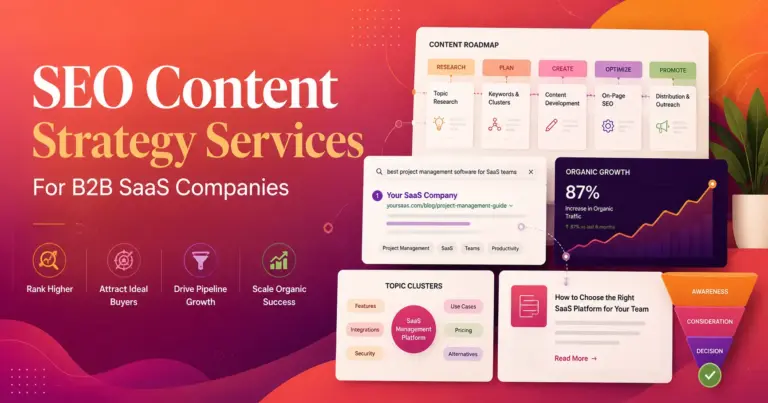
B2B SEO Services for Companies With Long Sales Cycles: Strategy, Leads, and Revenue Growth
B2B SEO Services for Companies With Long Sales Cycles
Buying a pair of shoes online is simple. Search, compare, click, pay.
Buying enterprise software, industrial equipment, cybersecurity consulting, logistics technology, or a multi-year professional service contract is not simple. It can involve procurement, finance, legal, IT, operations, department heads, executive sponsors, security reviews, technical demos, budget cycles, and internal politics.
That is exactly why B2B SEO services need to be built differently.
For companies with long sales cycles, SEO is not just about ranking for high-volume keywords. It is about showing up at the right moments across a messy buying journey. A potential buyer may search one problem today, compare vendors three weeks later, read implementation guides next month, and finally request a demo after an internal stakeholder meeting.
A generic SEO campaign usually misses that reality.
Good B2B SEO connects search visibility with pipeline. It helps your company become visible when buyers are researching problems, defining requirements, comparing options, checking risk, and looking for proof. It also gives your sales team better assets to use during conversations that rarely close quickly.
That matters for B2B SaaS companies, industrial suppliers, manufacturers, engineering firms, enterprise consultants, managed service providers, compliance companies, and any business where the buyer needs trust before they speak to sales.
The goal is not “more traffic” on its own.
The goal is better demand, better-fit leads, clearer buyer education, stronger sales enablement, and more qualified opportunities from search.
Why B2B SEO Is Different When the Sale Takes Months
B2B SEO gets harder when the buying process is slow.
In short-cycle consumer SEO, someone may search “best running shoes for flat feet,” read two reviews, and buy the same day. In B2B, someone may search “how to reduce cloud infrastructure costs,” download a checklist, attend a webinar, compare platforms, speak with peers, evaluate three vendors, and wait until next quarter’s budget is approved.
That difference changes the entire SEO strategy.
The Buyer Is Rarely One Person
In B2B, the person doing the search is not always the final decision-maker.
A searcher might be:
- A marketing manager researching CRM migration problems
- A plant manager comparing predictive maintenance solutions
- A CFO reviewing cost-control software
- An IT director evaluating security risks
- A procurement analyst building a vendor shortlist
- A founder checking whether a tool solves a scaling problem
- A technical lead validating integration requirements
Each person asks different questions.
That means one landing page usually cannot satisfy the whole buying committee. You need content that speaks to users, influencers, decision-makers, and blockers.
For example, a B2B SaaS company selling compliance automation may need content for legal teams, finance leaders, security officers, operations managers, and procurement. Each audience cares about a different type of risk.
The legal team may care about audit readiness.
The CFO may care about cost exposure.
The security team may care about access controls.
The operations team may care about workflow friction.
Procurement may care about vendor stability.
A strong B2B SEO agency understands this and builds content around buying roles, not just keywords.
The Sale Depends on Trust Before Contact
Many B2B buyers do not want to contact sales early.
They want to self-educate first. They want to understand the problem, learn the terminology, compare solution categories, and decide whether a vendor seems credible.
If your site only has sales pages, you are asking for commitment too early.
That is a common problem in B2B SEO. A company creates a homepage, a few service pages, a pricing page, and maybe three blog posts. Then it wonders why organic traffic does not convert.
The issue is not always traffic volume. Often, the issue is that the site does not answer enough of the buyer’s questions.
Long sales cycles require a deeper content ecosystem.
You need pages that help buyers move from vague awareness to confident action.
Search Terms Change as the Buyer Matures
A buyer does not search the same way at every stage.
Early-stage searches are often problem-focused:
- “why is sales forecasting inaccurate”
- “manufacturing downtime causes”
- “how to reduce customer churn in SaaS”
- “manual compliance reporting problems”
Middle-stage searches become solution-focused:
- “sales forecasting software”
- “predictive maintenance platform”
- “customer success software”
- “compliance automation tools”
Late-stage searches become vendor-focused or comparison-based:
- “best sales forecasting software for enterprise”
- “predictive maintenance software comparison”
- “customer success platform pricing”
- “compliance automation vendor checklist”
If your SEO strategy only targets bottom-funnel terms, you may miss buyers while they are still shaping the problem. If your strategy only targets top-funnel education, you may attract readers who never become opportunities.
The strongest B2B SEO services cover the full journey.
What B2B SEO Services Actually Include
B2B SEO services should not be a vague monthly package with “blogs, backlinks, and reports.”
That model is too shallow for companies with long sales cycles.
A serious B2B SEO program usually includes strategy, research, technical SEO, content planning, content production, conversion optimization, analytics, sales alignment, and ongoing performance refinement.
Strategic Discovery
Before writing content or changing metadata, a B2B SEO partner should understand the business model.
That includes:
- Target industries
- Ideal customer profile
- Average contract value
- Sales cycle length
- Buyer roles
- Sales objections
- Product complexity
- Competitive positioning
- Geographic focus
- Current pipeline sources
- Conversion paths
- CRM and analytics setup
Without this, SEO becomes disconnected from revenue.
For example, a keyword may have plenty of search volume but attract the wrong buyer. “Free inventory software” might bring traffic, but if your product sells to enterprise supply chain teams at $60,000 per year, that traffic may waste sales resources.
Good B2B SEO starts with commercial fit.
B2B Keyword Research
B2B keyword research is not just collecting search volume.
It involves mapping search terms to:
- Buyer awareness
- Funnel stage
- business pain
- product category
- buying role
- industry vocabulary
- commercial intent
- sales objections
- content type
- conversion opportunity
A simple keyword list is not enough.
For long-cycle B2B companies, keywords need to be grouped by intent. Some terms deserve service pages. Some deserve comparison pages. Some need technical explainers. Some should become use-case pages. Some are better suited for sales enablement content than organic acquisition.
A high-quality keyword strategy should separate:
- Problem keywords
- Solution keywords
- Category keywords
- Industry keywords
- Competitor keywords
- Integration keywords
- Compliance keywords
- ROI keywords
- Implementation keywords
- Pricing keywords
- Comparison keywords
- “Alternative to” keywords
This is where many campaigns go wrong. They chase broad informational topics but ignore terms that show buying intent.
Technical SEO
Technical SEO helps search engines access, crawl, index, and understand a website. Google’s own SEO Starter Guide emphasizes making sites easier to crawl, index, and understand, which is especially important for large or complex B2B websites. (Google for Developers)
For B2B companies, technical SEO often includes:
- Crawlability improvements
- Indexation cleanup
- XML sitemap optimization
- Robots.txt review
- Canonical tag fixes
- Redirect mapping
- Internal linking improvements
- Core Web Vitals review
- JavaScript rendering checks
- Schema markup planning
- Duplicate content cleanup
- Faceted navigation control
- International SEO checks
- CMS template optimization
- Log file analysis for large sites
Technical SEO is especially important for enterprise websites with product libraries, resource hubs, gated content, documentation, partner pages, regional pages, and multiple CMS templates.
If search engines cannot understand your site structure, even strong content may underperform.
Enterprise Content Strategy
An enterprise content strategy is more than publishing blog posts.
It defines how content supports business goals across search, sales, customer education, and brand authority.
For B2B SEO, content strategy should answer questions like:
- Which topics should the company own?
- Which buyer problems are commercially valuable?
- Which pages support lead generation?
- Which content helps sales close deals?
- Which pages need expert input?
- Which topics require product screenshots, diagrams, or demos?
- Which content should be gated or ungated?
- Which old content should be updated, merged, or removed?
- Which internal links should connect awareness content to conversion pages?
A good strategy builds topical authority without creating thin, repetitive pages.
That matters because modern search quality systems are increasingly focused on helpfulness, originality, and user value. Google’s guidance stresses creating reliable, people-first content rather than content designed only to manipulate rankings. (Google for Developers)
Content Production
B2B content needs subject-matter depth.
A generic writer can produce clean copy, but long-cycle B2B buyers often need practical detail. They want to know how the solution works, what tradeoffs exist, how implementation happens, and whether the vendor understands their industry.
Strong B2B SEO content may include:
- Use-case pages
- Industry pages
- Service pages
- Comparison pages
- Technical guides
- Implementation guides
- ROI explainers
- Buyer guides
- Glossaries
- Case studies
- Integration pages
- Product-led content
- Problem-solution articles
- Procurement support content
- Sales enablement pages
The best content often comes from collaboration between SEO strategists, writers, product marketers, sales teams, technical experts, and customer-facing staff.
Conversion Optimization
Traffic without conversion is not enough.
B2B SEO services should improve the path from organic visit to qualified lead.
That may include:
- Clear calls to action
- Better demo request pages
- Lead magnets matched to intent
- Stronger forms
- Trust signals
- Proof points
- Case study placement
- Pricing or packaging clarity
- Sticky navigation
- Internal links to commercial pages
- Chat or contact routing
- Newsletter or nurture capture
- Persona-specific CTAs
Not every visitor is ready to request a demo. That is fine.
The site should offer different conversion options for different stages:
- Read more
- Compare options
- Download a checklist
- View a case study
- Watch a demo
- Estimate ROI
- Contact sales
- Request a consultation
Long sales cycles require softer conversion points, not just hard sales forms.
How Long Sales Cycles Change SEO Strategy
A long sales cycle changes what SEO needs to accomplish.
For a short-cycle purchase, SEO can often focus on ranking, product pages, reviews, and checkout. For long-cycle B2B, SEO has to create repeated moments of trust.
SEO Must Support Multiple Touchpoints
A buyer may visit your website several times before converting.
They may read an article, leave, return through a branded search, compare a solution page, send a resource to a colleague, and later submit a form after seeing your company appear again for another query.
This means attribution can be messy.
Organic search might influence the deal long before the final conversion. If reporting only credits last-click demo requests, SEO may look weaker than it really is.
A better measurement model considers:
- Assisted conversions
- Organic-influenced pipeline
- First-touch source
- Returning organic users
- Content engagement by account
- Lead quality by landing page
- Sales-qualified opportunities
- Closed-won revenue influenced by SEO
- CRM notes mentioning content assets
For companies with six-month or twelve-month sales cycles, SEO should be evaluated over time, not by immediate lead volume alone.
Content Must Reduce Buyer Uncertainty
B2B buyers delay decisions when they feel risk.
They may wonder:
- Will this integrate with our systems?
- How hard is implementation?
- Will our team adopt it?
- Is the vendor stable?
- Can this meet compliance requirements?
- What happens if we choose the wrong solution?
- Will this actually produce ROI?
- Can we justify this internally?
SEO content can reduce uncertainty before the sales call.
For example, an enterprise SaaS company might create content around implementation timelines, data migration, integration requirements, security controls, pricing models, and internal business-case templates.
That content does two things.
First, it attracts serious buyers searching those questions.
Second, it gives sales teams useful assets to send during active deals.
SEO Must Align With Sales Language
Many SEO campaigns fail because they use keyword language that does not match sales reality.
Marketing may target “workflow optimization platform,” while prospects say “we’re drowning in manual approvals.”
A good SEO strategy uses both.
It captures search demand while reflecting the language buyers actually use in calls, demos, RFPs, and customer interviews.
Useful sources include:
- Sales call recordings
- CRM notes
- Customer interviews
- Demo objections
- Lost deal reasons
- Support tickets
- Product review sites
- RFP language
- Industry forums
- Analyst reports
- Internal sales decks
This is where B2B SEO becomes more than search marketing. It becomes buyer intelligence.
B2B Keyword Research for Serious Buyers
Keyword research for B2B companies should not start with a tool. It should start with the buying journey.
Tools help, but they do not understand your sales process by default.
Start With Commercial Reality
Before choosing keywords, define what a qualified buyer looks like.
Ask:
- Which industries produce the best customers?
- Which company sizes have budget?
- Which use cases close fastest?
- Which pain points create urgency?
- Which buyers have authority?
- Which problems lead to high contract value?
- Which terms attract students, job seekers, or low-budget users?
- Which terms signal a real project?
This helps separate traffic from pipeline.
For example, “what is ERP” may have high search volume. But “ERP implementation partner for manufacturing” may be far more valuable for an enterprise consulting firm.
Volume is not the whole story.
In B2B SEO, a keyword with 90 searches per month can outperform a keyword with 9,000 searches per month if it reaches the right buyer at the right moment.
Map Keywords by Funnel Stage
A practical B2B keyword framework looks like this:
| Funnel Stage | Search Behavior | Example |
|---|---|---|
| Problem aware | Buyer understands pain, not solution | “why are supply chain costs rising” |
| Solution aware | Buyer explores categories | “supply chain planning software” |
| Vendor aware | Buyer compares providers | “best supply chain planning tools” |
| Validation | Buyer checks risk and fit | “supply chain software implementation timeline” |
| Decision | Buyer wants next step | “supply chain planning software demo” |
This mapping helps you avoid building a content library that attracts readers but not buyers.
Use Bottom-Funnel Keywords Carefully
Bottom-funnel keywords are commercially valuable, but they are also competitive.
Examples include:
- “B2B SEO agency”
- “enterprise SEO services”
- “lead generation SEO agency”
- “industrial SEO company”
- “SaaS SEO consultant”
- “best SEO agency for B2B SaaS”
These terms often deserve strong landing pages, not generic blog posts.
A bottom-funnel page should include:
- Clear service positioning
- Industry fit
- Problems solved
- Process
- Deliverables
- Proof points
- Case studies
- FAQs
- Conversion CTA
- Internal links to supporting resources
Do not overdo it with keyword repetition. Buyers notice when a page is written for a crawler instead of a person.
Do Not Ignore Low-Volume Expert Keywords
Long-cycle B2B buyers often search niche terms.
Examples:
- “ISO 27001 vendor due diligence checklist”
- “predictive maintenance ROI calculation”
- “SOC 2 requirements for SaaS vendors”
- “multi-plant inventory visibility”
- “enterprise content governance model”
- “ERP integration with warehouse management system”
These queries may not look impressive in keyword tools. But they can indicate serious intent.
A buyer searching for “SOC 2 requirements for SaaS vendors” may be involved in procurement, compliance, or security review. That person may not convert immediately, but they can influence the deal.
Expert keywords are often where trust is built.
Building an Enterprise Content Strategy That Supports Pipeline
An enterprise content strategy should connect search demand with business priorities.
It should not be a random publishing calendar.
Build Topic Clusters Around Commercial Themes
A topic cluster is a group of related pages organized around a central subject.
For B2B SEO, topic clusters should be built around commercially relevant themes.
For example, a cybersecurity company might build clusters around:
- Vendor risk management
- Security compliance
- Cloud security posture
- Incident response
- Identity and access management
- Data protection
- Security automation
Each cluster could include:
- A core service or solution page
- Supporting educational guides
- Comparison content
- Templates or checklists
- Industry-specific pages
- Case studies
- FAQ pages
- Integration pages
- Internal links between related assets
This helps users navigate the topic. It also helps search engines understand the site’s topical depth.
Use Product-Led Content
Product-led content teaches while naturally showing how the product or service solves the problem.
It is not a disguised sales pitch.
For example, instead of writing “10 Benefits of Workflow Automation,” a B2B SaaS company could write:
- “How to Automate Approval Workflows Without Breaking Compliance”
- “Workflow Automation Examples for Finance, HR, and Operations Teams”
- “Manual Approval Bottlenecks: How to Find and Fix Them”
- “Workflow Automation Requirements Checklist for Enterprise Teams”
These topics attract buyers with real operational pain.
Inside the content, the company can naturally explain how its product handles routing, approvals, permissions, audit trails, integrations, and reporting.
That is much stronger than generic thought leadership.
Create Content for Internal Champions
In long sales cycles, one person often becomes the internal champion.
This person needs to convince others.
SEO content can help them.
Useful assets include:
- ROI calculators
- Business case templates
- Vendor comparison checklists
- Security review guides
- Procurement-ready one-pagers
- Implementation timelines
- Cost of inaction articles
- Executive summary pages
- Industry benchmark explainers
This content may not always generate massive traffic. But it can help move deals forward.
That is the difference between traffic-focused SEO and revenue-focused B2B SEO.
Refresh Existing Content Before Publishing More
Many B2B websites already have content. The issue is that much of it is outdated, thin, duplicated, buried, or disconnected from conversion paths.
Before publishing 50 new articles, review what already exists.
Look for:
- Pages with impressions but low clicks
- Pages with rankings on page two
- Pages with traffic but no conversions
- Pages with outdated examples
- Duplicate blog posts targeting similar topics
- Old webinars that could become guides
- Sales decks that could become landing pages
- Case studies that are not internally linked
- Product pages missing buyer questions
- Technical documents hidden from search
Updating existing content can sometimes produce faster gains than creating new content from scratch.
It also reduces the risk of scaled, low-value publishing. Google’s spam policies specifically caution against large amounts of unoriginal content made primarily to manipulate rankings. (Google for Developers)
Lead Generation SEO: From Traffic to Qualified Opportunities
Lead generation SEO is not just about getting form fills.
It is about attracting the right people and giving them enough confidence to take the next step.
Traffic Quality Matters More Than Traffic Quantity
A B2B company can increase organic traffic and still get poor results.
This happens when SEO attracts:
- Students
- Job seekers
- DIY users
- Very small businesses with no budget
- Consumers
- Competitors
- Unqualified international visitors
- Research-only audiences
- People looking for free tools
Some of that traffic is not bad. But if it dominates the site, sales teams may lose trust in SEO.
Better B2B SEO measures quality.
Useful indicators include:
- Demo requests from target industries
- Lead-to-MQL conversion rate
- MQL-to-SQL conversion rate
- Organic pipeline value
- Target account visits
- Content engagement by company size
- Returning visitors from strategic accounts
- Conversion rate by landing page type
- Sales feedback on organic leads
For B2B, one qualified enterprise opportunity can be worth more than thousands of casual visits.
Match CTAs to Intent
Not every visitor should see the same call to action.
A visitor reading “what is vendor risk management” may not be ready for a demo. A visitor reading “vendor risk management software comparison” might be closer.
CTA matching can improve lead quality.
Examples:
| Page Type | Best CTA |
|---|---|
| Beginner guide | Read related guide, subscribe, download checklist |
| Problem article | View solution page, calculate impact, download framework |
| Comparison page | Book demo, view pricing, request consultation |
| Use-case page | See case study, talk to expert |
| Technical page | Download requirements checklist, view integration docs |
| Case study | Request similar results discussion |
The goal is to give the buyer a natural next step.
Build Conversion Paths, Not Dead Ends
Many B2B blogs are dead ends.
A visitor reads the article and leaves because there is no logical path forward.
Every important SEO page should answer:
- What should the reader do next?
- Which related page deepens the topic?
- Which commercial page connects to this problem?
- Which proof point supports trust?
- Which CTA matches the reader’s stage?
Internal linking should feel helpful, not forced.
A strong article about “reducing manual compliance reporting” might link to:
- Compliance automation service page
- Audit readiness checklist
- Case study from a regulated industry
- Integration guide
- ROI article
- Demo request page
That is how SEO becomes part of the buyer journey.
SEO for B2B SaaS Companies
B2B SaaS SEO has its own challenges.
The product is often complex, competitors are aggressive, and buyers compare multiple vendors before booking a demo.
SaaS SEO Needs Category and Use-Case Coverage
A SaaS company should usually build around both category and use-case terms.
Category pages target the product market:
- CRM software
- HR compliance software
- Customer success platform
- Revenue intelligence software
- Inventory management software
- Workflow automation software
Use-case pages target specific problems:
- Automate employee onboarding
- Reduce customer churn
- Forecast sales pipeline
- Manage vendor risk
- Track manufacturing defects
- Improve support ticket routing
Category pages help buyers who know the solution type. Use-case pages help buyers who know the problem.
Both are needed.
Integration Keywords Can Be Valuable
B2B SaaS buyers often search for integrations.
Examples:
- “Salesforce integration”
- “HubSpot integration”
- “NetSuite inventory integration”
- “Slack workflow automation”
- “SAP integration for procurement”
- “Microsoft Teams approval workflow”
Integration pages can attract high-intent buyers because they show operational fit.
A strong integration page should explain:
- What the integration does
- Who needs it
- Common workflows
- Setup requirements
- Data sync behavior
- Security considerations
- Limitations
- Related use cases
- CTA for implementation help
Thin integration pages rarely perform well. Detailed, useful pages are much stronger.
Comparison Content Must Be Honest
SaaS buyers search for alternatives and comparisons.
That includes:
- “[Competitor] alternative”
- “[Tool A] vs [Tool B]”
- “best [category] software”
- “[software] pricing”
- “[software] reviews”
This content can be powerful, but it must be handled carefully.
Weak comparison pages exaggerate, attack competitors, or hide important details. Strong comparison pages explain fit.
A good comparison page should clarify:
- Who each option is best for
- Main differences
- Pricing model considerations
- Implementation complexity
- Integrations
- Support model
- Security and compliance features
- Scalability
- Migration factors
Buyers appreciate honesty. So do sales teams, because honest positioning reduces bad-fit leads.
SEO for Industrial and Manufacturing Companies
Industrial SEO is often overlooked, which creates opportunity.
Many manufacturers and industrial service firms have strong expertise but weak digital visibility.
Industrial Buyers Search Differently
Industrial buyers often use technical language.
They may search by:
- Part type
- Material
- Process
- Specification
- Application
- Industry
- Compliance requirement
- Equipment type
- Failure mode
- Maintenance issue
- Engineering standard
For example, an industrial buyer may not search “best manufacturing company.” They may search:
- “custom stainless steel pressure vessels”
- “CNC machining for aerospace components”
- “industrial heat exchanger maintenance”
- “food-grade conveyor belt supplier”
- “predictive maintenance for rotating equipment”
- “ISO certified metal fabrication company”
This requires precise keyword research and strong technical content.
Product and Capability Pages Matter
Industrial websites often underuse capability pages.
A strong capability page should explain:
- What the company does
- Materials handled
- Equipment used
- Tolerances or specifications
- Industries served
- Quality controls
- Certifications
- Production capacity
- Lead times
- Engineering support
- Relevant case studies
- Request-a-quote path
This type of content helps both search visibility and buyer confidence.
Technical Proof Is Essential
Industrial buyers need proof.
Useful trust signals include:
- Certifications
- Standards
- Facility capabilities
- Engineering experience
- Quality assurance process
- Safety practices
- Equipment lists
- Project examples
- Industry experience
- Testing procedures
- Compliance documentation
- Supplier qualifications
SEO content should not be vague. It should show operational competence.
SEO for Enterprise Service Firms
Enterprise service firms sell expertise, not just deliverables.
That includes consulting firms, IT service providers, cybersecurity firms, implementation partners, legal support companies, financial advisory firms, and specialized agencies.
Expertise Must Be Visible
Enterprise buyers want to know who is behind the service.
That means content should include:
- Expert authorship
- Clear methodology
- Use cases
- Client scenarios
- Industry experience
- Frameworks
- Case studies
- Original insights
- Practical examples
- Clear limitations
Google’s guidance around helpful content encourages creators to consider who created the content, how it was produced, and why it exists. (Google for Developers) For enterprise service firms, that means expert input should be visible, not hidden.
Service Pages Need More Than Generic Claims
A weak service page says:
“We provide world-class digital transformation consulting.”
A strong service page explains:
- Which transformation problems you solve
- Which industries you serve
- How the engagement works
- What the client receives
- What stakeholders are involved
- What risks you reduce
- What timeline is realistic
- What makes your approach different
- What proof supports your claims
- What the next step looks like
Enterprise service buyers need clarity.
They are not looking for vague confidence. They are looking for reduced risk.
Thought Leadership Should Connect to Demand
Thought leadership can support SEO, but only when it connects to buyer concerns.
A consulting firm might publish strong content around:
- Operating model redesign
- Enterprise AI governance
- Cloud migration risk
- Cybersecurity maturity
- Procurement transformation
- Data governance
- Revenue operations
- Compliance modernization
- Change management
- Cost optimization
The content should not just offer opinions. It should help buyers understand decisions, tradeoffs, risks, and next steps.
What a Strong B2B SEO Agency Should Do Differently
Not every SEO agency is built for B2B.
A local SEO agency, ecommerce SEO agency, or general content agency may not understand long-cycle buying behavior.
A B2B SEO Agency Should Understand Pipeline
A qualified B2B SEO agency should ask about revenue, not only rankings.
Good questions include:
- What is your average contract value?
- What is your sales cycle length?
- Which deals are most profitable?
- Which industries convert best?
- Which buyer roles are involved?
- What objections slow deals down?
- Which content does sales already use?
- Where do leads drop off?
- Which competitors appear in deals?
- What does a qualified opportunity look like?
If an agency only asks for target keywords, be careful.
That may lead to a campaign that improves traffic but does not improve pipeline.
The Agency Should Audit the Full Buyer Journey
A good B2B SEO audit should review:
- Technical SEO
- Site architecture
- Keyword gaps
- Competitor visibility
- Content quality
- Funnel coverage
- Conversion paths
- Internal linking
- Analytics tracking
- CRM attribution
- Sales enablement assets
- Brand search demand
- Service page quality
- Case study visibility
- Pricing or demo friction
- Trust signals
- Schema opportunities
SEO is not isolated from the rest of the site.
If the blog ranks but the demo page is weak, revenue suffers. If service pages are strong but technical SEO blocks indexation, rankings suffer. If content attracts the wrong audience, sales suffers.
The Agency Should Know When Not to Publish
This is underrated.
A mature SEO partner will not recommend publishing content just to hit a monthly quota.
Sometimes the better move is to:
- Update old content
- Merge overlapping pages
- Improve conversion paths
- Rewrite service pages
- Strengthen internal links
- Add expert quotes
- Build comparison pages
- Create industry pages
- Fix crawl waste
- Improve analytics
- Remove low-quality content
More content is not always better content.
Technical SEO for Complex B2B Websites
Technical SEO is often the quiet reason a B2B site underperforms.
The company may have strong subject-matter expertise, but the site structure prevents search engines and users from finding it.
Common Technical Issues on B2B Sites
B2B sites often suffer from:
- Thin service pages
- Duplicate industry pages
- Poor internal linking
- JavaScript-rendered content problems
- Outdated sitemap files
- Canonical tag mistakes
- Uncontrolled parameter URLs
- Broken redirects after redesigns
- Blog categories creating index bloat
- Gated PDFs with little indexable HTML
- Slow page templates
- Missing schema markup
- Poor mobile layout
- Weak navigation
- Multiple versions of the same page
These problems matter because they affect both crawling and user experience.
Google’s SEO Starter Guide frames SEO as improving a site’s presence in Search through practical improvements that help search engines crawl, index, and understand content. (Google for Developers)
B2B Site Architecture Should Reflect Buyer Needs
A good B2B website structure usually includes:
- Homepage
- Product or service pages
- Use-case pages
- Industry pages
- Solution-category pages
- Resource hub
- Case studies
- Comparison pages
- Integration pages
- Pricing or consultation page
- About and trust pages
- Contact or demo page
The structure should make sense to humans first.
A buyer should quickly understand:
- What you do
- Who you serve
- Which problems you solve
- Why you are credible
- What proof exists
- What to do next
Search engines also benefit from that clarity.
Schema Markup Can Help Clarify Content
Schema does not guarantee rankings. But it can help search engines better understand page entities and structure.
Useful schema types for B2B websites may include:
- Organization
- WebSite
- WebPage
- BreadcrumbList
- FAQPage where appropriate
- Product where appropriate
- SoftwareApplication for SaaS products
- Service
- Article
- CaseStudy, where supported through relevant structured data patterns
- Review or AggregateRating only when valid and policy-compliant
Schema should match visible content. Do not mark up claims that users cannot see on the page.
Content That Moves Buyers Through the Funnel
B2B SEO content should not sit in a blog silo.
It should move buyers forward.
Awareness Content
Awareness content helps buyers understand a problem.
Examples:
- “Why Manual Reporting Slows Finance Teams”
- “Common Causes of Manufacturing Downtime”
- “How SaaS Companies Lose Revenue Through Poor Onboarding”
- “What Vendor Risk Means for Enterprise Procurement”
This content should be educational but not vague.
It should define the problem, explain symptoms, show business impact, and introduce possible solution paths.
Consideration Content
Consideration content helps buyers compare approaches.
Examples:
- “In-House vs Outsourced Compliance Management”
- “Manual vs Automated Invoice Processing”
- “Cloud ERP vs On-Premise ERP”
- “Predictive Maintenance vs Preventive Maintenance”
This content should explain tradeoffs.
Do not pretend every buyer needs your solution. Explain when each option fits. That builds trust.
Decision Content
Decision content helps buyers choose a vendor or take action.
Examples:
- “How to Choose a B2B SEO Agency”
- “Vendor Risk Management Software Checklist”
- “Questions to Ask Before Hiring an ERP Consultant”
- “Best Workflow Automation Software for Enterprise Teams”
This content should include clear evaluation criteria, proof, and next steps.
Sales Enablement Content
Sales enablement content supports active opportunities.
Examples:
- Implementation guide
- ROI model
- Procurement checklist
- Security overview
- Migration plan
- Executive business case
- Case study library
- Technical architecture guide
- Comparison sheet
Some of this content may rank. Some may not. That is fine.
Its job is to help deals move forward.
Measurement: How to Prove SEO ROI in a Long Sales Cycle
B2B SEO measurement needs patience and precision.
If your sales cycle is nine months, judging SEO only after 30 days makes no sense.
Track Leading and Lagging Indicators
Leading indicators show whether SEO is moving in the right direction.
Examples:
- Indexed pages
- Keyword visibility
- Organic impressions
- Click-through rate
- Rankings by intent group
- Organic sessions
- Engagement time
- Scroll depth
- Resource downloads
- Assisted conversions
- Demo page visits
- Returning users
- Target account visits
Lagging indicators show business impact.
Examples:
- Marketing qualified leads
- Sales qualified leads
- Pipeline value
- Opportunity creation
- Closed-won revenue
- Customer acquisition cost
- Sales cycle influence
- Deal velocity
- Organic-influenced revenue
Both matter.
Leading indicators help guide optimization. Lagging indicators prove commercial value.
Connect SEO With CRM Data
For B2B companies, analytics should connect to CRM where possible.
This allows you to answer better questions:
- Which pages generate qualified leads?
- Which topics influence opportunities?
- Which industries convert from organic search?
- Which landing pages create pipeline?
- Which assets help closed-won deals?
- Which keywords attract bad-fit leads?
Without CRM connection, SEO reporting can become superficial.
Avoid Overvaluing Last Click
Last-click attribution often undervalues SEO.
A buyer may discover your company through a guide, return through a branded search, click a LinkedIn ad, attend a webinar, and finally convert through direct traffic.
If you only credit the final visit, organic search disappears from the story.
For long sales cycles, use a wider attribution view.
Consider:
- First-touch organic
- Assisted organic
- Organic landing page before conversion
- Content engagement by opportunity
- Account-level organic activity
- Sales feedback on content influence
SEO is often a trust-building channel, not just a last-click conversion channel.
Common B2B SEO Mistakes That Kill Pipeline Quality
B2B SEO can fail even when rankings improve.
Here are the mistakes that usually cause it.
Mistake 1: Chasing Search Volume Instead of Buyer Fit
High-volume keywords can look tempting.
But if they attract the wrong audience, they waste effort.
A cybersecurity firm may get more traffic from “what is phishing” than “enterprise phishing simulation platform,” but the second query is likely closer to revenue.
Volume matters. Buyer fit matters more.
Mistake 2: Publishing Generic Blog Content
Generic content does not build trust.
Articles like “10 Benefits of Automation” or “Why Digital Transformation Matters” usually fail because they say what everyone already knows.
B2B buyers need depth.
They want implementation detail, risk analysis, examples, technical clarity, and decision support.
Mistake 3: Ignoring Service Pages
Many B2B companies invest in blogs while neglecting core service pages.
That is backwards.
Service pages are often the pages buyers visit before converting. They should be clear, specific, and commercially useful.
A strong service page should explain:
- Who the service is for
- What problems it solves
- What the process looks like
- What deliverables are included
- What proof supports the offer
- What makes the company credible
- What the buyer should do next
Mistake 4: Weak Internal Linking
Internal links guide both users and search engines.
Without them, good content gets buried.
Important pages should link to related:
- Service pages
- Use cases
- Industry pages
- Case studies
- Guides
- Comparison pages
- Contact pages
Internal links should help the buyer keep moving.
Mistake 5: No Sales Alignment
SEO teams sometimes create content without talking to sales.
That is a mistake.
Sales teams know:
- Buyer objections
- Competitor mentions
- Common questions
- Deal blockers
- Procurement concerns
- Budget issues
- Industry-specific pain
- Product misunderstandings
This information should shape the SEO roadmap.
Mistake 6: Measuring Only Traffic
Traffic is not the final goal.
A B2B SEO campaign should be judged by whether it supports qualified demand and pipeline.
Organic traffic is useful, but it is not enough.
Mistake 7: Creating Too Many Similar Pages
Some companies try to create hundreds of near-identical pages for every industry, city, or use case.
That can create low-quality content risk.
Google’s spam policies describe scaled content abuse as creating many pages mainly to manipulate rankings rather than help users. (Google for Developers)
If you create industry or programmatic pages, each page needs real value: specific examples, buyer problems, terminology, use cases, proof, FAQs, and meaningful differentiation.
How to Choose the Right B2B SEO Services Partner
Choosing a B2B SEO partner is not just about price.
The wrong partner can spend months producing content that ranks but does not create revenue.
Look for B2B Experience
Ask whether the agency has worked with:
- B2B SaaS companies
- Industrial firms
- Enterprise service providers
- Technical products
- Long sales cycles
- Multi-stakeholder buying committees
- High-ticket services
- Niche markets
- CRM-connected reporting
B2B SEO requires a different mindset than local SEO, affiliate SEO, or ecommerce SEO.
Review Their Strategy Process
A strong provider should explain how they build strategy.
Look for:
- ICP research
- Buyer journey mapping
- Keyword intent mapping
- Competitor analysis
- Content gap analysis
- Technical audit
- Conversion review
- Sales alignment
- Analytics setup
- Roadmap prioritization
Avoid agencies that jump straight to “we’ll write four blogs per month.”
Ask How They Measure Success
Good answers include:
- Qualified organic leads
- Organic-assisted pipeline
- Conversion rate by content type
- Ranking improvements by intent group
- Demo or consultation requests
- Target account engagement
- Sales-qualified opportunities
- Revenue influenced by organic search
Weak answers focus only on rankings and traffic.
Check Their Content Standards
Ask how they produce technical or expert content.
The right agency should use:
- SME interviews
- Sales team input
- Product documentation
- Customer insights
- Original examples
- Competitive research
- Editorial review
- Clear quality control
For B2B, shallow content is not enough.
Evaluate Strategic Honesty
A strong SEO partner will tell you when SEO is not the right immediate priority.
For example, if your website has unclear positioning, broken tracking, weak service pages, or no defined ICP, the first step may not be content production.
It may be positioning, analytics, technical cleanup, or conversion improvement.
That honesty matters.
Practical B2B SEO Workflow for Long Sales Cycles
A well-run B2B SEO engagement usually follows a structured workflow.
Step 1: Business and Buyer Discovery
Start with business context.
Clarify:
- Ideal customer profile
- Sales cycle length
- Revenue goals
- Product or service positioning
- Buyer personas
- Key industries
- Average deal size
- Sales process
- Competitive landscape
- Current marketing channels
This prevents SEO from drifting into irrelevant traffic.
Step 2: SEO and Content Audit
Review the current website.
Look at:
- Technical issues
- Existing rankings
- Traffic patterns
- Content quality
- Conversion paths
- Internal linking
- Service page strength
- Duplicate or outdated pages
- Competitor gaps
- Analytics accuracy
The audit should produce priorities, not just a long list of problems.
Step 3: Keyword and Topic Mapping
Build a keyword map based on intent.
Group terms into:
- Awareness topics
- Problem topics
- Solution topics
- Product category terms
- Use cases
- Industry terms
- Comparison terms
- Integration terms
- Decision-stage terms
Assign each group to the right page type.
Step 4: Content Roadmap
Create a prioritized roadmap.
A good roadmap balances:
- Quick wins
- Bottom-funnel pages
- Topic authority
- Technical fixes
- Existing content updates
- New content creation
- Conversion improvements
- Sales enablement assets
Prioritization should consider commercial value, ranking difficulty, existing assets, and buyer urgency.
Step 5: Production and Optimization
Create or update content with expert input.
Each page should have:
- Clear search intent
- Strong title and H1
- Useful structure
- Specific examples
- Buyer-focused explanations
- Internal links
- Relevant CTA
- Metadata
- Schema where appropriate
- Clear differentiation
- Review by someone who knows the subject
Step 6: Measurement and Refinement
SEO is not finished at publication.
Track performance and refine.
Look for:
- Query growth
- Ranking movement
- Engagement
- Conversion rate
- Assisted conversions
- Lead quality
- Sales feedback
- Pipeline influence
- Content decay
- New keyword opportunities
Long-cycle SEO improves through iteration.
What Good B2B SEO Content Looks Like
Good B2B SEO content is specific.
It does not just define a topic. It helps the buyer make a better decision.
Weak Content Example
A weak article might say:
“SEO is important for B2B companies because it helps generate leads and improve visibility. Businesses should use keywords, create content, and build backlinks.”
That is true, but not useful.
Strong Content Example
A stronger article would explain:
- How search intent changes across a long buying cycle
- Which keywords indicate buying committee involvement
- How to map content to CRM stages
- How to avoid unqualified leads
- How to support sales conversations with SEO assets
- Which pages matter for SaaS, industrial, or enterprise service firms
- How to measure pipeline influence
- What mistakes create traffic without revenue
That type of content helps a real buyer.
The Best Content Feels Operational
Experienced buyers can tell when content is written by someone who has never been close to the work.
Operational content includes:
- Real workflows
- Tradeoffs
- Failure points
- Implementation details
- Examples
- Decision criteria
- Internal stakeholder concerns
- Practical next steps
That is what builds trust.
B2B SEO Services vs Paid Search vs ABM
B2B companies often compare SEO with paid search and account-based marketing.
The right answer is usually not one channel. It is the right mix.
SEO vs Paid Search
Paid search can generate visibility quickly. But costs rise, and traffic stops when spend stops.
SEO takes longer, but strong content can compound over time.
Paid search works well for:
- Testing messaging
- Capturing high-intent terms
- Promoting offers
- Supporting launches
- Retargeting buyers
- Filling short-term pipeline gaps
SEO works well for:
- Building authority
- Reducing paid dependency
- Capturing long-tail demand
- Supporting research journeys
- Creating evergreen assets
- Improving brand trust
- Supporting sales enablement
For long sales cycles, SEO and paid search can work together.
Paid search can test which topics convert. SEO can then build durable pages around proven demand.
SEO vs ABM
ABM targets specific accounts. SEO captures active demand from people searching.
ABM works well when you know exactly which accounts you want. SEO works well when buyers are researching problems, categories, or vendors.
Together, they can be powerful.
For example, SEO can attract stakeholders from target accounts, while ABM nurtures those accounts through ads, email, LinkedIn, and sales outreach.
SEO content can also support ABM campaigns by giving targeted accounts useful resources.
SEO vs Content Marketing
SEO and content marketing overlap, but they are not identical.
Content marketing can include newsletters, webinars, reports, social posts, podcasts, and customer stories. SEO focuses on organic search visibility and search intent.
A strong B2B strategy uses both.
SEO helps buyers find the content. Content marketing helps deepen the relationship.
When B2B SEO Services Are Worth the Investment
B2B SEO is not right for every company at every stage.
It is usually a strong fit when:
- Buyers search for your category
- Your average deal size supports long-term investment
- Your sales cycle needs education
- Your product or service is complex
- You have expertise worth publishing
- Competitors are visible in search
- Paid acquisition is expensive
- Sales teams need better content
- You serve defined industries or use cases
- You can measure leads and pipeline
It may not be the best first investment if:
- You have no clear positioning
- Buyers do not search for the problem
- The website cannot convert visitors
- You need leads immediately and have no runway
- You cannot provide subject-matter input
- You have no analytics or CRM tracking
- Your offer is still changing every month
SEO works best when it is connected to a clear business strategy.
FAQ
What are B2B SEO services?
B2B SEO services help business-to-business companies improve organic search visibility, attract qualified buyers, and convert search traffic into leads, opportunities, and pipeline. These services usually include technical SEO, B2B keyword research, content strategy, content optimization, service page improvement, internal linking, conversion optimization, and performance reporting.
How is B2B SEO different from regular SEO?
B2B SEO is different because the buyer journey is longer, the purchase is more complex, and multiple stakeholders are usually involved. Instead of focusing only on traffic, B2B SEO focuses on qualified demand, buyer education, trust-building, sales enablement, and pipeline influence.
Why do companies with long sales cycles need SEO?
Companies with long sales cycles need SEO because buyers research extensively before contacting sales. SEO helps your company appear during early research, solution comparison, vendor evaluation, and final decision-making. It also gives sales teams useful content to support active deals.
What does a B2B SEO agency do?
A B2B SEO agency researches buyer intent, identifies valuable search opportunities, improves technical SEO, builds content strategies, creates or optimizes pages, improves conversion paths, and measures organic impact on leads and pipeline. A strong agency also aligns SEO with sales, product marketing, and business goals.
Is SEO good for B2B lead generation?
Yes, SEO can be effective for B2B lead generation when it targets the right keywords and buyer intent. The key is attracting qualified visitors, not just increasing traffic. Good lead generation SEO connects content with conversion paths, CRM tracking, and sales follow-up.
How long does B2B SEO take to work?
B2B SEO often takes several months to show meaningful results, especially in competitive markets. Technical fixes and content updates may show early movement, but pipeline impact usually takes longer because B2B sales cycles can last months. Measurement should include both leading indicators and revenue-related outcomes.
What keywords should B2B companies target?
B2B companies should target a mix of problem-aware, solution-aware, category, comparison, industry, integration, implementation, and decision-stage keywords. The best keywords are not always the highest-volume terms. Low-volume, high-intent terms can produce better leads.
Should B2B companies create blog content?
Yes, but blog content should not be random. It should support buyer education, topical authority, internal linking, and lead generation. B2B companies should also invest in service pages, use-case pages, comparison pages, case studies, and sales enablement content.
What is enterprise content strategy?
Enterprise content strategy is a structured plan for creating, organizing, optimizing, and measuring content across a larger business website. For B2B companies, it connects SEO, sales, product marketing, customer education, and brand authority.
How do you measure B2B SEO success?
B2B SEO success should be measured through rankings, organic traffic, engagement, conversions, qualified leads, sales-qualified opportunities, assisted conversions, pipeline value, and closed-won revenue influenced by organic search.
Conclusion
B2B SEO services are not just about rankings.
For companies with long sales cycles, SEO has a bigger job. It must help buyers understand problems, compare solutions, evaluate risk, build internal confidence, and take the next step when they are ready.
That requires more than keyword research and blog publishing.
It requires strategy, technical discipline, commercial intent mapping, expert content, sales alignment, conversion planning, and long-term measurement.
The companies that win with B2B SEO are usually not the ones publishing the most content. They are the ones creating the most useful content for the right buyers at the right stage of the decision process.
When done well, SEO becomes more than a traffic channel.
It becomes a trust engine, a lead generation system, and a durable source of qualified demand.